
A Practical Playbook for Families Who Want to Protect More, Spend Less, and Earn More from Every Dollar
It costs money to run a family. You can’t keep track of how quickly groceries at the store, school, health-care, car payments, insurance premiums, holidays, and all the other bills and purchases add up. The three things that most families may not realize that are most distant — saving, insurance and credit card benefits are all very tied together and can be used together as a strong financial engine when coordinated on purpose.
Hundreds sometimes thousands of dollars are saved each year by families who understand this connection and are simply saving them in their pocket. This guide covers everything, from creating a savings plan that truly works to figuring out how to get the most out of your insurance without paying for more than you need to, to getting money off the counter with your credit card rewards.
No requirement for financial degree. Let’s get into it.
Part one focuses on creating a family savings plan that works for everyone.
Part one is about “How to develop a savings plan that works for the whole family”.
The majority of families are aware that they should be saving more. The challenge is to develop a system that works without a lot of willpower and decision-making. The families which save regularly are not necessarily the richest. They are the families that have a smooth, automated and frictionless system.
1. The 50/30/20 Rule Adapted for Families
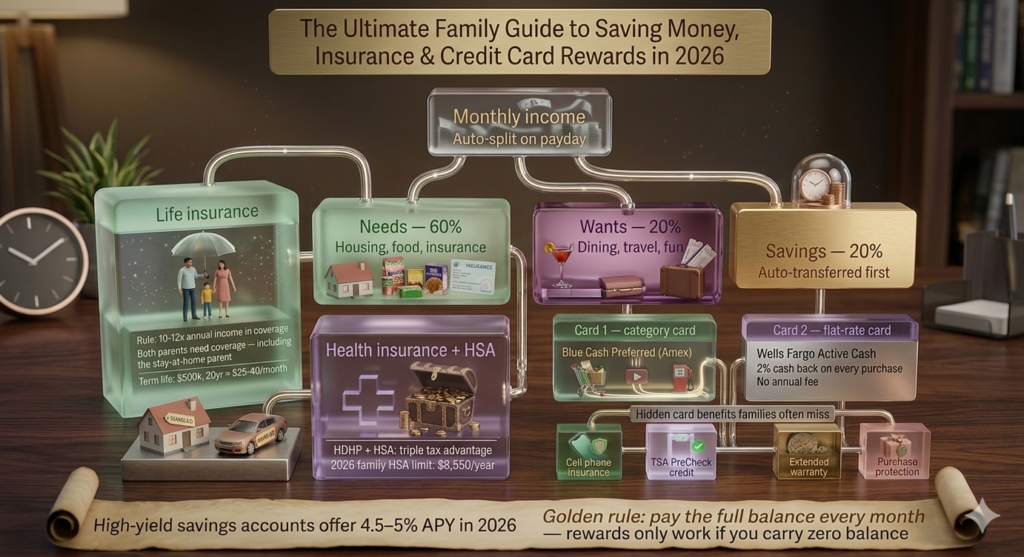
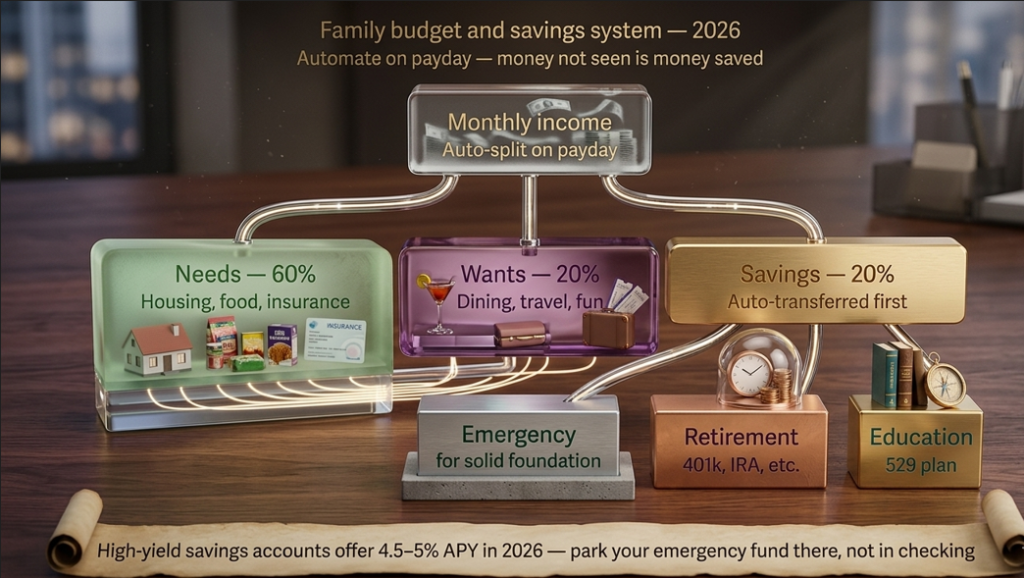
The 50/30/20 budget guideline (50% needs, 30% wants, and 20% savings or debt payment) is a good place to start. However, families need to make some changes to it. The ‘needs’ category may be higher if there are childcare costs, money spent on school and extra-curricular activities. A realistic family version could be 60% needs, 20% wants and 20% savings (or 65% needs, 15% wants, 20% savings in areas with a higher cost of living). It doesn’t necessarily matter what is split, just that everyone takes the time to put their savings on the list of non-negotiables and not the list of afterthoughts.
2. Automate Everything
The strongest savings habit is one you don’t need to think about! Transfer money to savings on payday, or the day your salary arrives, to make sure a set amount goes into your savings account first. This is because of a scientifically-proven behavioral principle—cash that doesn’t get deposited into your checking account doesn’t feel like spending. Set up all those goals, such as an emergency fund, retirement account and saving for your kids’ education, separately and automatically.
The goal of a 3-6 month emergency fund is to include 3-6 months of basic family needs. Basic family needs include mortgage or rent, groceries, utilities, insurance, and minimum debt payments. That would represent $12,000–$24,000 in a high-yield savings account for a family that expects to spend $4,000 per month on living expenses. Many online banks are still paying 4.5–5% per year on high-yield savings without requiring a minimum deposit it’s like free money with little effort.
3. Remember to keep checking on subscriptions every six months
Three to four of those households average pay for three or four streaming services, are paying for multiple apps, gym memberships, and digital tools, many of which are rarely used. A subscription audit is completed twice a year and usually reveals $50-$150/month in recurring, and cancelable, charges. One easy way: print out your bank and credit card statements from the past three months, circle anything that you paid for in each month or year, and then ask yourself: “Were we using it over the past 30 days?” If it is answered No twice consecutively, cancel it out.
4. Model the Use of Money for Purchases
Money talks, and when that happens within the family, kids learn good money manners. This does not mean “the children must have to deal with adult stress” but rather “the children must have to deal with the adult’s stress, but in a manner appropriate to their age. These are all great ways to help a child learn about money: a weekly allowance based on contribution; a clear discussion of the reasons for selecting one vacation over another; and a savings jar that the child can see growing. Research has repeatedly demonstrated that financial behaviors that are developed at a young age are among the most lasting ones as an adult.
Part Two: The correct insurance for your family without paying too much!
Insurance is among the most emotional financial issues for families. You have the option to forget you’re buying something you’re not sure you’ll ever need, so you’re avoiding it and even skimping on the purchase because of that worry. A strategic approach will help you guard what’s important without spending more than you need.
Life Insurance: It is a must for parents!
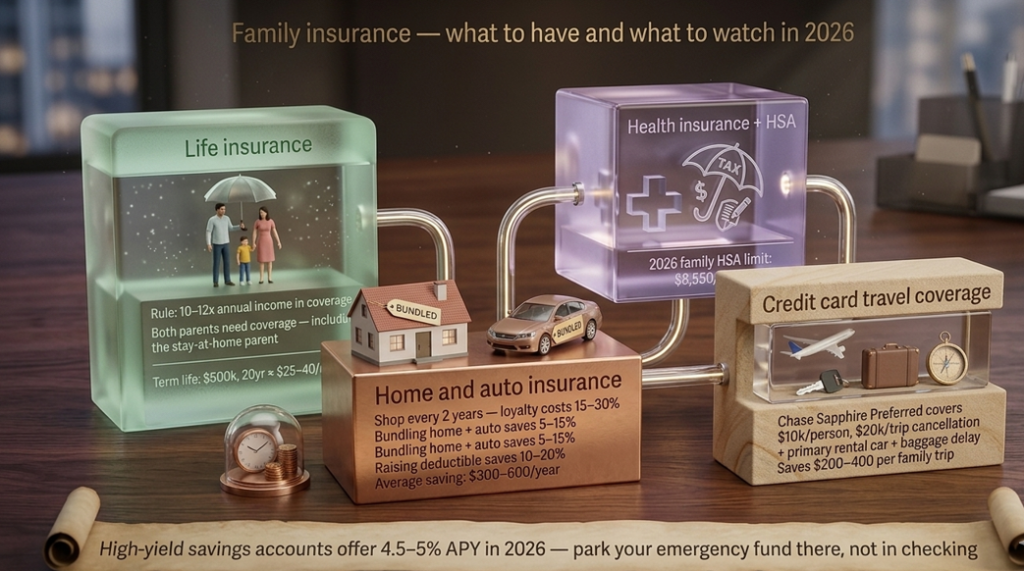
If you have children who rely on your income, life insurance is a must. The question being, what kind and how much? For the majority of families, term life insurance which provides coverage for a specific period of time, usually between 20-30 years, is the most affordable policy for the largest coverage. A 35-year-old person with a good health history can get a $500,000 life insurance policy for $25–$40 per month for a 20-year term. Whole life or universal life insurance is 5–15x more expensive, and develops the cash value that typically doesn’t outperform simply investing the premium difference into a low-cost index fund.
The general guideline is to buy 10-12 times your annual income. Both working parents should be covered, even the stay at home parent whose contribution (household management, childcare) will cost a lot to replace.
Learn the basics of health insurance. Get to know health insurance numbers.
One of the biggest insurance costs for a family is most likely their health insurance. The question for 2026 is, should a High Deductible Health Plan (HDHP) and a Health Savings Account (HSA) be the better option than a traditional PPO? The monthly premiums for HDHPs are lower, but the costs you have to pay for services once you need them are higher. The higher deductible may not be as significant for healthy families that don’t require much medical attention other than annual physicals. The clincher is the HSA: contributions are triple tax advantaged (phenomenon where contributions are made pre-tax; can grow inside without paying taxes; can be used free of taxes for qualified medical expenses); and, if not used, funds roll over indefinitely.
The HSA contribution limits in 2026 are $4,300 per person and $8,550 per family. One of the best tax strategies for the middle income family is to max out your HSA.
Home & Auto Insurance Shop Twice a Year!
Don’t think that insurance companies reward loyalty; they charge you for it. Some of these companies engage in ‘price walking,’ whereby their longstanding customers are charged 15–30% more for the same coverage as their new customers. The solution is easy: compare rates for the next two years, and switch when there are savings to be made. With no drop in coverage, the average family can save $300-$600 annually, simply by shopping for home and auto insurance.
The average savings from having both home and auto coverage under a single policy is 5–15%. You can lower your premium by 10-20% by raising your deductible from $500 to $1,000. Additional discounts can be had if smart home security devices are installed, up to 15–5%. In most states, a better credit score, which is directly tied to credit card use, can significantly reduce insurance costs.
The hidden family benefit of credit card travel insurance
One of the most underused family benefits in 2026 is credit card travel insurance. For example, with the Chase Sapphire Preferred, they’ll pay up to $10,000 per person or $20,000 per trip to cover trip cancellation or interruption, just for booking your travel on the card. It also covers flight delays, primary rental car coverage, and trip delay coverage. If a family of four is vacationing for $6,000, the money saved by using the right credit card to pay for the trip could be $200 to $400 and possibly even more for each vacation.
Financial literacy course broken down into three parts: Credit Card Rewards: You’re Family’s Hidden Income Stream.
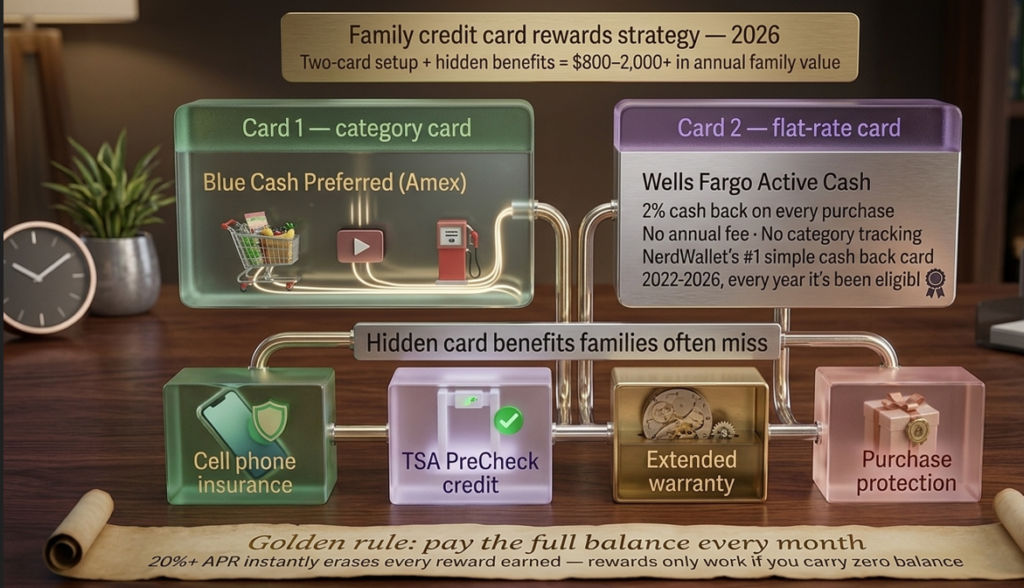
When used properly, the rewards that come with the use of a credit card are among the best ways for families to take advantage of spending they were already going to do. The correct word is key. If you have a balance at 20%+ APR, you immediately lose all of your benefits. However, if families are paying off their balance in full each month, the key is finding the right mix of cards to gain $800–$2,000+ in annual cash back, travel points, statement credits and card-embedded rewards.
The Best Family Rewards Cards in 2026 are listed below.
Below is the list of Best Family Rewards Cards in 2026.
Family spending focuses on just a handful of items: grocery bills, gas, meals out, streaming, childcare and travel. The cards that pay out the most for those categories in 2026 are listed here:
Blue Cash Preferred® (American Express): 6% cash back at U.S. supermarkets (up to $6,000/year), 3% cash back on streaming subscriptions and 3% cash back on transit & gas. This card is tailored to households that spend a lot on streaming and groceries, specifically for families. A family that spends $500/month on a category of their expenses can realize $360/year from that category.
Chase Sapphire Preferred® ($95/year): 5x points on dining at Chase, 3x points on travel to Chase Travel, $50 annual hotel credit and primary rental car insurance. It’s one of the most flexible family travel cards with a 1:1 point transfer to airline and hotel partners. It offers coverage for trips that are canceled for $10,000 per person, making it unlikely that travel insurance is needed on top of the coverage it provides.
Wells Fargo Active Cash® (no annual fee): 2% cash back on all purchases, no tracking of purchases by category. The top simple cash back card for the past four years (2022-2026) according to NerdWallet. Use in conjunction with a category-specific card for an effective two-card combination.
Wells Fargo Autograph℠ (annual fee): 3x points for travel, gas, dining, streaming, transportation and phone plans. This card may be the only one that offers a lot of great rewards in several areas of everyday life without needing to pay an annual fee, making it extremely competitive for families who don’t want to pay an annual fee but do want good rewards in a variety of everyday areas.
The Two-Card Family Strategy
For most families, the best two-card strategy is to get the highest possible rate on one card for your major spending categories, and the flat-rate card on all other spending at 2%. The combination of the Blue Cash Preferred and the Wells Fargo Active Cash is a great mix for a family that spends a lot on groceries and streaming, and it’s only $95/year (the annual fee for Amex), and covers virtually all spending quite efficiently.
Here are some of the benefits of hidden cards that families are often unaware of.
In addition to rewards, there are a number of “embedded benefits” that families often don’t take advantage of when utilizing a credit card. Look at your existing cards for these:
• Cell phone insurance: Many cards offer $600–$1,000 per claim coverage (with a $25–$50 deductible) for cell phone coverage when payments is made on your phone bill. This can be used as an alternative to costly carrier protection plans for a family that has more than one phone.
TSA PreCheck / Global Entry credit: Travel cards often reimburse the $85-$100 membership fee. According to TSA, just 1% of PreCheck customers wait 10 or more minutes in April 2026, a significant quality-of-life improvement for families traveling with young children.
• Extended warranty protection: Some cards can provide you with additional one-year warranty coverage from the manufacturer. This is a great value for larger items for the family, such as appliances, electronics, etc., where it can be hundreds of dollars a pop.
Purchase protection: Protects new purchases for 90-120 days after purchase against damage and theft. Perfect for the high dollar gifts for kids, sports, and electronics.
From March 2026, all USAA credit cardholders will receive a $200 reimbursement for their car insurance deductible, once a year, from any insurance company.
Part Four: Your 2026 Family Financial Action Plan: Bringing It All Together
Here is a handy action plan checklist to follow to implement all the points in this guide. Spend the following 30 days working through it:
Week 1 Savings: Automate transfer of payday savings into a high-yield savings account. Set aside 20% of income to pay yourself. Pay yourself 20% of your take-home pay. Conduct subscription audit and cancel unused subscriptions.
Week 2: Insurance: Check on your life insurance coverage. Obtain quotes on home and auto insurance. If you qualify, consider the options of an HDHP + HSA plan for your family’s healthcare usage.
Week 3 Credit cards: Check into all credit card accounts, and read over your complete benefits book. If you’re not taking advantage of any benefits you may be entitled to, such as purchase protection, phone insurance, travel credits, etc., be sure to find out.
Week 4 Optimization: Check if your current card configuration is aligned with your largest spending categories. If you don’t have a two-card strategy, then think about one! Make full and prompt payments on balances.
Ongoing: Review your budget every 6 months as your family’s circumstances change. Shop insurance every 2 years. Reassess credit card rewards annually as new offers emerge.
Final Thoughts
Family finances don’t have to be overwhelming. The best financial decisions aren’t the most complicated ones they’re the ones you actually make and stick with. Automating your savings, right-sizing you’re insurance, and aligning your credit cards to your real spending patterns are not glamorous strategies. But they are the strategies that quietly add up to thousands of dollars of difference over time.
The families that win financially in 2026 aren’t necessarily the highest earners. They’re the ones paying attention reviewing their subscriptions, reading their insurance policies, knowing what their credit cards actually include, and building systems that work even when life gets busy.