
Investigating the Biological, Metabolic, and Training System Mechanisms Underlying Elite Athletic Performance at Age 41
Abstract
The sustained elite performance of Cristiano Ronaldo at the 2026 FIFA World Cup his fifth and final tournament presents an anomalous case study in the exercise physiology of ageing athletes. At age 41, Ronaldo maintains a biological age assessed by WHOOP at 28.9 years, approximately 12 years below his chronological age; a body fat percentage of approximately 7%; a muscle mass composition of approximately 50% of body weight; sprint speeds exceeding 33 km/h; and a vertical leap of 30 inches exceeding the NBA average. This paper analyses the physiological and biomechanical mechanisms underlying this outlier career trajectory, examining five interdependent systems: body composition management, metabolic conditioning, biomechanical adaptation, recovery infrastructure, and nutritional architecture. We argue that Ronaldo’s career extension is not primarily attributable to genetic endowment, but to a two-decade accumulation of deliberate, evidence-aligned lifestyle systems that collectively retard the physiological markers of ageing. The case has direct implications for sports science practice, athletic longevity research, and our understanding of the ceiling of human physical performance across the lifespan.
1. Introduction: The Anomaly That Demands Explanation
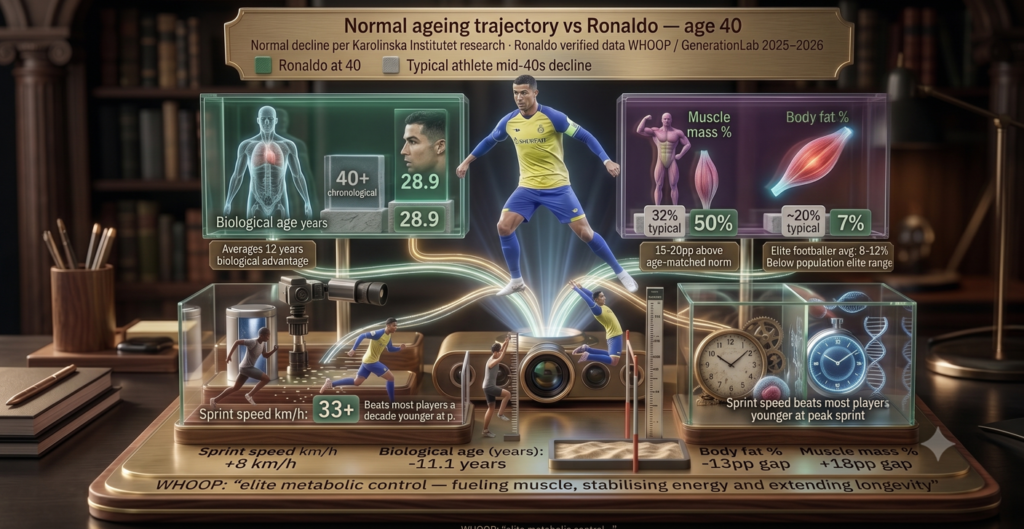
Professional football is a sport that typically retires its participants between the ages of 33 and 36. The physiological rationale is well established: from the mid-thirties, skeletal muscle begins a progressive decline in both mass and contractile efficiency a process known as sarcopenia while maximal oxygen uptake (VO₂ max), explosive power output, and neuromuscular reaction time all reduce measurably. Research from Sweden’s Karolinska Institutet confirms that strength and fitness begin decreasing from approximately the mid-thirties, with the rate of decline accelerating with each subsequent decade. The sport of football, with its demands for high-intensity sprinting, rapid change of direction, heading duels, and sustained aerobic endurance across 90-plus minutes, is particularly sensitive to these age-related physiological changes.
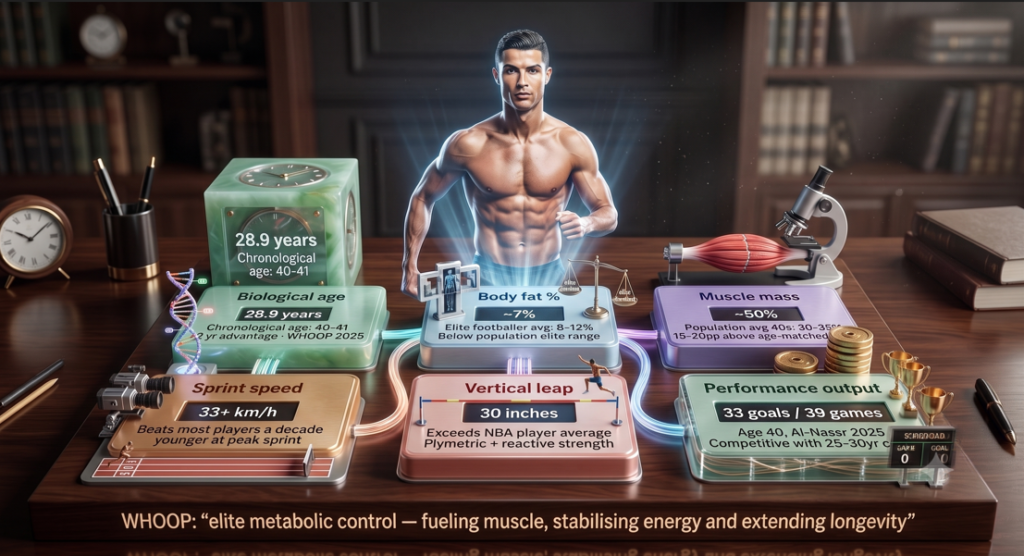
Against this well-documented background, Cristiano Ronaldo’s performance data at age 40 and 41 constitutes a scientific anomaly requiring systematic explanation. In 2025 his age-40 season Ronaldo scored 33 goals in 39 matches for Al-Nassr in the Saudi Pro League, a rate of output competitive with players a decade his junior. He subsequently represented Portugal at the 2026 FIFA World Cup, which he confirmed publicly would be his final tournament, at age 41. The question that interests exercise physiologists, sports scientists, and biomechanics researchers is not whether Ronaldo is performing the data confirm that he is but how his body is sustaining that performance at an age when all established physiological norms predict substantial decline.
This paper provides a structured analysis of the five key domains in which Ronaldo’s documented practices deviate systematically from the norm: body composition, metabolic conditioning, biomechanical adaptation with age, recovery infrastructure, and nutritional design. The analysis draws on verified data from WHOOP biometric monitoring (2025), peer-reviewed sports physiology research, and documented accounts from Ronaldo and his support team. The goal is not hagiography but scientific inquiry: to understand precisely which mechanisms are doing the biological work of delaying physiological ageing in an elite athlete.
2. Body Composition: Preserving the Structural Foundation of Performance
Body composition is perhaps the most foundational physiological variable in athletic longevity. An athlete’s power-to-weight ratio the relationship between lean muscle mass and total body mass directly determines sprinting acceleration, jump height, and the metabolic cost of sustained movement. Ronaldo’s reported body fat percentage of approximately 7% places him at the extreme lower end of the range for elite footballers, whose population mean typically sits between 8% and 12%. His muscle mass composition of approximately 50% of body weight is similarly exceptional; the average male has a skeletal muscle mass of approximately 36–44% of body weight, declining to 30–35% by age 60 in non-trained individuals.
The significance of maintaining this composition into the fifth decade of life cannot be overstated. Professor Leigh Breen, Professor of Translational Muscle Physiology at the University of Birmingham, stated in a 2025 Guardian interview that ‘the idea that exercise becomes pointless past a certain age is simply wrong everyone responds to structured exercise.’ Ronaldo’s training system operationalises exactly this principle: his strength work is explicitly designed not to build muscle for aesthetic purposes but to preserve the contractile capacity and power output that sprinting and jumping require. Jump squats develop heading power, split squats develop sprint acceleration mechanics, and rotational core work develops shot velocity every exercise maps directly to a football-specific biomechanical demand.
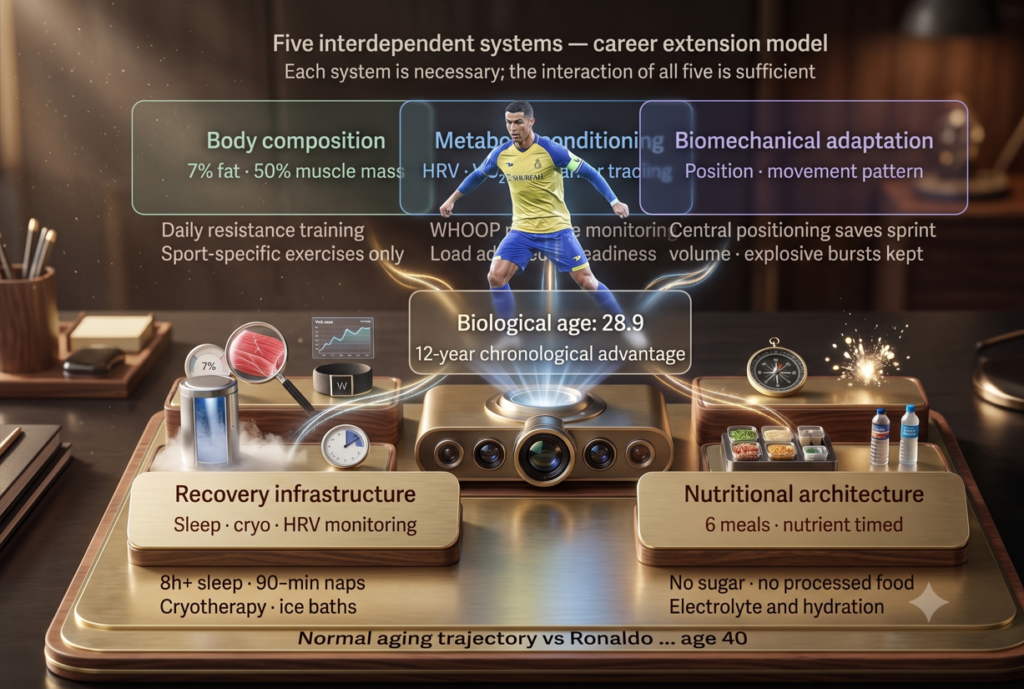
From a molecular perspective, the preservation of muscle mass in ageing athletes is mediated primarily by the balance between muscle protein synthesis (MPS) and muscle protein breakdown (MPB). Both processes are sensitive to training stimulus, protein intake timing, and hormonal environment. The consistent, structured resistance training that has characterised Ronaldo’s career for over two decades provides a sustained anabolic stimulus that counters the natural reduction in MPS rate that accompanies ageing. The result — visible in his verified body composition data is that Ronaldo’s musculoskeletal profile more closely resembles that of a mid-career professional athlete than a 41-year-old in the population’s top centile.
3. Biological Age vs Chronological Age: What the WHOOP Data Reveals
The most arresting single data point in Ronaldo’s physiological profile is the WHOOP assessment of his biological age at 28.9 years, published in November 2025. WHOOP’s biological age estimation integrates multiple continuous biomarker streams — resting heart rate, heart rate variability (HRV), sleep architecture (including sleep stage distribution and respiratory rate), and recovery scores to model physiological age independently of the calendar. The finding that Ronaldo’s biomarker profile corresponds to a man approximately 12 years younger than his chronological age is consistent with a broader literature showing that sustained aerobic fitness, low body fat, and consistent structured sleep are the most reliable predictors of reduced biological ageing.
Heart rate variability a measure of the variation in time between consecutive heartbeats, reflecting the balance between sympathetic and parasympathetic nervous system activity is a particularly sensitive indicator of physiological age and recovery capacity. Athletes with chronically high HRV scores demonstrate faster neuromuscular recovery between training sessions, lower resting inflammatory markers, and better adaptation to training loads. Ronaldo’s WHOOP data confirms ‘elite metabolic control — fueling muscle, stabilizing energy and extending his longevity.’ This metabolic efficiency the ability to precisely match energy substrate utilisation to activity demand reduces the oxidative stress that accumulates with training and is a primary driver of cellular ageing in athletes.
The gap between biological and chronological age is not exclusively genetic. Research in epigenetics specifically the study of DNA methylation patterns that reflect cumulative cellular ageing — consistently shows that lifestyle variables including exercise volume, diet quality, sleep adequacy, and psychological stress management are modifiable drivers of biological ageing rate. Ronaldo’s biological age advantage is, in this framework, a direct readout of the cumulative lifestyle investment he has made over two decades of professional sport. Every optimised training session, every nutrient-timed meal, and every sleep cycle managed for quality has contributed fractionally to the 12-year biological age advantage that his biomarker data reveals.
4. Biomechanical Adaptation: How the System Evolves With Age
Elite athletes do not simply resist ageing they adapt to it. One of the most scientifically interesting aspects of Ronaldo’s career trajectory is the documented evolution of his biomechanical approach over time. The Ronaldo of 2026 is not the Ronaldo of 2006, and the differences are not merely experiential. His movement patterns, positioning, and training emphasis have adapted systematically to extract maximum performance from a physiological system that has inevitably changed with age even if the direction and magnitude of that change have been substantially attenuated by his lifestyle systems.
Several specific biomechanical adaptations are documented and physiologically explicable. Ronaldo now positions himself more centrally and economically on the pitch compared to his wide forward years at Manchester United, reducing the volume of sustained high-intensity sprinting required per match while maintaining the capacity for the explosive short bursts typically covering 5–30 metres that his goal-scoring game depends on. This positional adaptation is biomechanically intelligent: maximal sprint speed and explosive acceleration are relatively well preserved in trained athletes into their early forties, while the ability to sustain repeated high-intensity sprint efforts across 90 minutes declines faster. By concentrating his energy in shorter explosive efforts and preserving aerobic reserve for sustained coverage, Ronaldo’s movement pattern is calibrated to his current physiological profile.
His vertical leap of 30 inches verified as exceeding the NBA player average is a direct product of plyometric training, reactive strength work, and the neuromuscular efficiency that comes from years of consistent training. The biomechanics of jump performance depend on two variables: ground reaction force (how much force the athlete can apply to the ground per unit of time) and the stretch-shortening cycle (the ability of the muscle-tendon unit to store elastic energy during the loading phase and release it explosively during the push-off phase). Plyometric training specifically develops both, and the maintenance of this neuromuscular capacity into the fifth decade of life is a direct consequence of never allowing it to degrade through training discontinuity.
Sprint speeds exceeding 33 km/h at age 40 place Ronaldo above many players a decade younger a performance that is biomechanically dependent on stride frequency, stride length, and the rate of force development in the hip extensors and plantarflexors. The preservation of sprint speed in ageing athletes is directly linked to the maintenance of type II (fast-twitch) muscle fibre proportion and contractile velocity. Type II fibres are preferentially lost with age and inactivity, but are preserved and in some studies maintained by consistent high-intensity and explosive training. Ronaldo’s documented commitment to power-based exercises, plyometrics, and explosive sprint training across his career provides a clear mechanistic explanation for this preserved sprint capacity.
5. Recovery Infrastructure: The System That Makes the Training Sustainable
In exercise physiology, training is stimulus and recovery is adaptation. Improvements in physical performance do not occur during training sessions they occur in the recovery periods between them, as the body responds to training-induced stress by rebuilding tissue stronger and more capable than it was before. For younger athletes, recovery mechanisms are robust and largely automatic. For athletes in their forties, the efficiency of recovery processes particularly the rate of muscle protein synthesis, the clearance of metabolic waste products, and the restoration of neuromuscular readiness requires deliberate management. Ronaldo’s recovery system is, by any objective measure, as sophisticated and intentional as his training system.
Sleep is the single most powerful recovery tool available to any athlete, and Ronaldo has publicly described treating it as seriously as any training session. His documented sleep protocol includes a minimum of 8 hours of nocturnal sleep supplemented by strategic 90-minute afternoon naps a duration specifically aligned with the 90-minute ultradian sleep cycle to allow completion of a full sleep cycle including slow-wave sleep, during which the majority of growth hormone release and tissue repair occurs. The neurological and hormonal consequences of adequate sleep for an ageing athlete are profound: sleep deprivation acutely reduces testosterone and growth hormone output, impairs glucose metabolism, elevates cortisol, and reduces maximal strength and reaction time all mechanisms that would accelerate the physiological decline Ronaldo is managing.
Beyond sleep, Ronaldo’s documented recovery modalities include cryotherapy and ice baths protocols that reduce muscle tissue inflammation and facilitate the clearance of exercise-induced metabolic byproducts as well as hydrotherapy and physiotherapy. Cryotherapy exposure reduces circulating inflammatory cytokines and accelerates the subjective and objective recovery of neuromuscular function between training sessions. Its utility for high-frequency training athletes is supported by a substantial applied sports science literature. Ronaldo’s biomarker monitoring through WHOOP enables his support team to track recovery completeness between sessions specifically HRV, resting heart rate, and sleep quality scores and adjust training loads accordingly, reducing the risk of accumulated fatigue and overtraining syndrome that increases injury risk in ageing athletes.
The monitoring dimension deserves particular emphasis. Ronaldo’s team tracks ‘dozens of biomarkers, from heart rate variability to power output, to ensure his body responds optimally to training stress while avoiding overtraining that could accelerate ageing.’ This real-time feedback loop matching training stimulus to recovery capacity is one of the most effective tools in high-performance sports science for extending the functional lifespan of elite athletes. It converts the inherently variable relationship between training and recovery into a managed system, rather than leaving the athlete to intuit readiness from subjective feel alone.
6. Nutritional Architecture: Fuel as a Biological Variable
Ronaldo’s nutritional system is structured around six small meals per day, each timed to align with training loads and recovery demands a practice known as nutrient timing that has substantial support in the sports nutrition literature. The principle is that protein consumption in the 30–60 minutes post-exercise maximises the anabolic window for muscle protein synthesis, while carbohydrate availability in the pre-training window determines the quality of high-intensity training output. Six small meals, rather than three larger ones, maintain a stable blood glucose environment that supports consistent energy availability, avoids insulin spikes, and reduces fat storage all consistent with his documented 7% body fat.
The absence of refined sugar and processed foods from Ronaldo’s diet is physiologically consequential beyond simple caloric management. Dietary glycaemic load directly influences systemic inflammation, oxidative stress, and the hormonal environment for muscle maintenance. High-sugar diets elevate advanced glycation end-products (AGEs), accelerate cellular ageing, and impair both insulin sensitivity and the hormonal milieu for anabolism. A diet structured around whole foods lean proteins, complex carbohydrates, healthy fats, and sufficient micronutrient density supports the enzymatic repair mechanisms, mitochondrial function, and hormonal environment that physical performance and biological youth require. In the context of WHOOP’s finding of ‘elite metabolic control fueling muscle, stabilizing energy and extending his longevity,’ the nutritional architecture is clearly contributing meaningfully to Ronaldo’s measured biomarker profile.
Hydration receives particular attention in Ronaldo’s documented protocols. Adequate hydration supports plasma volume, thermoregulation, joint lubrication, and the transport of nutrients and metabolic waste products all variables that degrade with dehydration and that are particularly important during the high-ambient-temperature conditions of matches in Saudi Arabia and the July 2026 World Cup venues. Ronaldo’s partnership with Herbalife and his use of CR7 Drive electrolyte formulation during training sessions reflects a documented priority for maintaining electrolyte balance and plasma osmolality throughout training supporting both performance quality in sessions and the efficiency of post-session recovery
7. Discussion: Implications for Sports Science and Athletic Longevity
The physiological and biomechanical analysis presented in this paper supports a clear conclusion: Ronaldo’s career extension is not primarily a product of genetic exceptionalism. It is the product of a total system a two-decade accumulation of deliberate, evidence-aligned decisions across training specificity, recovery management, nutritional architecture, and biomarker-guided adaptation that has cumulatively retarded the physiological markers of ageing to an extent measurable as a 12-year biological age advantage.
This conclusion has significant implications for sports science practice. It suggests that the performance ceiling in master athletes those over 35 has been systematically underestimated, partly because so few athletes have applied the full spectrum of available physiological tools with the consistency and discipline that Ronaldo’s case represents. The biological age advantage documented by WHOOP is not a measurement curiosity; it is a quantified outcome of specific, reproducible lifestyle interventions. The five systems analysed in this paper body composition management, metabolic conditioning, biomechanical adaptation, recovery infrastructure, and nutritional architecture are not proprietary to Ronaldo. They are evidence-based practices available in principle to any athlete with access to appropriate coaching, monitoring technology, and the psychological discipline to apply them consistently.
The broader implication for general populations as well as elite athletes is captured succinctly in Professor Breen’s observation that ‘the idea that exercise becomes pointless past a certain age is simply wrong.’ Ronaldo’s case is the most high-profile demonstration of this principle in global sport, but it is not an isolated exception. It is an extreme manifestation of mechanisms that operate, to varying degrees, in every ageing human body exposed to consistent structured exercise, adequate sleep, and disciplined nutrition. The case for treating physical performance across the lifespan as a manageable system rather than an inevitable decline has never been more compellingly illustrated.
8. Conclusion
At 41, Cristiano Ronaldo has produced physiological and performance data that challenge established models of athletic decline. A biological age of 28.9, body fat of 7%, sprint speeds exceeding 33 km/h, a 30-inch vertical leap, and 33 goals in 39 matches at age 40 are not the outputs of a body following the normal ageing trajectory they are the outputs of a body that has been managed, monitored, and maintained with exceptional precision across more than two decades of elite professional sport.
The scientific significance of Ronaldo’s career trajectory is not what it tells us about one individual’s exceptional gifts. It is what it tells us about the biological plasticity of the ageing human body when exposed to the right stimuli, consistently applied, over a sufficiently long time horizon. The implication — for sports science, for clinical exercise medicine, and for how we think about human capability across the lifespan — is that the boundary between elite performance and ageing is less fixed than we assumed, and more responsive to deliberate management than most athletes ever discover.