
A Technical and Applied Analysis of Two Competing Paradigms for AI-Generated Text Detection
Abstract
As large language models (LLMs) become ubiquitous generators of text across educational, journalistic, and commercial contexts, the ability to reliably identify AI-generated content has become a pressing technical and policy problem. Two dominant detection paradigms have emerged: proactive watermarking most prominently represented by Google’s SynthID-Text, which encodes a mathematical signature into generated text at inference time and post-hoc statistical detection, which analyses text after generation for linguistic patterns associated with LLM outputs. This study compares these approaches across five evaluative dimensions: technical mechanism, detection reliability, adversarial robustness, fairness implications, and practical deployability. We argue that while proactive watermarking offers definitional advantages in provenance authentication, its coverage limitations and scalability constraints mean that post-hoc statistical detection remains indispensable in the near-to-medium term. A layered approach combining both paradigms is identified as the most viable operational framework for 2026 and beyond.
1. Introduction
The proliferation of AI-generated text represents one of the most consequential shifts in the information environment since the adoption of social media. Research from 2023 documented 95,820 deepfake videos online a 550% increase since 2019 — and analysis of high-engagement social media content reveals a growing proportion of AI-generated posts among the most-viewed material (Azoma AI, 2025). Against this backdrop, the question of how reliably detection systems can identify AI-generated text has moved from an academic curiosity to a matter of institutional urgency.
Existing approaches divide broadly into two technical families. Post-hoc statistical detectors including commercial tools such as GPTZero, Winston AI, and Originality.ai, as well as research systems such as DetectGPT (Mitchell et al., 2023) analyse completed text for statistical hallmarks of machine generation without any cooperation from the generating system. Proactive watermarking, by contrast, encodes a detectable signal into text during the generation process itself, creating a cryptographically grounded provenance record that does not depend on stylistic differences between human and AI output.
Google’s SynthID-Text, first deployed across Gemini models and announced in full at Google I/O 2025, represents the most mature and large-scale deployment of proactive text watermarking to date. As of mid-2026, more than 10 billion pieces of content across text, image, audio, and video modalities have been watermarked using SynthID infrastructure (Azoma AI, 2025). This paper provides a structured comparative analysis of SynthID’s tournament-sampling watermarking mechanism against the statistical pattern-based approach embodied by post-hoc detectors, with attention to both theoretical properties and practical performance under real-world adversarial conditions.
2. Technical Mechanisms
2.1 Google SynthID-Text: Tournament Sampling Watermarking
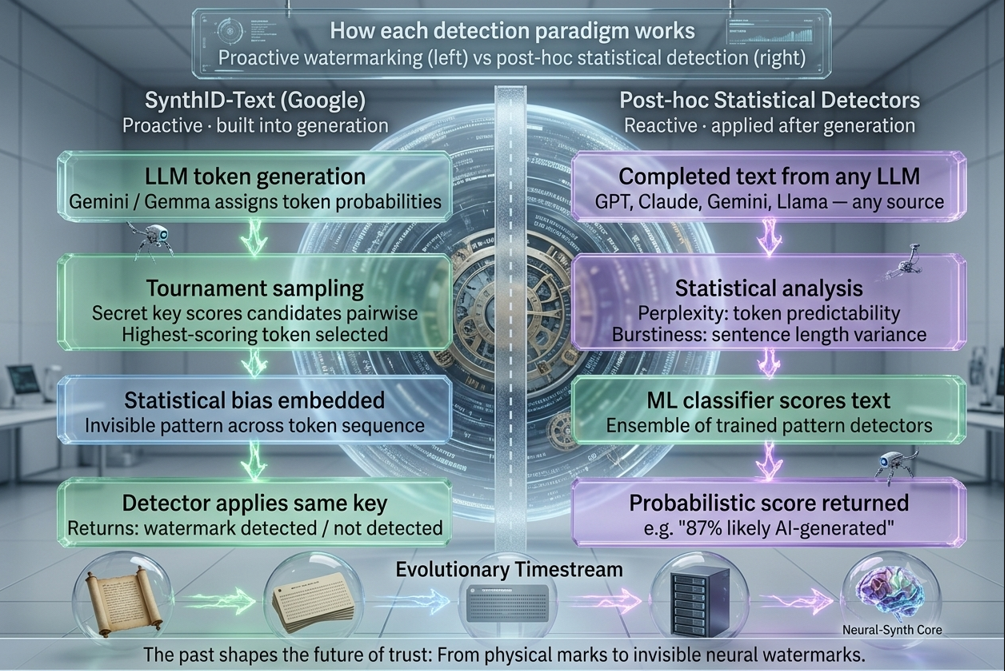
SynthID-Text operates by modifying the token selection process during text generation. At each decoding step, standard LLM inference assigns a probability distribution over the model’s vocabulary the set of all possible next tokens. SynthID-Text applies a pseudorandom scoring function, seeded by a secret watermarking key, to the candidate tokens before selection is made. Tokens are then ranked through a ‘tournament sampling’ procedure in which candidates compete pairwise according to their watermark scores, and the highest-scoring token in the tournament is selected.
Crucially, this process introduces a statistical bias across the token sequence without meaningfully altering the semantic content of the text. The watermark is not a visible tag or a stylistic anomaly it is a mathematical pattern distributed across thousands of token selections, invisible to any human reader and undetectable without the corresponding secret key. Detection is performed by a separate detector model that applies the same pseudorandom scoring function to candidate text and identifies whether the pattern of token selections matches what would be expected from the watermarked generation process.
This architecture has two critical implications. First, SynthID’s detector portal returns only binary outputs ‘likely watermarked’ or ‘not detected’ without confidence scores (arxiv.org/pdf/2505.23814). Second, and more fundamentally, SynthID can only detect content generated by systems in which it has been integrated at the generation stage. Content produced by competing LLMs — OpenAI’s GPT series, Anthropic’s Claude, Meta’s Llama carries no SynthID watermark and will return a ‘not detected’ result even if algorithmically generated. The system is a provenance authenticator for Google’s own outputs, not a universal AI detector.
2.2 Post-Hoc Statistical Detection: Perplexity and Burstiness Analysis
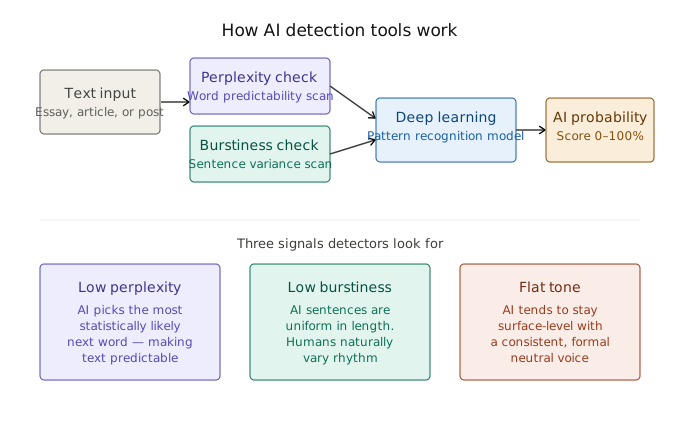
Post-hoc detectors operate on a fundamentally different principle: they assume that AI-generated text has detectably different statistical properties from human-written text, and they train machine learning classifiers to exploit those differences. The two most diagnostic properties are perplexity and burstiness. Perplexity measures how predictable the token sequence is relative to a reference language model AI-generated text tends toward lower perplexity because LLMs sample from learned probability distributions that favour high-likelihood tokens, producing text that is statistically more ‘expected’ than human writing, which is characterized by idiosyncratic vocabulary choices, unexpected turns, and personal register. Burstiness measures variance in sentence length and structural complexity human text mixes long, architecturally complex sentences with short, punchy ones, while LLM output tends toward uniform sentence structure with low burstiness.
More sophisticated post-hoc methods include DetectGPT’s curvature-based approach, which perturbs candidate texts and measures the curvature of the log-likelihood surface around the candidate genuine human text tends to lie in relatively flat regions, while AI-generated text occupies local maxima in the probability landscape (Mitchell et al., 2023). Research systems also exploit lexical entropy, token frequency distributions, and decoding artefacts specific to sampling strategies. These signals are then combined in ensemble classifiers trained on large corpora of human and AI-generated texts.
The breadth of post-hoc detection is simultaneously its chief advantage and its fundamental vulnerability: it applies to any text from any generator, but it depends on stylistic differences that are an artefact of current LLM behaviour differences that narrow as model quality improves (Sadasivan et al., 2025; Zhang et al., 2024, cited in arxiv SynthID analysis). As models become better at producing varied, idiosyncratic, low-perplexity prose, the statistical signal on which post-hoc detectors depend will weaken.
3. Comparative Analysis Across Five Dimensions
3.1 Detection Reliability
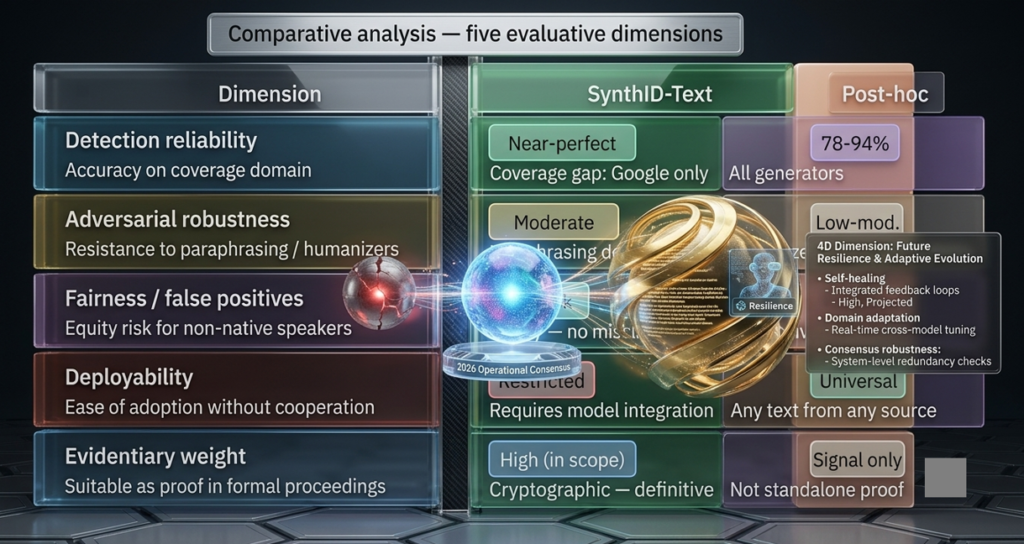
SynthID offers near-perfect detection reliability for content generated by its integrated models when a watermark is present, the detection threshold of 0.52 (as used in the open-sourced MarkLLM evaluation framework) reliably identifies it. The fatal caveat is coverage: it cannot detect AI content from non-Google generators. Post-hoc detectors, by contrast, offer broad coverage across all LLMs but substantially lower reliability. Commercial tools achieve 78–94% accuracy under ideal conditions, with considerable variation by content type, length, and domain. Both paradigms face the fundamental challenge that reliability in controlled test conditions often fails to replicate in deployment.
3.2 Adversarial Robustness
Both detection paradigms are vulnerable to adversarial attack, and neither has achieved robustness guarantees against a sufficiently motivated adversary. SynthID-Text demonstrates ‘moderate performance degradation under adversarial scenarios such as paraphrasing attacks’ (Dathathri et al., 2024, cited in arxiv SynthID analysis). Paraphrasing systematically rewriting AI-generated text with different vocabulary and sentence structure while preserving meaning can substantially reduce watermark signal strength, since the watermark pattern is encoded in specific token selections that are disrupted by lexical substitution. The arxiv DAMAGE paper (2025) makes the point explicit: ‘humanizers are also reliable methods to remove such statistical watermarks,’ placing both post-hoc detection and watermarking in the same adversarial vulnerability class.
Post-hoc detectors face the additional attack surface of ‘humanizer’ tools specifically designed pipelines that rewrite AI text to reduce its statistical predictability and increase burstiness. Testing by GPTZero’s research team and independent evaluators has confirmed that aggressive humanization can reduce detection scores to near-chance levels across multiple commercial detectors simultaneously.
3.3 Fairness and False Positive Rates
The fairness implications of detection errors are asymmetric and socially significant. For post-hoc detectors, false positive rates — classifying human-written text as AI-generated are documented to be significantly elevated for non-native English speakers, who tend to write with higher lexical predictability, simpler syntactic structures, and lower burstiness than native speakers (Liang et al., 2023, cited in arxiv SynthID paper). This differential error rate raises serious equity concerns in academic integrity contexts where detection is used to adjudicate misconduct.
SynthID’s binary detection approach — returning only ‘watermark detected’ or ‘not detected’ without confidence gradations — largely avoids the false positive problem for content it covers: a text either carries the watermark or it does not. However, SynthID’s coverage gap creates a different fairness risk: a ‘not detected’ result may be misinterpreted by users as evidence of human authorship when it simply means the content was generated by a non-Google system.
3.4 Deployability and Ecosystem Coverage
Post-hoc detectors win decisively on deployability. They require no cooperation from the content-generating system, no architectural integration, and no access to model internals. Any text from any source can be submitted to a post-hoc detector, which is why commercial tools such as GPTZero have found rapid adoption across education, publishing, and media. SynthID, by contrast, requires that the watermarking infrastructure be built into the generating model a requirement that limits its coverage to Google’s own production systems, though the open-sourced implementation (available through the MarkLLM framework) enables research deployment on open-weight models such as Gemma-2-9b.
From a governance standpoint, the deployability gap highlights a structural dependency: effective SynthID coverage at societal scale would require either voluntary adoption by all major LLM providers, regulatory mandate, or a shift in market dominance sufficient to make Google’s models the primary text generation infrastructure. None of these conditions currently obtains, though regulatory momentum particularly in the European Union’s AI Act provisions on AI content labelling may accelerate watermark standardisation across providers.
3.5 Evidentiary Weight and Use-Case Fit
The use cases for which each paradigm is suited differ substantially from their technical properties. SynthID is appropriate as proof-of-provenance for content generated by integrated systems a publisher verifying that an article submitted by a freelancer was generated by Gemini, or a regulatory audit of AI-generated disclosures. Post-hoc detectors are appropriate as probabilistic screening tools filtering incoming content for likely AI generation, triaging academic submissions for human review, or providing a risk signal that triggers further investigation. The 2026 consensus in applied AI governance is explicit: probabilistic detection scores are insufficient as standalone grounds for consequential decisions such as academic sanctions or employment termination. They are evidence to be weighed, not verdicts to be executed.
4. Toward a Layered Defence Framework
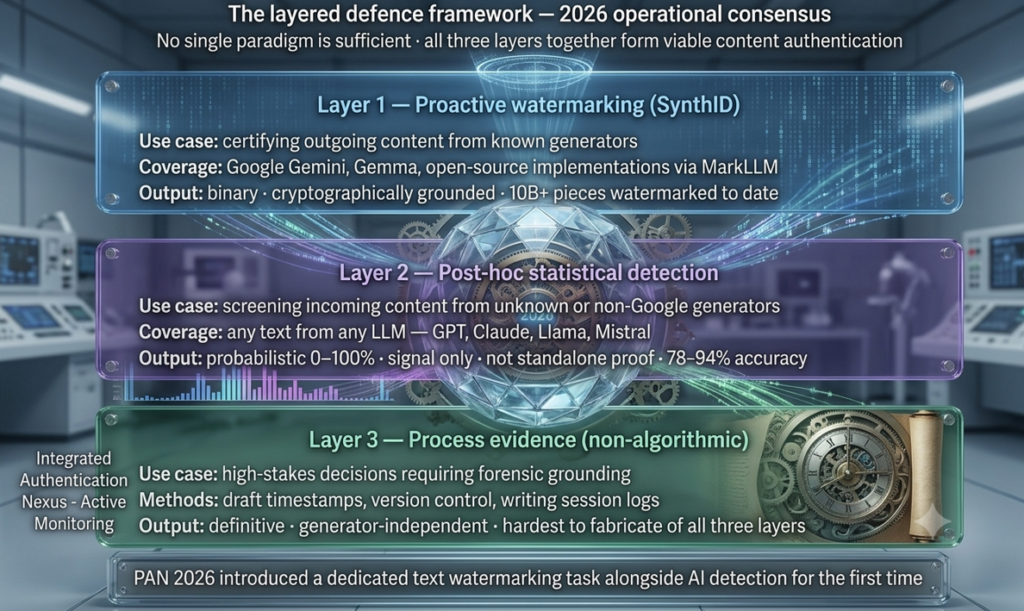
The comparative analysis above clarifies that watermarking and statistical detection are not competing solutions to the same problem they are complementary tools suited to different segments of the detection challenge. The emerging operational consensus, articulated across AI governance research and practitioner guidance published in early 2026, is that a layered defence is the only viable strategy: watermarking to certify and authenticate outgoing content from known generators, statistical detection to screen incoming content from unknown sources (Applied AI Tools, 2026; AI Dev Day India, 2026).
This layered approach should also incorporate non-algorithmic verification methods that neither paradigm alone can replicate. Process evidence draft histories, writing session timestamps, version control records provides forensic grounding that is difficult to fabricate and independent of the statistical properties of the final text. In academic contexts, direct follow-up with the author (asking them to explain, extend, or defend their work verbally) remains the most reliable signal of genuine engagement with the material.
The PAN 2026 shared task in Text Watermarking (arxiv.org/pdf/2602.09147) reflects the academic community’s recognition of this layered imperative: for the first time, the major AI detection benchmarking competition has introduced a dedicated watermarking task alongside its longstanding AI detection track, signalling that the field has moved from treating detection and watermarking as alternatives to treating them as necessary complements.
5. Discussion and Limitations
Several limitations constrain the conclusions of this comparative analysis. First, the SynthID-Text system deployed in Google’s production Gemini infrastructure is a black box the open-sourced implementation evaluated in academic studies uses Gemma-2-9b as a proxy, and it is unclear how faithfully this proxy represents the production system’s detection accuracy, adversarial robustness, or failure modes. Second, the adversarial landscape is dynamic: bypass techniques that are effective against current detector generations will encounter updated models, while detection systems will in turn adapt to novel evasion strategies.
Most importantly, the technical detection problem exists within a broader sociotechnical system in which purely algorithmic solutions are insufficient. As LLMs continue to improve in their ability to produce varied, idiosyncratic, contextually nuanced prose, the stylistic gap between human and AI text that post-hoc detectors exploit will narrow toward statistical invisibility. The long-run viability of detection as a standalone governance strategy is doubtful. The more durable response lies in provenance infrastructure — watermarking standardised across providers, metadata standards such as C2PA for content authentication, and regulatory frameworks that mandate disclosure rather than attempting to infer it from text alone.
6. Conclusion
Google’s SynthID-Text and post-hoc statistical detectors each represent a coherent technical response to the AI content authentication problem, but neither is sufficient alone. SynthID offers definitive provenance authentication within its coverage domain — Google-integrated generators with minimal text quality degradation and binary output that avoids probabilistic overreach. Post-hoc detectors offer broad, generator-agnostic coverage at the cost of probabilistic reliability, equity risks for non-native speakers, and vulnerability to humanizer-based evasion. The 10-billion-piece scale of SynthID’s deployed watermark corpus demonstrates the operational maturity of the proactive approach, but also its current coverage ceiling.
The most credible path forward is not the triumph of one paradigm over the other, but the development of interoperable provenance infrastructure in which multiple LLM providers adopt watermarking standards alongside post-hoc detection as a second layer of probabilistic screening. Until that infrastructure matures, both tools should be understood for what they are: imperfect signals in a problem domain where the adversary is also, in a precise technical sense, an intelligence.