The Complete Guide to How They Work, Which Ones Actually Do, and What You Need to Know
A student has given a perfect essay. An applicant of a job sends a slick cover letter. A content agency can provide 50 blog posts within 48 hours.
In both instances, more educators, employers, and publishers are posing the same question: was this written by a human, or by an AI?
The answer to that question has become the technology world solution to that question in the form of AI detection tools. But just how true are they? What are some of the tools that can be used in 2026? And how do their restrictions affect students, teachers, content creators and businesses? This guide includes all the information you want to know; without the marketing hype.
What an AI Detection Tool?
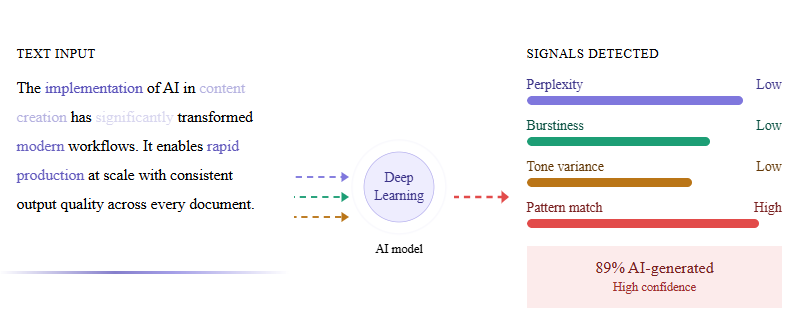
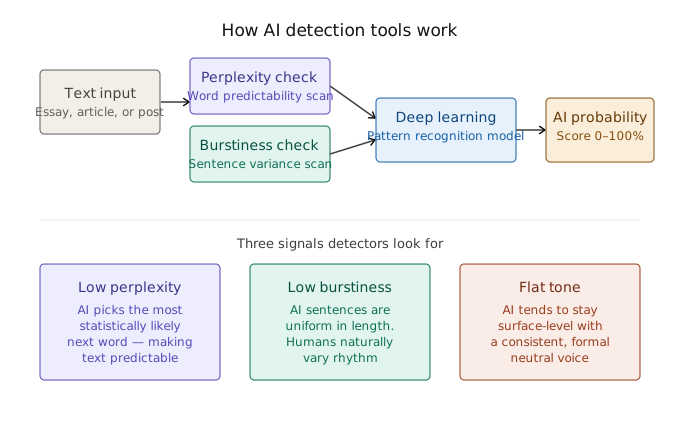
An AI detection tool is a software that examines a piece of writing and estimates the likelihood that it was written not by a human, but by an artificial intelligence system – such as ChatGPT, Gemini, Claude, or Llama – instead. It should not be confused with a plagiarism detector, which merely tries to find copied text. AI detectors search something less obvious: the invisible fingerprints which machine-generated language is more likely to leave behind.
These tools mainly examine two aspects:
• Perplexity: How predictable is the use of words? AI is also inclined to choose the next word in a sequence that is the most statistically likely. Human authors are much more unpredictable – they resort to unexpected vocabulary, make narrative digressions and break patterns.
Burstiness: To what extent does sentence length and structure vary? It is a natural tendency of humans to confuse long and complicated sentences with short and punchy sentences. AI writing is more homogenous, or what researchers term as low burstiness, which leads to the feeling of smooth but somehow flat.
Other than these two measures, the modern detectors rely on deep learning models trained on large collections of both human and AI-generated text, and therefore are able to detect less obvious stylistic cues, such as repetitive phrasing, overly formal transitions, a suspiciously consistent tone, and the tendency to remain surface level instead of digging into genuinely specific or personal detail.
The importance of AI Detection in 2026.
The stakes surrounding AI detection have soared dramatically as AI writing tools have not only become more capable but also more extensively utilized. The applications today where detection is actually important now cut across several industries:
Education: Universities and schools should ensure that they are actually learning and acquiring skills, and not just outsourcing homework to chatbots. One of the cornerstones of equitable grading is academic honesty, and AI-written papers compromise it.
Publishing and SEO: Search engines are placing an ever-growing emphasis on original and human-first content. Publishers, blogs, and content agencies must ensure that what they are paying and publishing is legitimate – and will not be downgraded or demoted by algorithms in the future.
Hiring and recruitment: AI can produce cover letters, writing samples, and skills tests, among other things. Firms that filter applicants to fill writing intensive positions, must find solutions to ensure that the work submitted by the applicants is a true reflection of the ability.
And journalism and legal: In areas where accuracy, authorship and accountability are paramount, the ability to detect AI-generated content is becoming more and more important both in terms of fact-checking and in terms of compliance with disclosure regulations in regulated industries.
The top AI detection tools of 2026.
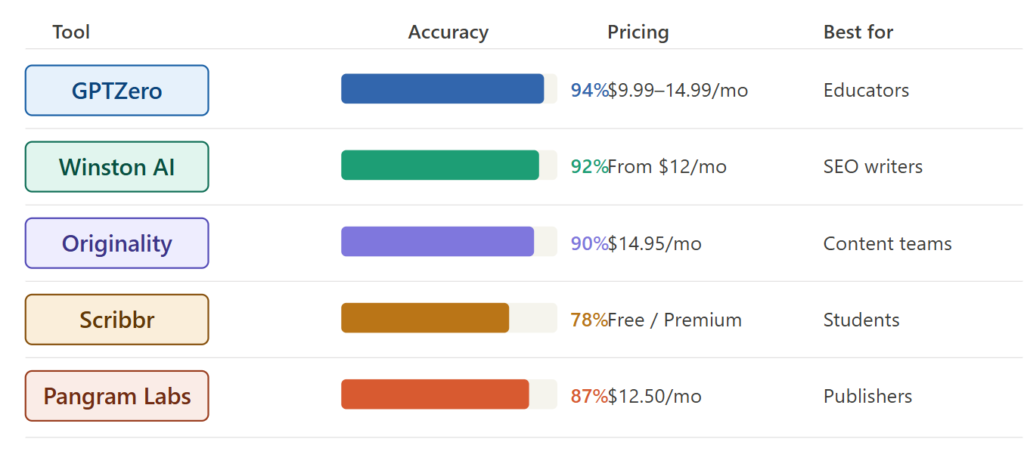
These are the tools which, in 2026, actually do provide results:
1. GPTZero – Optimal Overall Accuracy.
GPTZero is the highest independently tested AI detection tool currently available on the market. It has a general accuracy of about 94 percent, in third-party testing, with a false positive of about 6 percent, i.e. it incorrectly labels human writing about 6 percent of the time, compared to competitors. It contains the content of all the major models such as ChatGPT, GPT-5, Gemini, Llama, and Claude.
The GPTZero feature (Writing Replay) of the Google Docs application, which captures a video of the writing process, is what makes GPTZero special to educators specifically, as a potent piece of evidence when a student challenges a detection result. Its Deep Scan is sentence-level highlighting and it is integrated with Canvas and Google Classroom. It has also specifically targeted the reduction of bias against non-native English speakers and has been able to reduce the false positive rates on TOEFL essays to as low as 1.1.
Pricing: Free plan have 10,000 words/month. Premium starts at $9.99–$14.99/month.
2. Winston AI – Best with Educators and SEO Writers.
Especially popular with teachers, universities and content marketers, who require both accuracy and an easily understandable output. It is also equipped with sentence-by-sentence breakdowns, an integrated plagiarism scanner and even a shareable document known as the HUMN1 which is a certification that the content is human-written. It seamlessly integrates with Google Classroom and WordPress.
Pricing: Starts at $12/month. Image recognition as part of plans.
3. Originality.ai – Best on Content Teams and Publishers.
Originality.ai is designed on your behalf, should you be operating a content operation, be it a blog network, an agency, or even a media publication. It is a combination of AI detection and plagiarism checking, and is optimized to detect plagiarism in a large amount of articles. It is a high scoring tool in detecting lightly humanized text, in which many tools fail.
Pricing: $14.95/month with team capabilities and API access.
4. Scribbr – Best Free Alternative.
When the user is in need of a free tool that is reliable, the AI Detector of Scribbr takes the lead. Independent researcher Scribbr itself – testing 12 tools on hundreds of samples – found that its free detector was correct in identifying 78 percent of texts, tying with the free offering of QuillBot, to claim the top spot among free tools. Its premium version stretches accuracy to 84, which was the highest independently verified score in the 2026 testing round in Scribbr.
Pricing: Free version is available. Premium plan with an increase in word limits and accuracy.
5. Pangram Labs Best in Long-Form and Technical Content.
Pangram Labs has gained a good reputation of being accurate on long-form content and is trusted by publishers and content marketers. Its studies have been confirmed by scholars of the University of Chicago and University of Maryland. Another significant 2026 update was an explicit category of AI-assisted content, a significant nuance that implicitly reflects the reality that much of the real world is neither entirely human nor entirely AI.
Pricing: Single plan starting at $12.50/month. Educational plans that can be accessed at a cost of $5/month with unlimited checks.
The Honest Truth:
This is what all responsible guides on this matter should take into consideration: AI detection is not absolute but rather probable. No piece of equipment can answer the question of whether a piece of writing was composed by a human or a machine with 100 percent certainty. A 2026 real-world test has shown a number of limitations consistently:
• Variability of scores across scans: The same text can be scored radically differently by the same instrument on different days – or even different scores by two instruments tested at the same time. Detection scores are vulnerable to small edits, model updates and the last time the tool was trained.
• False positives exist in reality: Content authored by human beings is flagged as AI written with disturbing regularity – especially the material written by non-native English speakers, who tend to write in a more formal and predictable way. This is a grave issue of injustice, in the academic scene.
Humanizers are beating detectors: Tools that are trained to rewrite AI text in a more human style can successfully lower detection scores – and in some cases to zero – across a variety of popular detectors. None of the detectors is, so far, reliably consistent following the recurrent cycles of humanization.
It is always an arms race: As AI writing models are getting better, detectors have to work to keep pace. This can be a big gap between the release of a new model and the capability of a detector to identify the new model with high reliability.
The best practice, particularly in high-stakes cases, such as in an academic integrity case, is to treat a detection score as a signal to investigate, rather than a judgment. Teachers are encouraged to use detection tools in conjunction with other pieces of evidence: draft history, writing process information, post-conversation follow-up, and comparison with an established writing style of a student.
How to select the appropriate AI Detector to your needs.
The tool right is based on you, what you are attempting to do:
Teachers and educators: GPTZero is the obvious choice, with Writing Replay, LMS integration, fairness features to non-native speakers, and sentence-level transparency.
• Content agencies and publishers: Originality.ai or Pangram Labs – both designed with bulk scanning with high accuracy of edited and humanized content.
• Students who want to preview how their writing will be graded: The free detectors at Scribbr or at the free version of QuillBot will provide a reasonable preview of how your writing will be scored before you submit.
Businesses and HR teams: Winston AI has the Humn1 certification option – handy to create a verifiable history of content authenticity.
Developers and enterprises: GPTZero and Originality both have APIs that can be used in custom platforms and workflows.
Best Practices AI Detection Tools.
Always employ a variety of tools: There is no single detector which is reliably accurate with all types of content. Putting text through two or three programs and comparing the results will give you a far better picture than basing it on any individual score.
• Take results as indicators, not judgments: When the AI probability score is high, it means something is worth a closer examination – it does not imply AI use. Always go by with human judgment and corroborating evidence.
• Put emphasis on provenance: The most testable evidence of authentic human writing in 2026 is not the detection score but a verifiable record of the writing process. Google Docs version history, draft timestamps and videos of the writing process are much more difficult to counterfeit.
• Keep up to date: The AI detection environment is changing quickly. A tool that works well in the present might be outpaced by the next generation of AI writing models that are released. Search tools that promise to update their models on a regular basis.
Final Thoughts
The AI detection tools in 2026 are really helpful – however, they are the tools, but not the oracles. The most valuable ones such as GPTZero, Winston AI and Originality.ai provide a credible first pass to educators, publishers and content teams. None of them, however, can substitute human judgment, contextual knowledge and a thoughtful dialogue.
With the further development of AI writing capabilities, the cat-and-mouse game between generation and detection will only be aggravated. It is not to treat detection as a silver bullet but to create cultures, systems, and workflows where genuine human contribution is appreciated, authenticated by process and rewarded.
Finally, the best AI detector will remain a well-informed, careful human being who knows what they are seeking.