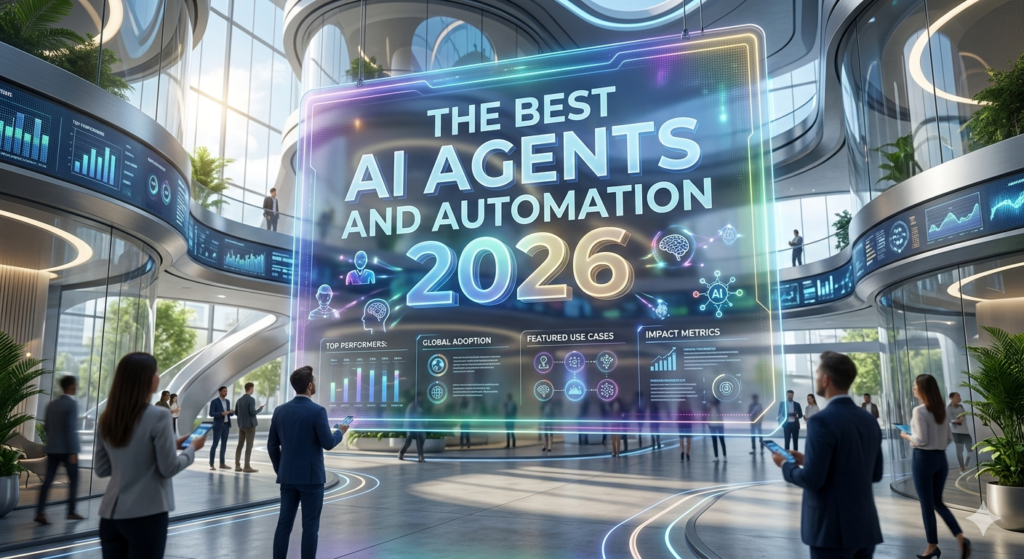
How Intelligent Agents Are Reshaping Work, Business Operations, and the Future of Human Productivity
There has been a change in the way business is conducted. For years, automation was “If this, then that” and required a rule to be written. Robots in the factory. Macros in spreadsheets. Scripts to transfer file content from one folder to another. Useful, of course, but rigid, narrow, and always man-dependent setting all the triggers and defining all the actions. In 2026, that era is over.
A NEW GEN OF TECHNOLOGY: one that goes beyond simply following instructions to understanding goals, making plans, and taking action within complex systems without being given all the instructions. These are AI agents, and along with the automation set-up being constructed around them, they are changing how software pulls the wool over our eyes. This guide will outline what AI agents are, their differences from standard automation, how they are already being used to get results, and what you should know to make your way ahead in a world where intelligent automation is no longer an option.
What is an AI Agent, Anyway?
The word ‘AI agent’ is used interchangeably, so let’s get specific. An AI agent is an automated software program with the power of large language models and tools and the ability to perform tasks on your behalf. An AI agent has a goal to accomplish and it determines how to do it while a regular chatbots answers questions and a rule-based automation runs a series of steps. The major difference is that it is a transition from task-based logic to mission-based logic.
Traditional automation is based on the premise of having a clear trigger and an action: ‘when this type of email is received, save the attachment to this folder.’ The AI agent is different in that you provide a general task, such as ‘Research these five competitors and create a marketing strategy’, and the agent figures out how to do it on its own which tools to resort to, what data to collect, what to write, and the order.
This is a major switch in paradigm from instruction-based computing (telling the computer how to do something) to intent-based computing (telling the agent to do something). The AI agent market is projected to grow from $4.42 billion in 2025 to $5.83 billion in 2026, and 96% of businesses that have experimented with AI agents say they are planning to invest in it further.
How AI Agent Works Actually?
The real-world applications of AI Agents can be quite fascinating. The AI agent is designed to perform four main tasks: perceive, reason, plan, and act, in a continuous loop.
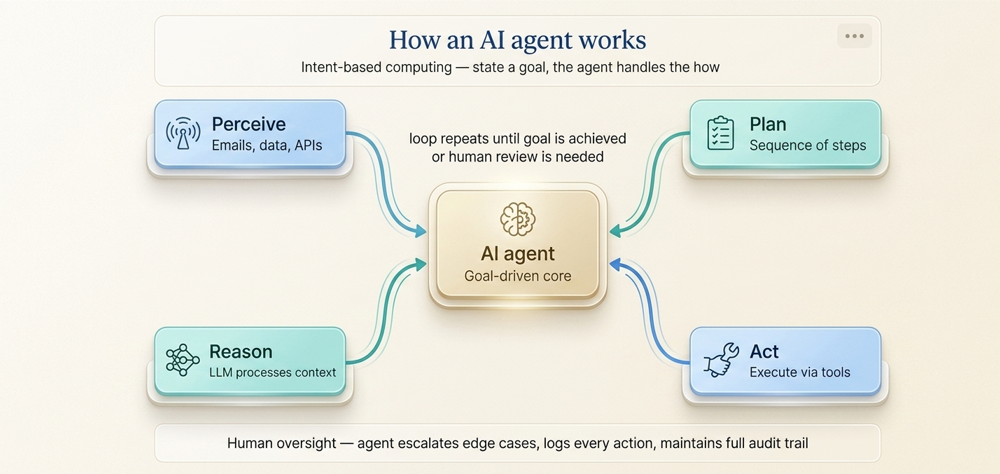
It starts collecting data from its surrounding such as email, database, APIs, documents, or even real-time data streams. It then processes that information in an underlying language model, understands what steps it must take to reach its target and takes those steps through linked tools and systems. The power of modern agents lies in the tools they have at their disposal.
A single agent that is attached to the company’s CRM, email system, calendar, database and project management software can manage tasks in all of these simultaneously in what would otherwise be an hours-long manual process for multiple human workers. Since it became an open standard in 2025, with more than 10,000 public servers deployed, a new protocol called the Model Context Protocol (MCP) has become the glue that allows agents to communicate with various external systems without having to make special integrations.
One crucial aspect of well-designed AI agents is that they are not standalone entities. They are used under human supervision – escalating to human when decisions lie outside their scope explaining what is going on – keeping audit trails of what they do. It is not about eliminating humans out of the equation; rather, it is about shifting the focus of human effort from execution to strategic oversight, judgment and creativity.
The Rise of Multi-Agent Systems:
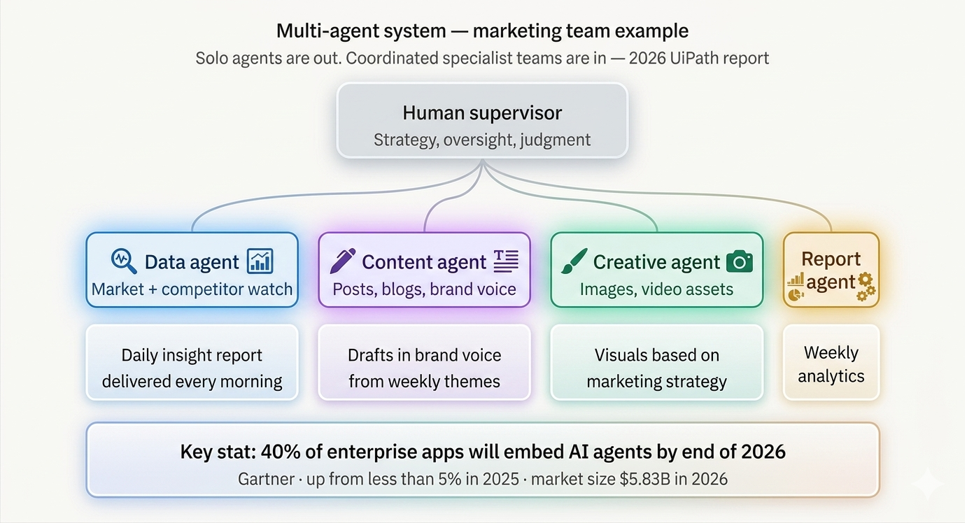
The rise of Multi-Agent Systems. Multi-Agent Systems, networks of specialized AI agents collaborating to execute complex, end-to-end tasks, is one of the most promising advancements for 2026. A multi-agent system sets up a number of agents, each with specific roles to play: one agent watches the data, one agent writes the content, one agent is responsible for scheduling, and one agent is responsible for compliance checks. It’s like a digital assembly line.
For instance, in the modern marketing department a Data Agent watches the market trends and competitor activity all day, and sends an insight report on only one page the next morning. Those insights are then leveraged by a Content Agent to create social posts and blog posts in a company’s unique voice. A Creative Agent creates the appropriate photos and videos. A Reporting Agent will automatically fetch weekly campaign performance data and generate an analysis.
The marketing manager is no longer doing all of this by hand but rather is managing the team of agents, making decisions and concentrating on strategy. This model is currently in use at enterprise level. Gartner forecasts that task-specific AI agents will be present in 40% of enterprise applications by 2026, up from less than 5% a year ago. By 2030, according to IDC, 45% of organizations will be orchestrating AI agents at scale across business functions. Those constructing the foundations will have a huge advantage.
Where AI Agents Are Delivering Results Right Now
Customer Service and Support
Customer service is being transformed more than ever since the dawn of the call center. Traditional support involved going back to the root cause of the issues explained to each new agent each time. That all changes with the help of AI agents based on CRM and logistics data. For instance, if a logistics delivery truck breaks down, a logistics agent can automatically reschedule the delivery, credit the customer’s account for the service and notify the customer with a different time slot before the customer even notices that anything is wrong. This proactive service, like a concierge, is changing expectations quickly.
Finance and Operations
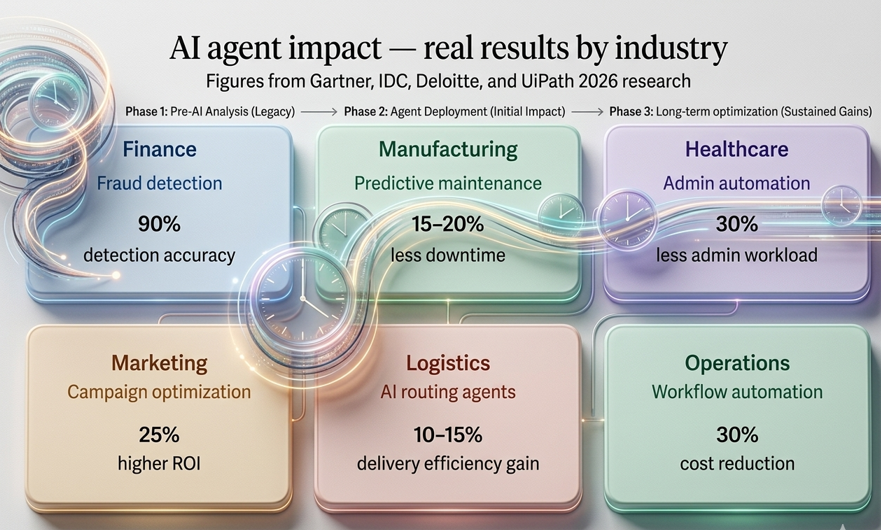
The AI agents in financial services can detect fraud with up to 90% accuracy, identifying suspicious transactions in real time and significantly decreasing false alarms that used to take analysts too much time. In accounts payable and receivable, agents are handling invoices, matching purchase orders, and making payments with very little manual effort, which saves up to 30% on the time and money required for repetitive tasks, and reduces processing time from days to minutes.
Healthcare
AI agents are cutting admin by as much as 30%. Multi-agent systems coordinate patient monitoring, diagnostics, treatment planning and scheduling, with each agent specializing in a domain and communicating with other agents in the system. 64% of health system leaders believe AI will help standardize and automate workflows, which will save costs, according to Deloitte. In fact, the infrastructure for wider clinical deployment is in place, as Microsoft has seen 50 million health-related AI sessions a day in its consumer products alone.
Manufacturing and Supply Chain
AI manufacturers are reducing downtime from 15-20% with predictive maintenance systems, which track sensor data in real-time, can detect a pattern of anomalies and can alert maintenance personnel before a failure happens. AI routing agents optimize real-time logistics by dynamically rerouting shipments in supply chain, boosting efficiency by 10-15%.
The New Human-Agent Relationship
The implications of the AI agent age for humans are one of the most significant and misunderstood. The myth that AI agents will replace human workers with the promise of easy gains is not particularly accurate, as AI agents are transforming the nature of work, not its necessity. The 2026 AI and Agentic Automation Trends Report by UiPath reveals that 78% of executives are compelled to reimagine their operating models to fully realize the potential of agentic AI.
It’s a new way of work that puts every staff member from analyst to executive in charge of intelligent agents, not just every task. The work becomes more about management than action, more about leading than doing. This is NOT a distant dream. It’s already happening. AI agents that are used correctly are resulting in more productive, not fewer, human agents. These jobs allow employees to avoid repetitive work and concentrate on what can only be done by humans: managing relationships, handling uncertainty, making ethical decisions, and stimulating innovation. The most effective AI automation initiatives do not replace human participation and action, they enhance it.
Governance is the Non-Negotiable Foundation
With AI agents doing more tasks from executing trades to customer communication, modifying data across systems, the issue of governance becomes crucial. Good AI governance in 2026 is not a policy document or steering committee discussion. It’s an operating model, integrated right into the automation infrastructure. The new rules are a standard: clear boundaries for autonomous action, explicit escalation paths that lead to human examination of edge cases, transparent logging of every decision and action an agent makes, and auditability that is applicable across complex cross-system workflows.
Companies who embed governance within their automation foundations operate with greater speed and confidence knowing that their automation systems are trusted by their teams. Governance urgency is at its peak in cybersecurity. With thousands of external systems connected to agents through MCP, there are real attack surfaces, such as tool poisoning attacks that can affect the behavior of an agent. Companies that are using agents on a large scale are putting money into trusted gateway models, zero-trust access controls, and anomaly detection systems that continuously monitor agent activity. In fact, 38% of organizations are already using autonomous AI agents for cybersecurity specifically to detect threats (38% of attack and 38% of defense are autonomous AI agents).
A Practical Roadmap to Starting with AI Agents
Those who are going to be leading the way in 2026 and beyond are not waiting for the technology to get even more developed they are creating experience and foundations. Let’s get to the nuts and bolts:
First, consider data quality:
AI agents can only be as valuable as the data they work with. The first investment you make, with the important one being intelligent document processing extracting and structuring the data you get stuck in invoices, contracts, emails and forms is a major one that benefits you for all your agents going forward.
Site selection:
Processes with high volume, many rules and lots of time to complete make for great starting points but so do processes with clearly defined success criteria. All the above are good candidates for Collections, Customer Onboarding, Approving Purchases, and Customer Ticket Triaging. Leverage low-code platforms to rapidly prototype:
Today’s platforms enable business teams to create, test, and deploy AI agents without coding. Don’t wait to get a prototype in front of actual customers the insights you get from a first prototype are invaluable and will help you understand where AI can add the most value in your context.
Governance build from Day 1:
Draw the lines on how autonomous the action is going to be before deployment, not after. Don’t add in escalation procedures, logging requirements, and audit processes as an afterthought. Plan for multi-agent orchestration: Single agents address point problems. Multi-agent systems change processes into end-to-end processes. Think about how you want your first agents to fit in with a larger, more coordinated ecosystem they will. Future integration means designing your first agents for it they will.
Final Thoughts
The question for business leaders in 2026 is no longer whether AI agents belong in their strategy. That debate is effectively over. The harder questions the ones that separate organizations that capture transformative value from those that achieve incremental efficiency are about trust, resilience, and design. Can your agents adapt when conditions change? Do your people know how to supervise them effectively? Is your governance robust enough to scale?
Automation is growing up. It’s moving from executing isolated tasks to orchestrating entire business processes from rule-following to goal-pursuing, from tool to colleague. The technology is ready. The platforms are mature. The early evidence from every industry is compelling.