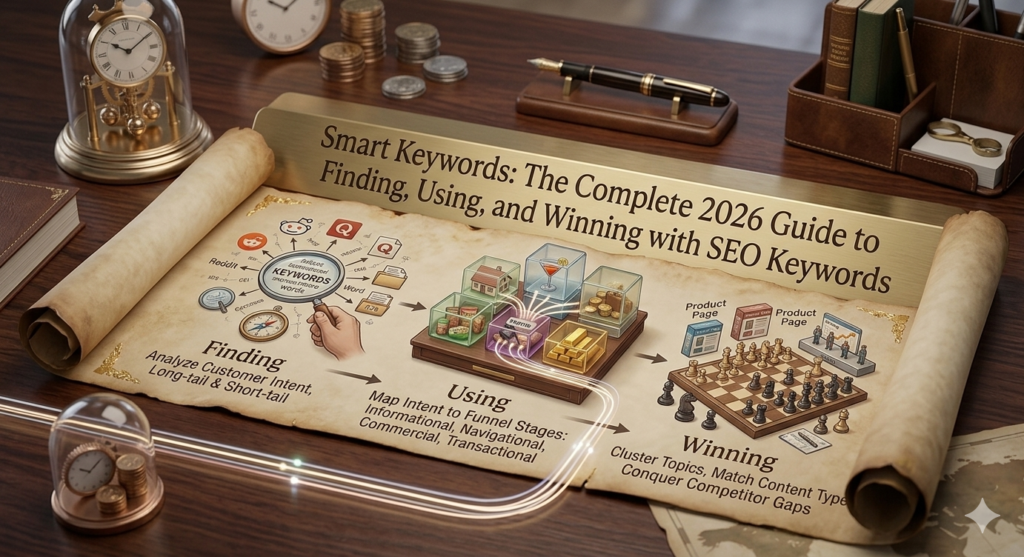
How to Stop Chasing Traffic and Start Capturing the Exact Search Opportunities Your Business Actually Needs
Most people will take the keyword research approach of eaters at an all-you-can-eat buffet, soaking up anything that is available. The outcome is always predictable: they end up with a bloated list of keywords, disorganized content, thin pages that rank for nothing and a feeling that their SEO efforts are failing to generate results.
It does work. It only needs a cleverer strategy than most guides will tell you! In 2026, keyword research isn’t just about determining the most sought-after keywords and stuffing them into content. It’s about commercial intelligence: knowing what your target audience wants, when they want it and how to place your content at the exact moment when your audience is ready to purchase.
This guide covers everything from what smart keyword research really means in 2026, how to actually find keywords that will bring in revenue (not just traffic), how it can be done faster using AI tools, to creating a keyword strategy that will grow in value over time. Let’s get into it.
So, what exactly does it mean to do smart keyword research in 2026?
There’s a fundamental misunderstanding of what keywords are and what they are used for. People generally believe that keyword research is the process of discovering popular phrases and stuffing them into a page. It isn’t. There is a saying by the strategic SEO agency Udjat that says: “Keyword research is market intelligence for search. It gives you a feel for what people want, how they want it, how much it is needed, and how competitive that search is, and more and where the commercial opportunities lie, right under your nose.
This re-framing is so important. When you consider keywords as market intelligence instead of traffic, your entire strategy changes. No more questions of “what has high search volume?” and more questions of “what terms are my ideal customer using when they are at the conclusion of their decision-making process?” These are two different questions — and very different content.
There’s a lot of business to be done getting this right.
The research from September 2025 by First Page Sage also found that B2B SEO offers returns of 702-1,389% ROI over 3 years. Content marketing with strategic keyword research gives 748% ROI, while regular content marketing without careful keyword research provides 16% ROI. It’s not about being lucky or having domain authority. Strategies at the keyword level.
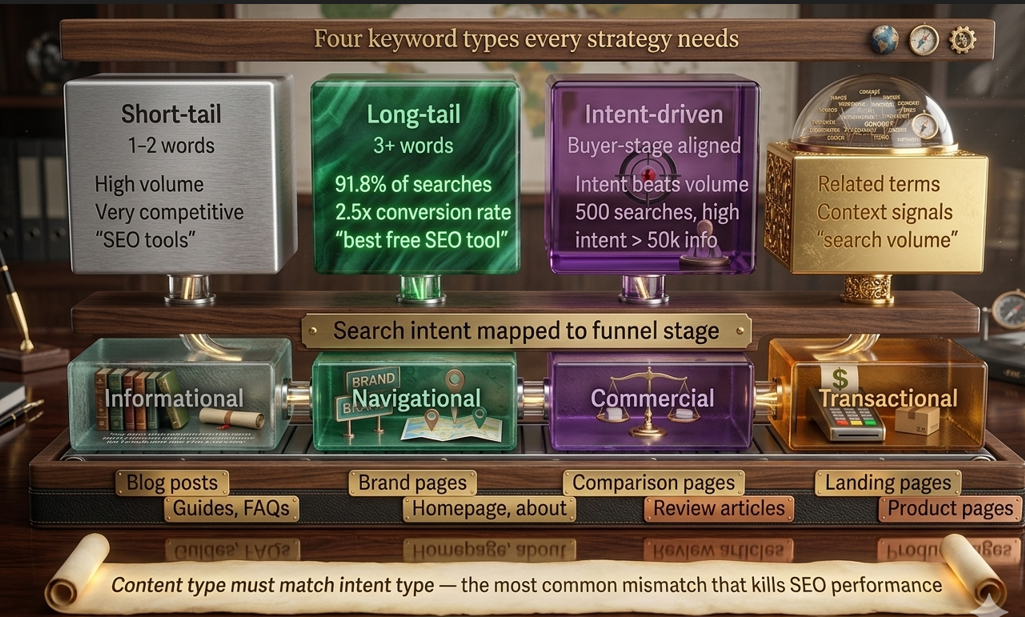
Every SEO strategy should contain the following four types of keywords. There are four types of keywords that every strategy should have.
Some keywords are better than others and some keywords have a different function in your funnel. Smart keyword research is the intentional targeting of all of these four types of keywords:
1. Short-tail (head) keywords
The keywords are very general, have high search volume and high competition. Some examples: ‘SEO tools’, ‘keyword research’, ‘digital marketing’. They are very difficult to rank for on a new or mid-tier site, but they can be valuable to a brand for the long term. Don’t stick to this one.
2. Long-tail keywords
Specific phrases (3 or more words). According to the research from Ahrefs, 91.8% of all searches are long-tail, and the long-tail terms convert 2.5 times faster than short-tail terms. These can include queries like “best free SEO tools for beginners 2026,” “local SEO strategies for restaurants near me” or “how to do keyword research for a new website”. Long-tail keywords are less competitive, more specific, and have a more clear intent. These should be the building blocks of any smart keyword strategy.
3. Intent-driven keywords
In 2026, the primary factor of keyword research is search intent. All searches can be divided into four categories: informational (‘how to do X’), navigational (‘brand name’), commercial investigation (‘best X vs Y’), and transactional (‘buy X now’, ‘X pricing’). The advantage of your business is that a keyword that has 500 per month of commercial intent is better than a 50,000 keyword of informational intent and no conversion power. Before writing content for any given target keyword, find out what type of intent it has.
- Likely keywords in the content.
- Common phrases used in the content.
4. Latent Semantic Indexing (LSI) keywords
These keywords are phrases and words that are related to your keywords, to help search engines understand your content in context. For the main keyword ‘keyword research’, other keywords such as ‘search volume’, ‘keyword difficulty’, ‘search intent’, ‘organic traffic’, and ‘SERP analysis’ naturally appear in the content. The topical depth of your post, not the number of keywords, is what the modern search algorithms pay attention to and LSI keywords are a clear indication that your content is covering a topic rather than a specific keyword.
The Smart Keyword Research Process: Step by Step
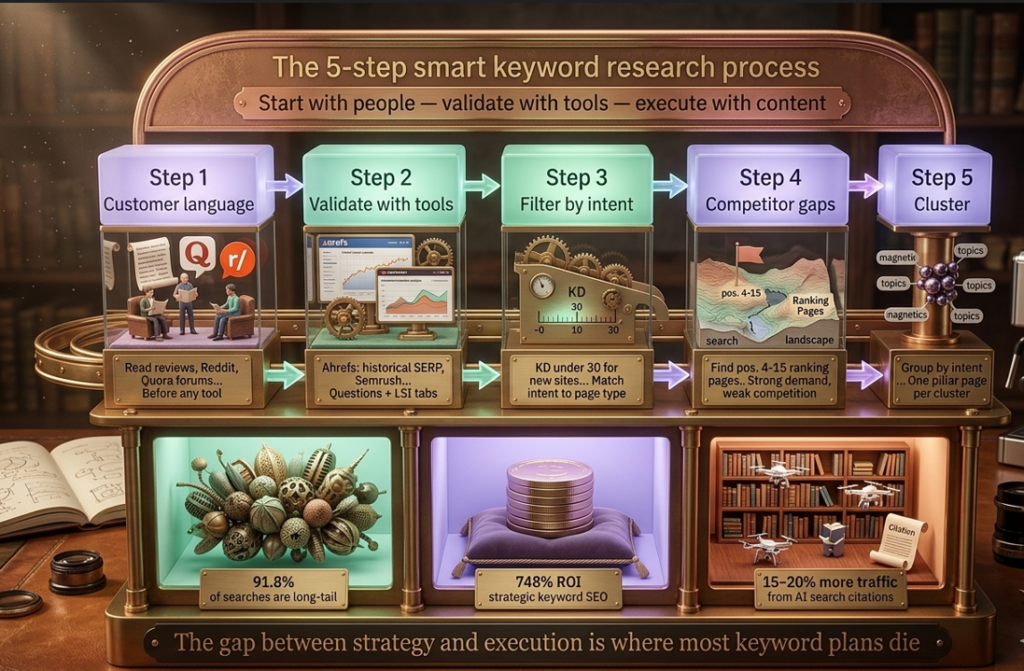
Use customer language, not tool data, for Step 1.
Spend 30 minutes where your customers talk before opening any keyword tool. Check out Amazon or G2 reviews. Scroll Reddit threads. Browse Quora questions. Check out competitor FAQ pages. Real people communicating the problem, asking questions, and comparing offerings in their own words is raw keyword gold – and it’s rarely the jargon generated by tools-first research. Customer language is the language that the actual customers search in.
Step 2: Validate and expand using tools
Make sure you have customer language in place, then add your keyword tools! In 2026, the industry leaders are Ahrefs and SEMrush Ahrefs is better for historical SERP data and for understanding which content is successful at getting links and shares, and SEMrush is better for competitor research, revealing exactly which keywords your competitors rank for and allowing in-depth analysis by URL. With both tools, take a look at “Questions”, “Also rank for” and “Matching terms” — these surfaces will show you the entire semantic universe of any topic.
Step 3: Keyword difficulty and intent filters
Use filters to find the appropriate keywords that are achievable with good commercial potential. For new websites, stick to words with a Keyword Difficulty (KD) below 30, and a definite commercial or transactional intent. Once you have established yourself, aim for more competitive keywords as you become more popular. In B2B settings, ignore low-volume keywords one of those that receives 50 clicks a month can still generate a lot of cash if 50 people is your entire target audience.
Step 4: Identify gaps in the keyword competition
One of the quickest methods to identifying high-value keywords is competitor keyword analysis. In SEMrush, type a competitor’s website URL into the search bar, and go to ‘Organic Research’ and click on ‘Pages’ to view their top pages ranked by traffic. Then click on the individual pages to see the full set of keywords that are responsible for their performance. You want to see pages that are in positions 4-15 these are strong enough to be sure that they get keywords but not strong enough that a well-optimized page could outrank them.
Step 5: Cluster and map to content
Keyword clustering is the process of grouping together keywords that have common meaning and search intent to be targeted together within a logical content structure. A single pillar page that is built around a group of 15-20 keywords will almost always beat 15 pages that are created for a single keyword. Cluster your keywords, prioritize each group to a content page and ensure each page on your website has a specific, clear goal keyword cannibalization (multiple pages ranking for the same term) is one of the most prevalent and expensive SEO blunders.
AI-Powered Keyword Research in 2026
The landscape of keyword research has been thoroughly transformed by the advent of AI. The way smart marketers do keyword research now has been completely revolutionized with the advent of AI. Don’t use AI to replace the strategic thinking that goes into keyword research, but use it to quickly get you to the research and analysis part of the process that were unimaginable even two years ago.
One of the most significant strategic benefits digital marketers have today is predictive keyword research, wherein AI can uncover search opportunities that haven’t gained traction in the saturated market. Rather than focusing on rankings on known keywords, predictive tools will help you target content to where demand will be at its highest. What a user may be looking for today is ‘best CRM tools’ today, but in three months it might be ‘CRM automation strategies’. These trajectory changes are monitored by predictive AI tools, which are able to highlight this trend before the competition.
ChatGPT, Claude and Gemini have also emerged as strong keyword research partners that can be used to spark ideas and brainstorm concepts, rather than as a substitute for tools such as Ahrefs. Brainstorm seed lists of keywords, compile related questions readers may have, find content gaps, identify content clusters and outline content based on keyword intent. The best keyword researchers in 2026 rely on AI to deal with the amount and pace of preliminary research, backed by their own evaluation of commercial viability and strategic suitability.
One particularly effective use: using AI to research the way your audience speaks to AI search engines. Instead of typing ‘small business SEO’, users are asking ‘what are the best SEO strategies for my small business?’. Whenever your content directly addresses these conversational questions be it within the first 100–150 words you’ll have a much better chance of being cited in AI-generated responses. SEMrush’s AI search traffic research for 2026 found that 15–20% of the organic traffic to a website that is included in the answers generated by AI comes from these answers.
The principles that never change is Keyword Strategy for 2026.
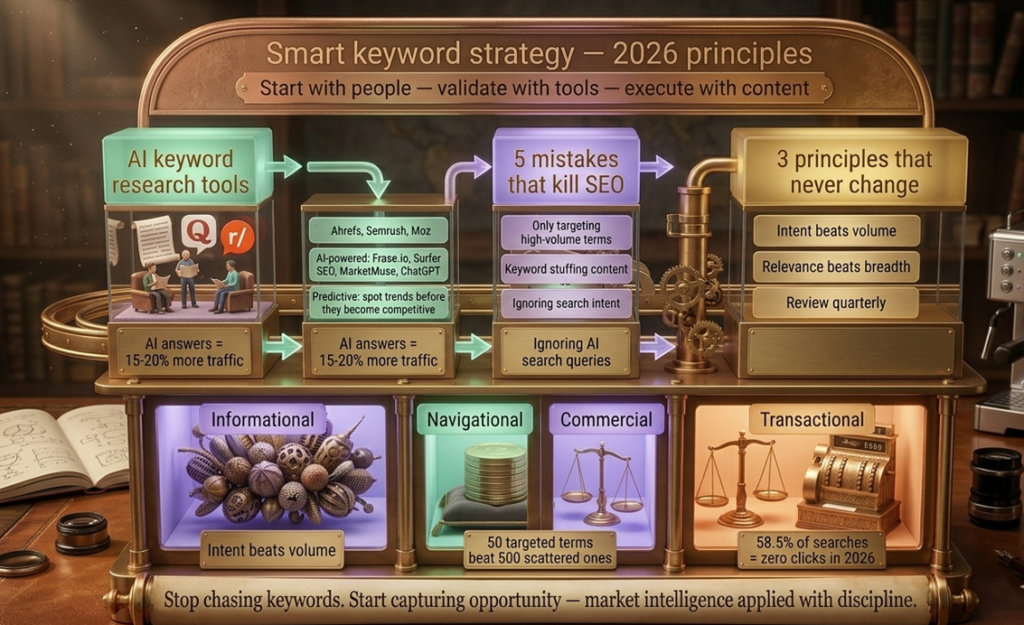
Platforms evolve. Algorithms update. New tools emerge. The essence of a smart keyword strategy, however, remains incredibly consistent. Here are the ones which will still be true in 2030:
- Intent beats volume. 300 monthly searches and strong customer intent (but no commercial context) is more valuable than 30,000 monthly searches for information but no commercial context. When thinking about what someone is searching for when they type this, and does it relate to our business?
- Relevance beats breadth. A targeted keyword strategy of 50 relevant keywords is always going to beat a list of 500 more or less related keywords. In SEO, you should think of focus as your force in business strategy!
- There should be a reason for each page. Ask: what is this piece of content for the purpose of targeting a specific keyword cluster? What is the purpose of it? How is this related to conversion? If there is no keyword purpose in the content, then it is noise.
- There is no end to keyword research. 58.5% of search traffic now goes to zero clicks, and even top-ranked content can fail to get clicks if Google can provide an answer in its AI Overviews. Check your keyword strategy every 3 months because search trends, search competition, and AI search trends are constantly changing.
- There needs to be a link between strategy and execution. The biggest problem when doing keyword research is not the quality of the research; it is the difference between the list of keywords and the actual content created. Keywords don’t add value until someone adds them, gives them a date to be published, and constructs the page. No execution equals no research.
The most common keyword mistakes that can destroy your SEO performance
- Only high volume words: There is virtually no possibility for new sites to rank for broad competitive words. Use low-difficulty, long-tail keywords first to establish authority, then use more competitive keywords as authority continues to be built.
- Keyword stuffing: is a major algorithmic culprit in 2026 excessive repetition of keywords in content. Modern algorithms don’t just consider keyword density, they consider the semantic richness and topical depth.
- SEO miss-matches: is to create a product page for an information search keyword, or a blog for a transactional search keyword. The content type should be the same as the intent type.
- Keyword Cannibalization: If multiple pages on your website target the same keyword, they will share the authority of the page and neither will perform as well as it could. Regularly review and merge redundant information.
- Ignoring AI search: Users are finding content via ChatGPT Search, Google AI Overviews and Perplexity. Find out how your target audience asks questions to AI and structure your content to respond to these conversational inquiries.
Final Thoughts: Keywords Are a Strategy, Not a Checklist
The businesses that win at search in 2026 are not the ones with the longest keyword lists or the most sophisticated tools. They are the ones that treat keyword research as commercial intelligence understanding demand before the market moves, positioning content where that demand already exists, and building a search strategy that compounds in value over time.
Smart keyword research takes time to do well. It requires discipline to focus, courage to ignore attractive-but-irrelevant terms, and consistency to execute over months and years rather than sprinting and abandoning. But for the businesses that commit to it, the returns are extraordinary and sustainable in a way that paid traffic never is.
Stop chasing keywords. Start capturing opportunity. The two things look similar on the surface but they lead to very different places.
References:
Sources: First Page Sage (2025), Ahrefs (2025), SEMrush (2026 AI Search Study), Outreach (2026), Udjat Agency (2026), White hat SEO (2026). Always verify current data with original sources.