From the way we wake up to the way enterprises make decisions, artificial intelligence has quietly become the invisible infrastructure of modern existence.
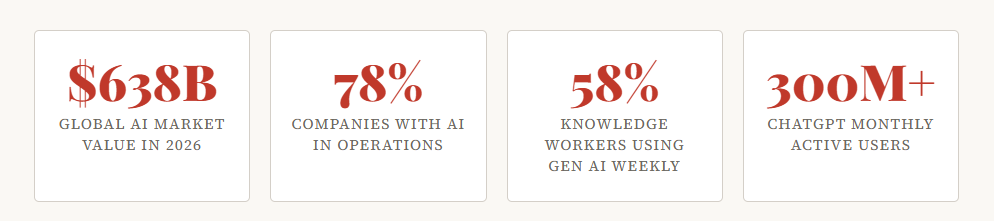
Not long ago, artificial intelligence was the province of research labs and science-fiction scripts. Today it routes your morning commute, drafts your emails, reads your medical scans, and quietly decides which products appear at the top of your shopping feed. In 2026, the global AI market is valued at $638 billion and growing at 35 percent annually a pace that makes Moore’s Law look leisurely.
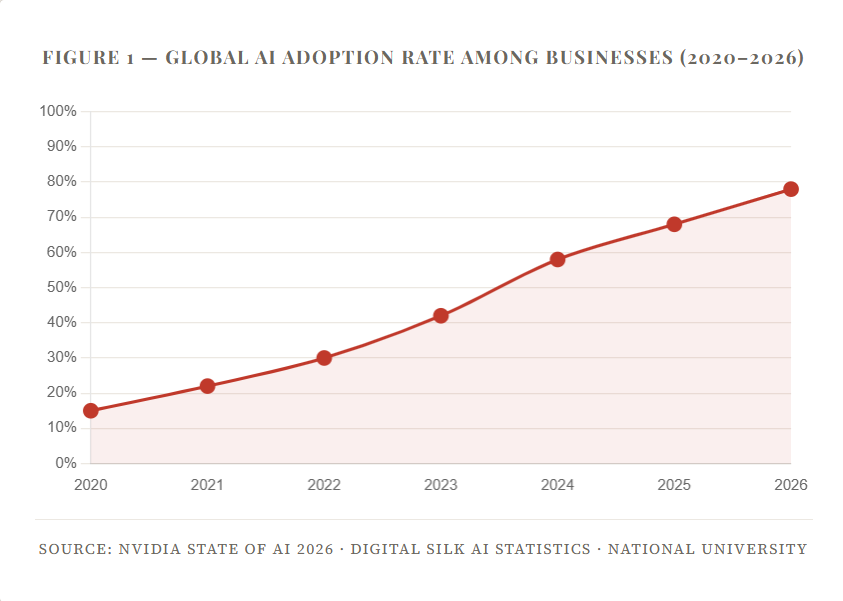
The transformation is not merely technical. It is cultural, economic, and deeply personal. Roughly 78 percent of companies have integrated AI into at least one business function, and among knowledge workers lawyers, analysts, engineers, marketers 58 percent now use generative AI tools at least once a week. The question is no longer whether AI will reshape society. It already has. The more urgent question is how, and for whom.
“AI is no longer a novelty. In 2026, it drives us, shops for us, manages our health — and raises questions we are only beginning to learn how to ask.”
The New Texture of Everyday Life
The most consequential changes in daily life are the ones that happen without announcement. Voice assistants now numbering roughly 8 billion globally — have become the default interface for household management. Half of U.S. mobile users rely on voice search every day. Chatbots have evolved from narrow tools for answering FAQs into what one analyst calls “everything apps”: platforms where users check their finances, plan travel, get health advice, manage relationships, and process complex emotions sometimes within the same session.
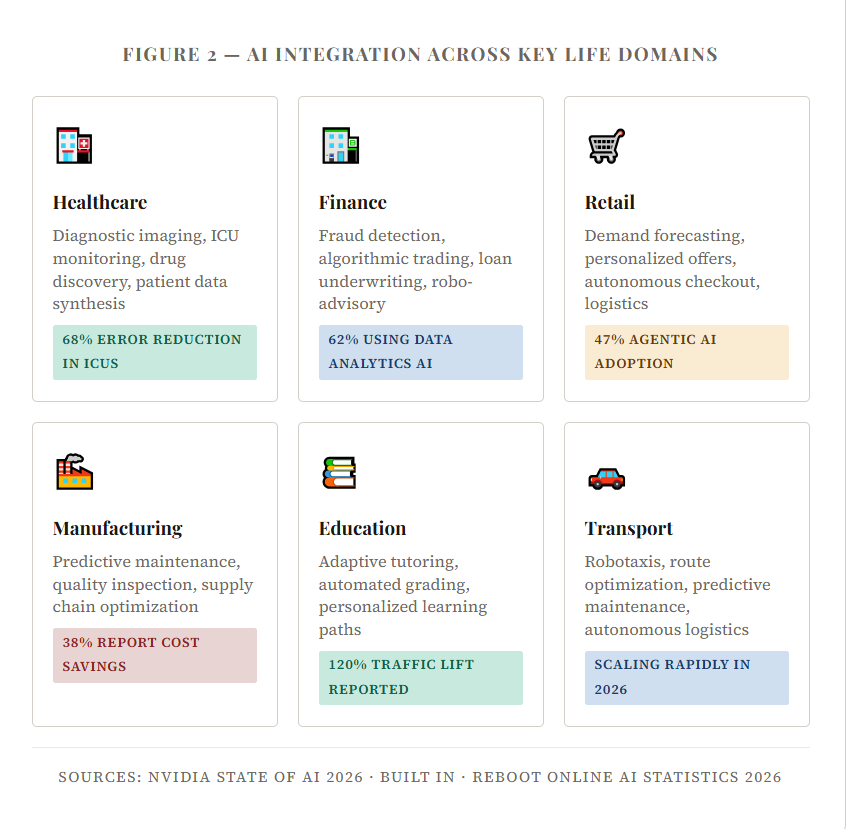
Grocery shopping, once an errand, is increasingly an AI-mediated act. Recommendation engines predict what you will run out of before you notice; autonomous checkout systems handle the transaction; route-optimization algorithms dispatch the delivery driver. In 2026, more than two-thirds of businesses use AI for at least one customer service function, from intelligent chatbots to real-time sentiment analysis that escalates frustrated callers to human agents before they hang up.
Healthcare has perhaps seen the deepest transformation. AI-powered diagnostic tools now assist radiologists in spotting tumors, help psychiatrists flag early signs of depression from speech patterns, and help clinicians in intensive care units consolidate patient data in real time. One medical assistant system in ICUs has produced a 68 percent reduction in documentation errors and a 33 percent reduction in perceived clinician workload freeing nurses to spend more time at the bedside rather than at the keyboard.
How Business Operations Have Been Rewritten
Inside the enterprise, AI has moved from pilot program to core infrastructure. The phrase “AI strategy” has been replaced, quietly, with simply “strategy.” Overall, 86 percent of organizations expect their AI budgets to increase in 2026, and nearly 40 percent expect increases of 10 percent or more. Big Tech Microsoft, Google, Amazon, and Meta combined committed $325 billion in capital expenditure on AI infrastructure and data centers this year alone.
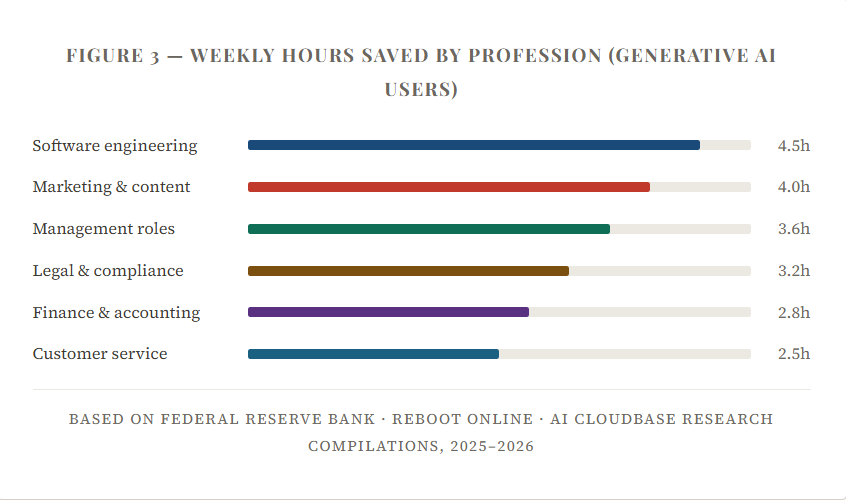
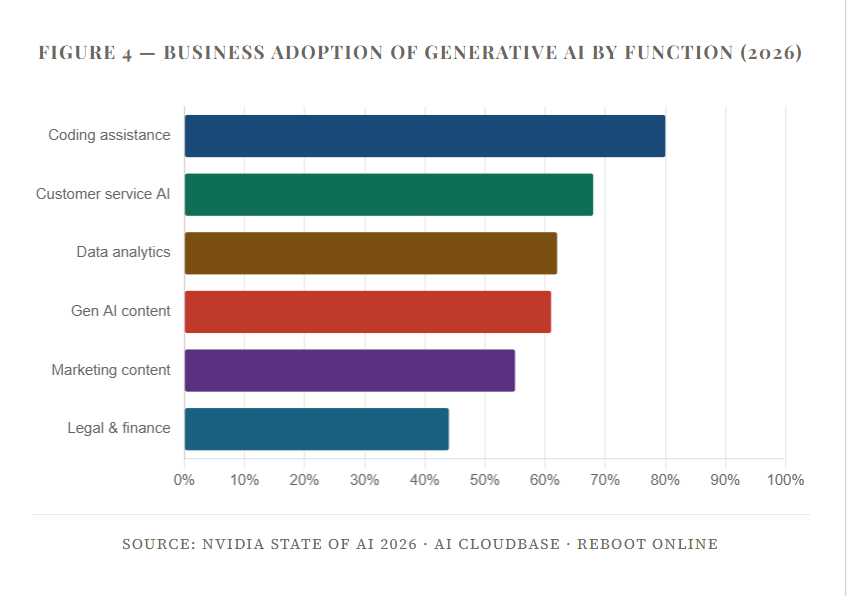
The productivity gains are measurable and, in some cases, striking. Workers who use AI tools daily save more than four hours per week on average. Computer and mathematics professionals see time savings equivalent to 2.5 percent of their weekly working hours small-sounding until you multiply it across an entire department. Software development has been transformed perhaps most visibly: 80 percent of developers now use AI coding assistants, and the average time to ship a feature has shrunk accordingly.
The rise of agentic AI systems that don’t simply answer questions but autonomously complete multi-step tasks may be the defining commercial story of 2026. Telecommunications leads in adoption at 48 percent, followed by retail at 47 percent. These agents negotiate with APIs, schedule meetings across time zones, file regulatory documents, and draft legal briefs with minimal human intervention. The technology is, by most accounts, still in its early-adopter phase. But the trajectory is steep.
The Creative Economy Remade
Perhaps nowhere is AI’s disruption more visible or more contested than in the creative industries. Over 15 billion AI-generated images have been created since 2022, a milestone that took traditional photography roughly 149 years to achieve. Approximately 34 million AI images are generated every single day. Marketing teams have embraced generative tools rapidly: 55 percent now use AI to produce at least some of their written and visual content.
The implications for individual creators are double-edged. On one hand, a solo entrepreneur can now produce a polished brand identity, a product video, and a year’s worth of blog content with tools that cost a fraction of hiring agencies. On the other, the downward pressure on creative rates is real and well-documented. The translation and localization sector where 67 percent of job listings now reference AI is a harbinger of things to come across many knowledge-work fields.
The Risks the Headlines Don’t Capture
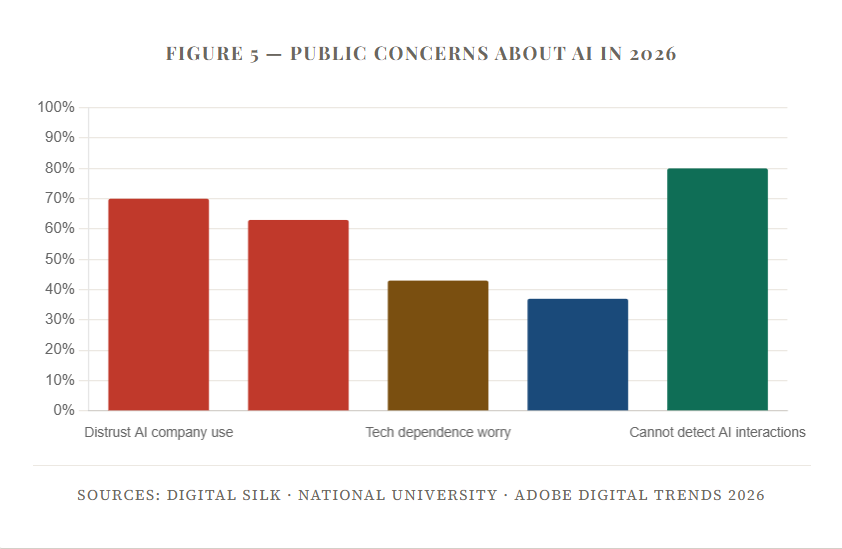
The optimism is real, but so is the anxiety and it tracks closely with the data. Some 63 percent of workers globally report worrying about losing their job to automation, and McKinsey estimates that up to 300 million full-time jobs could be affected by AI and related technologies by 2030. These are not abstract concerns: they are shaping political debates about retraining funds, universal basic income, and the regulation of autonomous systems in hiring decisions.
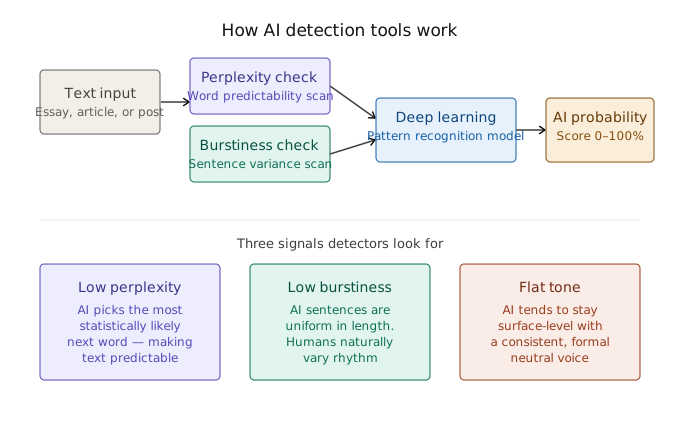
Trust remains fragile. Seventy percent of people say they do not trust companies to use AI responsibly. Adobe’s 2026 digital trends research found that a third of customers disengage when they discover content is AI-generated, and 37 percent say the same when they realize they have been interacting with an AI masquerading as a human. Only one-fifth of customers say they can reliably detect AI in their interactions meaning most of the time, they cannot tell the difference, and many would prefer to.
Environmental costs are also entering the public conversation. Training large AI models can require millions of liters of water for cooling data centers. The $325 billion in Big Tech infrastructure spending is not only a bet on revenue it is a physical footprint of massive energy and resource consumption that sustainability advocates have begun to scrutinize closely.
A Brief History of This Moment
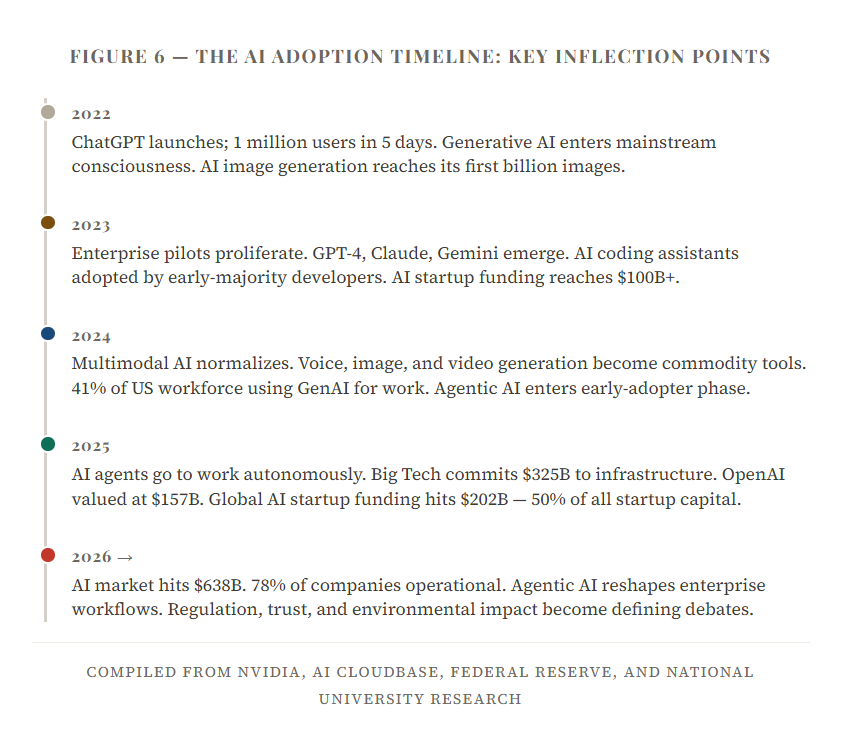
To understand how we arrived here, it helps to look at the compressed timeline of adoption. What took the internet nearly two decades to achieve embedding itself into the fabric of commerce and communication AI has accomplished in roughly four years of mainstream use.
What Comes Next
The forecasts for the rest of the decade are, by almost any measure, extraordinary. Over 1.1 billion people are expected to use AI by 2031. Economists project AI will add roughly 7 percent to global GDP within the next decade. AI adoption in China alone could increase that nation’s GDP by as much as 26 percent by 2030.
Agentic AI systems that operate with meaningful autonomy will be the next frontier. Analysts project that 33 percent of enterprise software applications will include agentic capabilities by 2028, up from less than 1 percent in 2024. When AI agents can negotiate, procure, hire contractors, manage budgets, and iterate on their own outputs, the nature of organizational structure itself comes into question.
The transition will not be painless. It will require investment in retraining, honest public discourse about automation’s distributional effects, and governance frameworks that move faster than they historically have. But the technology’s momentum is not in doubt. Nearly 80 percent of business leaders plan to increase AI budgets. A new AI company reaches unicorn status roughly every five to six days. The infrastructure data centers, chips, energy is being built at a pace and scale not seen since the electrification of industry a century ago.
In the end, the story of AI in 2026 is not primarily a story about machines. It is a story about choices — choices made by engineers, executives, regulators, and ordinary people navigating a world that is changing faster than the language we use to describe it. The technology will keep advancing. The question is whether the human institutions built to manage such change can keep pace.