How small business owners are using AI automation tools to cut costs, save 20+ hours a month, and grow faster without a tech team or a big budget.
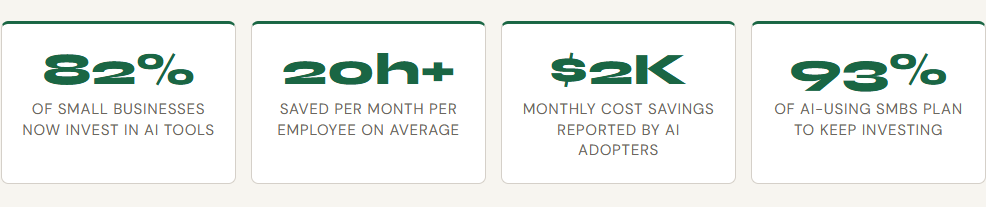
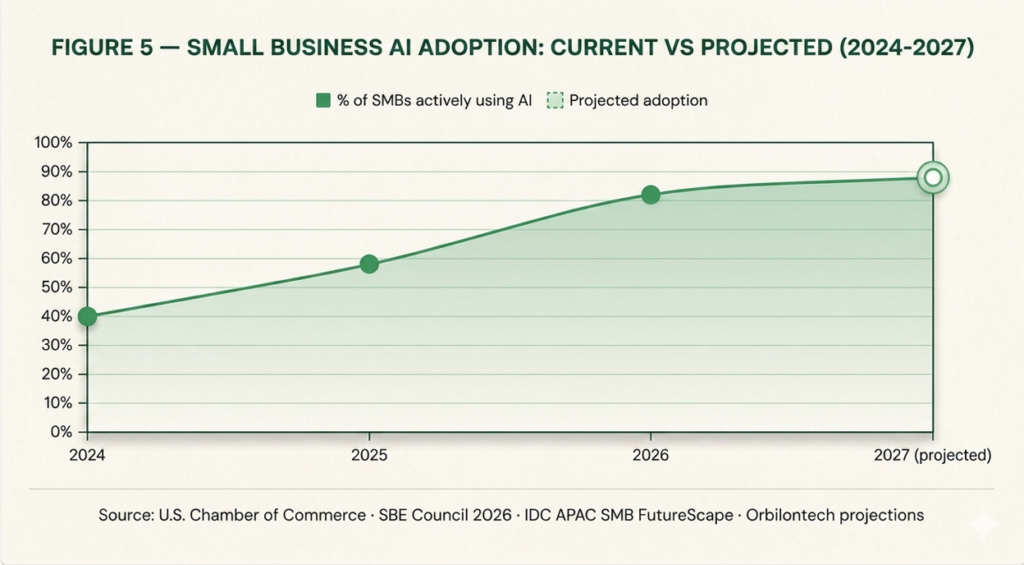
There is a quiet revolution happening on Main Street. While headlines focus on billion-dollar AI deployments at Fortune 500 companies, the real transformation in 2026 is happening inside small businesses — the bakeries, law firms, e-commerce shops, and independent consultancies that make up the backbone of every economy. According to the SBE Council’s 2026 Small Business Tech Use Survey, 82% of small business employers have now invested in AI tools, embedding them into daily operations at a pace that would have seemed impossible just three years ago.
The driving force is brutally simple: small teams feel every wasted hour. When you have three employees instead of thirty, a task that takes four hours to do manually drafting email campaigns, responding to customer inquiries, reconciling invoices is a tax that compounds daily. AI automation for small business is not about replacing people. It is about giving small teams the leverage of a much larger operation, without the payroll to match.

This guide breaks down exactly which AI tools for small business are delivering real ROI in 2026, what the data says about adoption and outcomes, and how to build a practical AI automation stack even if your budget is tight and your technical skills are modest.
Why AI Automation Is a Small Business Advantage
Counterintuitively, AI automation tools often deliver a higher relative impact for small businesses than for large enterprises. A large company that automates a customer service function saves one department’s time. A five-person company that automates the same function may effectively add the equivalent of a part-time hire without the benefits, desk, or onboarding process.
The correlation between AI adoption and growth is striking and well-documented. 83% of growing small and medium businesses have adopted AI, compared to just 55% of businesses in decline, according to research compiled by AdAI. Businesses that start using AI tools earlier see their operations run measurably smoother than competitors who hold back in some studies, a six-month operational advantage. This is the compounding logic of small business AI software: early adopters build habits, workflows, and data advantages that become harder to replicate over time.
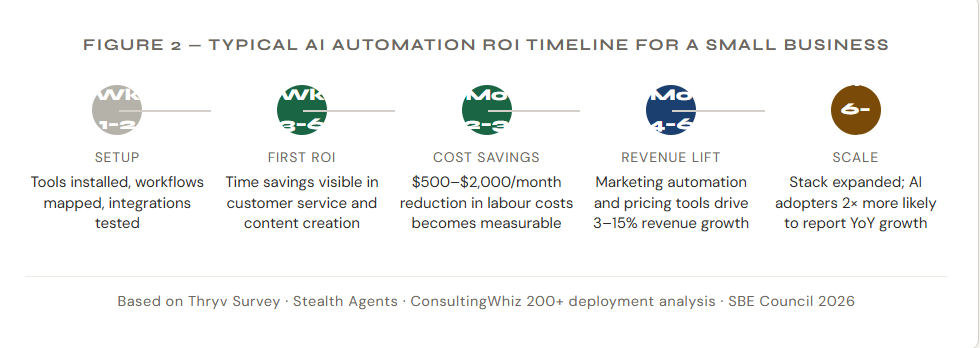
The cost equation has also shifted dramatically. A functional AI automation stack for a small business in 2026 typically runs between $200 and $500 per month, assembled from modular cloud tools. That is less than a single additional employee’s daily wage and the tools work around the clock, never call in sick, and do not require HR management.
The Five Highest-ROI Use Cases for Small Business AI
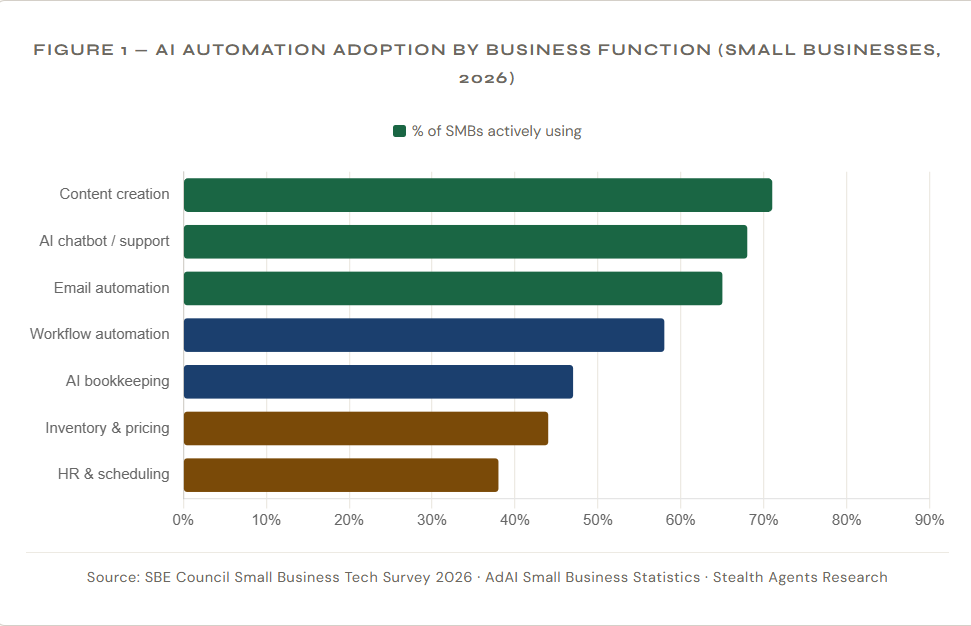
Not all AI automation delivers equal returns. Based on adoption data and reported outcomes across thousands of small businesses in 2026, five categories consistently show the fastest payback and the clearest operational impact.
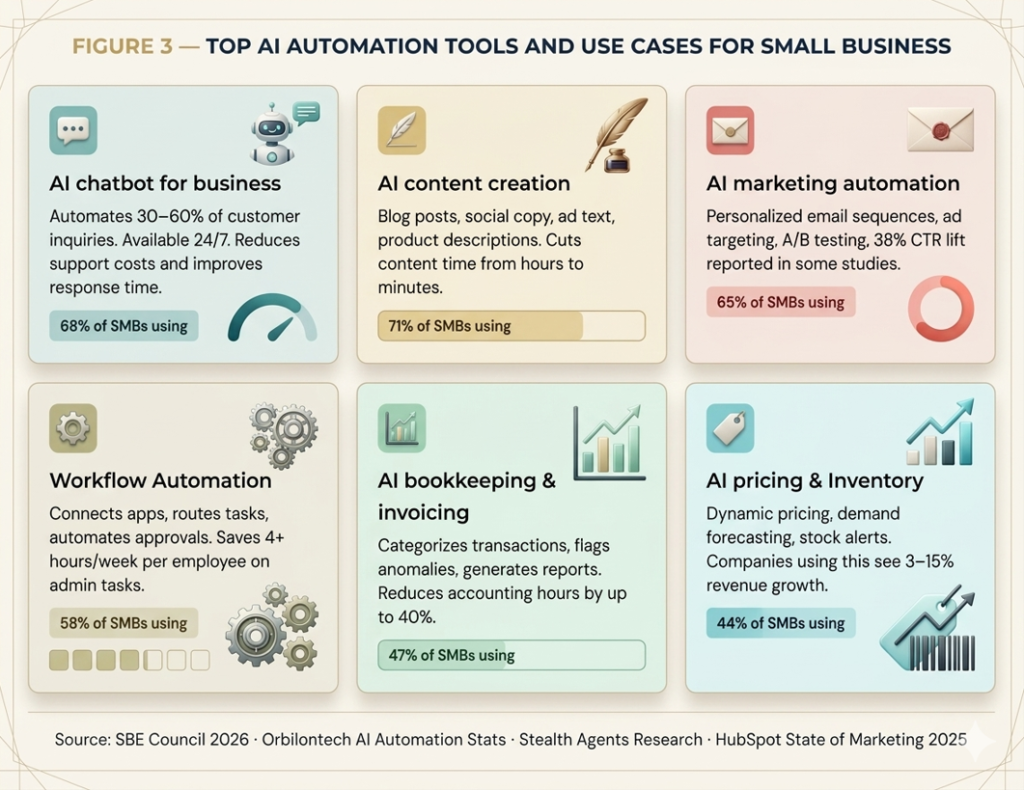
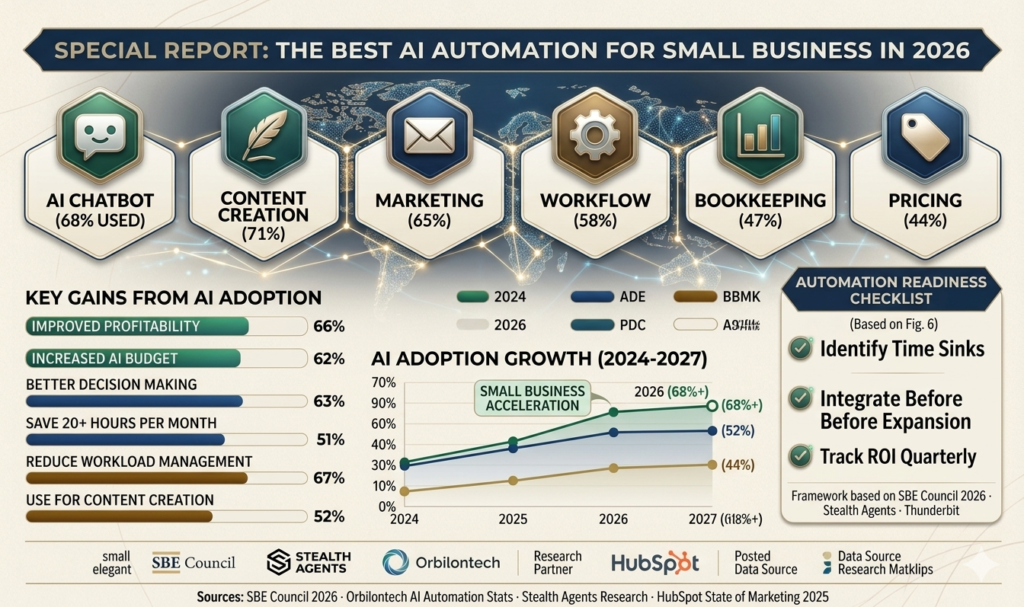
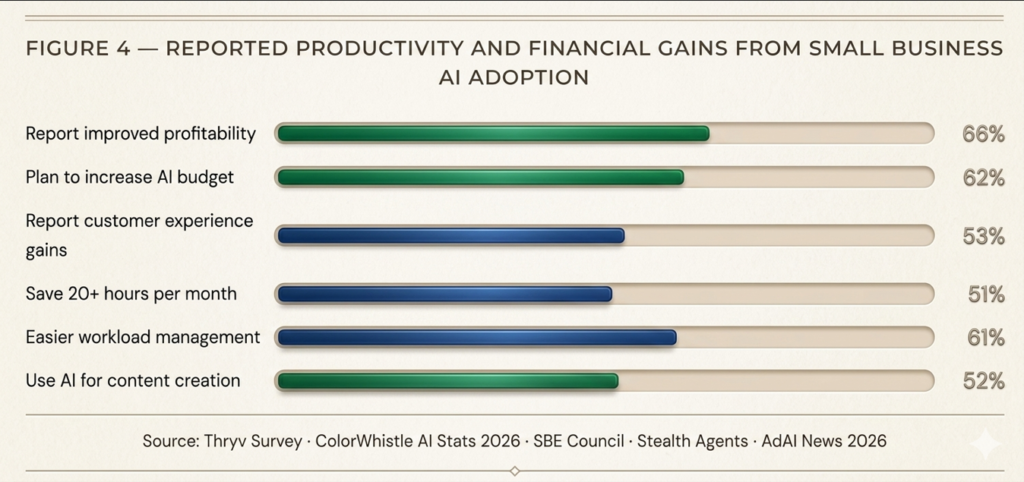
AI chatbots for business consistently deliver the fastest payback. A business fielding 100 customer inquiries per week that automates even 30% of those interactions simple FAQs, hours of operation, order status frees up multiple hours of staff time per week. Beyond efficiency, 53% of small business owners report noticeable improvements in customer experience after deploying AI customer service tools, which has competitive implications well beyond cost savings.
AI marketing automation is the second-fastest adopter category because the ROI is immediately visible and measurable. A task that once took four hours writing a week of social content, segmenting an email list, drafting a promotional campaign now takes under 30 minutes. Content marketing powered by AI tools has been associated with a 120% increase in organic traffic in some studies, and ad click-through rates boosted by up to 38%.
Workflow automation via tools that connect apps and route information between systems (think: a new lead auto-assigned in your CRM, a completed form triggering an invoice, a booking confirmation updating your calendar) is where the operational leverage compounds quietly over time. The average small business in 2026 uses a median of five AI tools, and connecting them into automated pipelines is where efficiency gains accelerate most dramatically.
The Barriers and How to Clear Them
Despite the compelling economics, barriers to AI adoption remain real for many small businesses. Cost is cited as the primary obstacle by 61% of SMBs that have not yet adopted AI tools yet the perception of expense often lags the reality. A year ago, enterprise-grade AI capabilities required significant investment. In 2026, many of the highest-performing tools offer free tiers or start at under $50 per month.
The second barrier is skills specifically, the fear that AI tools require technical expertise that most small business owners do not have. This concern is largely outdated. The best small business AI software in 2026 is designed for non-technical users: drag-and-drop workflow builders, natural language prompting, and pre-built templates for common business scenarios. If you can write an email, you can operate most AI automation tools.
The third barrier is uncertainty about where to start. The answer from the data is consistent: pick the one task you do most repetitively and automate that first. Customer inquiries and content creation show the quickest, most measurable benefits. Once you see results, expansion becomes easier to justify and easier to fund.
Building Your AI Automation Stack: A Practical Checklist
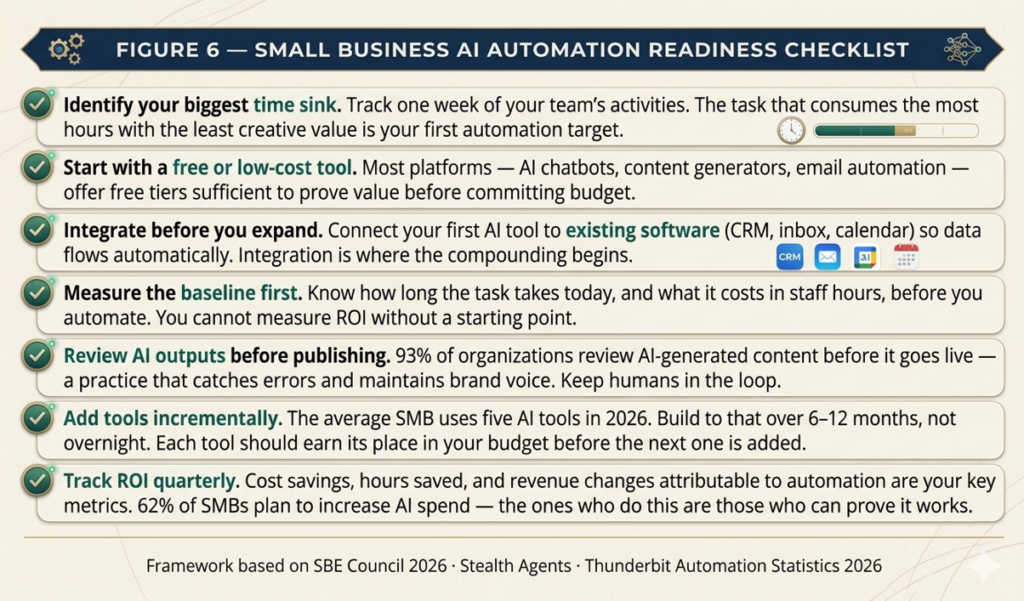
The businesses getting the highest returns from AI automation in 2026 are not necessarily using the most sophisticated tools. They are using the right tools, configured intentionally, with clear goals. Here is a practical framework for any small business owner ready to build or expand their AI stack.
The Competitive Reality in 2026
For small businesses in retail, professional services, and healthcare, AI automation has already crossed the threshold from competitive advantage to competitive baseline. A small retail operation running without AI-powered pricing, inventory management, or marketing tools is now competing at a structural disadvantage against AI-enabled peers doing the same volume with fewer staff hours.
The data tells a clear story. Growing SMBs adopt AI at nearly double the rate of declining businesses. Businesses that implement AI automation report cost savings, productivity gains, and customer experience improvements that compound over time. And 93% of small businesses that have adopted AI tools plan to keep investing a retention rate that reflects genuine, measurable value, not survey optimism.
For construction, trades, hospitality, and other sectors where AI adoption remains lower, there is still meaningful first-mover opportunity particularly for administrative automation, AI chatbots for customer communication, and scheduling tools that require minimal setup. In these sectors, early adopters are not chasing a trend. They are building a durable operational advantage before competitors realize the window is open.
The conclusion from 2026’s data is not that every small business needs to become an AI company. It is simpler than that: the small businesses that are growing fastest have decided to let machines handle the mechanical and humans handle the meaningful. That trade automating the repetitive to invest more in the creative, the relational, and the strategic is the real promise of AI automation for small business. And in 2026, the tools to make that trade have never been more accessible.