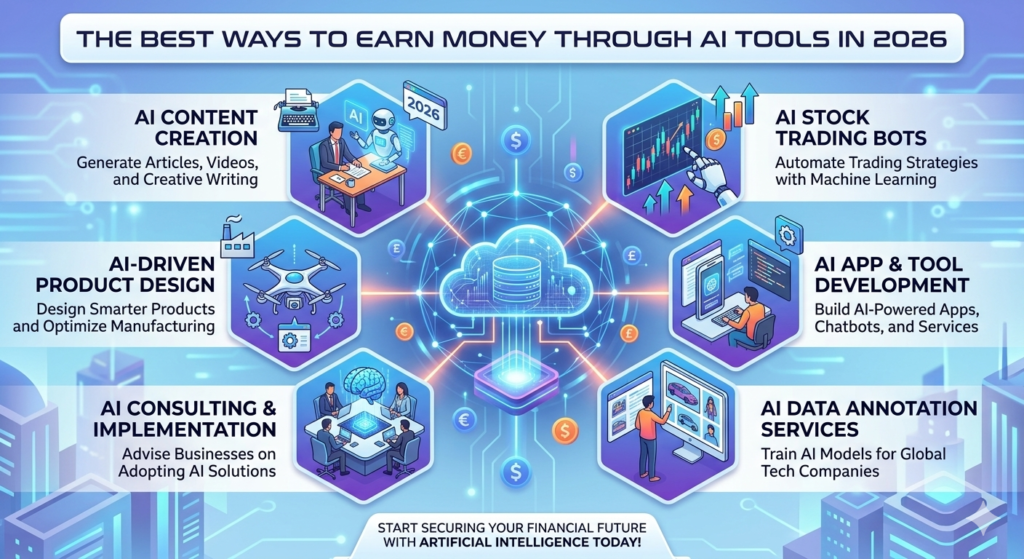
A comprehensive guide to building real income streams using artificial intelligence
Introduction: The AI Economy Has Arrived
The year 2026 is not a preview of what AI might one day do for your income it is the moment. Artificial intelligence has moved from a curiosity to an indispensable economic layer, reshaping how individuals create value, deliver services, and build businesses. What once required teams of designers, writers, developers, and analysts can now be produced by a single motivated person armed with the right AI tools.
But there is a critical distinction to make from the outset: AI does not earn money on its own. People who earn well through AI in 2026 are not passive recipients of automated income. They are skilled operators people who know how to direct AI systems, quality-check outputs, layer in human judgment, and sell the result. The tools are powerful; the leverage is real. But the human behind the tool still determines success.
This article covers the most viable, practical, and high-earning paths available right now, organized from accessible entry points to more advanced strategies.
1. AI-Powered Freelance Services
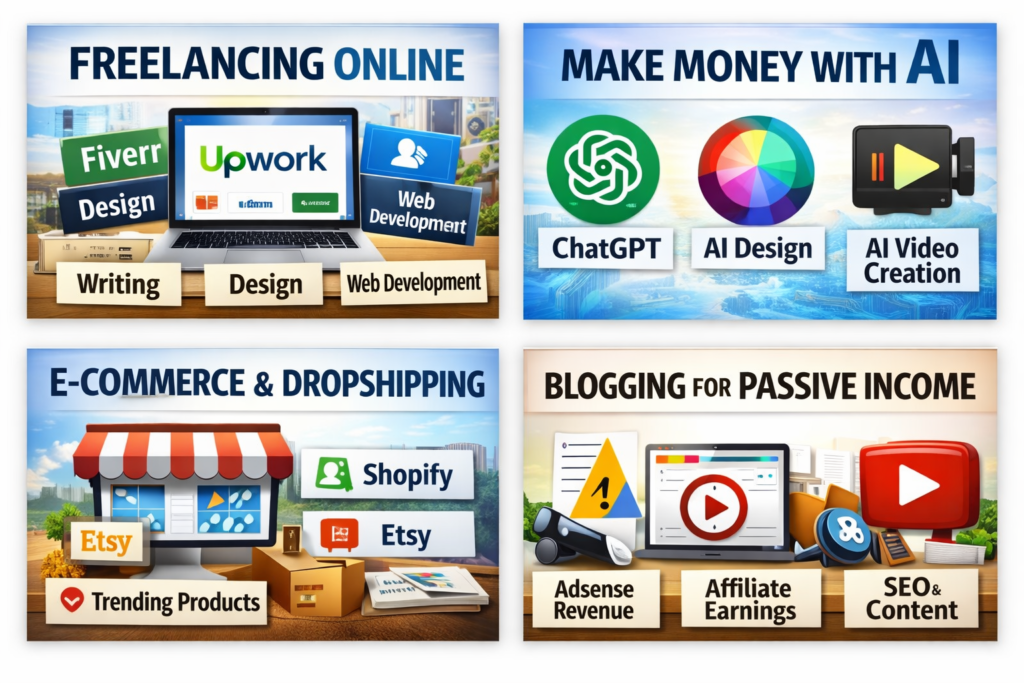
Freelancing was transformed entirely by AI. A solo freelancer today can produce the volume and quality that used to require an agency. Platforms like Upwork, Fiverr, Toptal, and a newer generation of AI-specialized marketplaces have become hunting grounds for those who know how to leverage this advantage.
Content writing and copywriting remain among the highest-demand services. AI writing tools — Claude, ChatGPT, Gemini — can produce polished drafts at speed, but businesses pay premiums not for raw output but for strategically directed, edited, and brand-aligned content. If you understand audience psychology, SEO principles, and brand voice, you can use AI to multiply your output tenfold while maintaining quality that generic AI outputs cannot match.
Graphic design has similarly shifted. Tools like Midjourney, Adobe Firefly, and Stable Diffusion allow a single designer to deliver brand kits, marketing assets, and social media graphics at a pace that was previously unthinkable. The freelancers earning the most are not just running prompts — they are curating, refining, and integrating AI outputs into professional deliverables that clients trust.
Video production is another exploding category. AI tools for script-to-video generation, voiceover synthesis, subtitle automation, and editing (Runway, Kling, HeyGen, ElevenLabs) have democratized what was once an expensive craft. YouTube channels, corporate training videos, and marketing reels are now being produced by solo operators at scale.
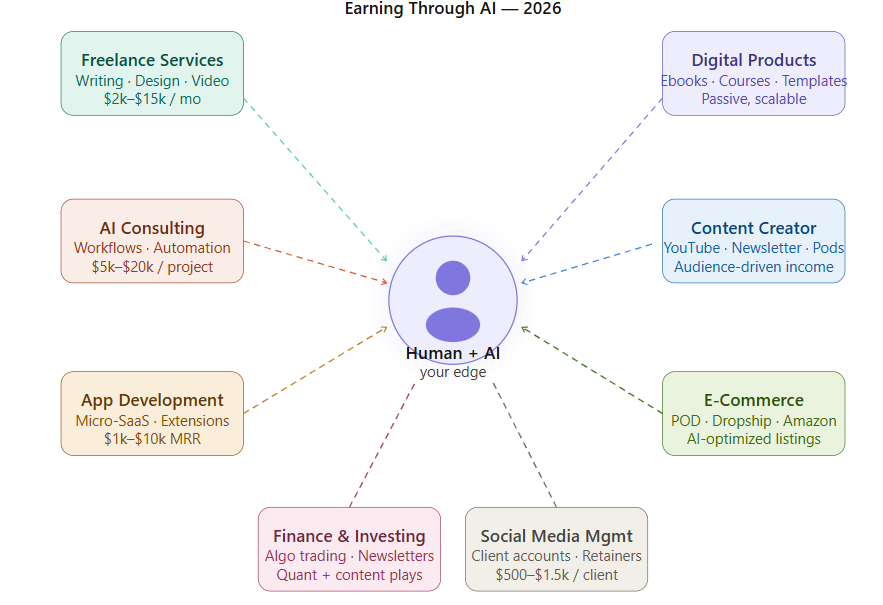
The earning range here is wide. A beginner using AI tools can realistically clear $2,000–$4,000 per month on freelance platforms within six months. An experienced operator with a defined niche and strong client relationships can earn $8,000–$15,000+ monthly.
2. Building and Selling AI-Enhanced Digital Products
Digital products represent one of the purest forms of leveraged income: you build once, sell repeatedly. AI has dramatically reduced the cost of creation, making digital products accessible to people who previously lacked the technical or creative skills to produce them.
Ebooks and digital guides can now be researched, drafted, and designed in a fraction of the time they once required. A well-structured guide on a specific professional topic — productivity systems for remote teams, legal basics for freelancers, nutrition protocols for athletes — can sell for $15–$50 on platforms like Gumroad, Lemon Squeezy, or your own website. The key is depth and specificity. Generic AI content fails in the market; focused, well-edited expert content succeeds.
Online courses and educational content represent a higher-effort but higher-return category. AI helps with curriculum design, script writing, slide creation, and even voiceover. A course on a practical skill — prompt engineering, AI-assisted marketing, no-code app building priced at $97–$297 with strong positioning can generate significant passive income over time.
Templates and tools are perhaps the most underappreciated category. AI-designed Notion templates, Canva design systems, spreadsheet automation tools, and custom GPT configurations are being purchased by businesses and individuals who want AI leverage without the learning curve. If you build it well and market it clearly, templates can sell at high volume with almost no marginal cost.
Stock media — AI-generated images, music, and video backgrounds remains a viable market on platforms like Adobe Stock, Shutterstock, and Pond5, though it is increasingly competitive. The edge goes to creators who identify underserved visual niches and produce consistently styled, commercially useful assets.
3. AI Consulting and Implementation Services
Organizations everywhere understand that AI is important but often lack the internal expertise to implement it effectively. This gap is a significant income opportunity for people who develop genuine knowledge of AI tools and workflows.
AI workflow consulting involves helping businesses identify where AI can reduce costs or increase output, and then building those workflows. This might mean setting up automated email response systems, creating internal knowledge bases using retrieval-augmented generation, or deploying AI-powered customer service pipelines. Consultants in this space are charging $5,000–$20,000 for project-based engagements, with retainer relationships generating recurring monthly income.
Prompt engineering as a formal service has matured. While the term became something of a joke in 2023, expert prompt engineers who can build reliable AI systems for enterprise use cases — consistent brand voice generation, legal document summarization, structured data extraction — command real fees. The work is less about clever prompts and more about systematic testing, reliability engineering, and understanding model behavior.
AI training and workshops serve companies investing in employee AI literacy. A half-day workshop on practical AI tools for a marketing team or a law firm can command $1,500–$5,000, and demand has only grown as AI tool proliferation creates genuine confusion in the workforce.
4. Content Creation and Audience Monetization
Building an audience remains one of the most durable income strategies, and AI has dramatically lowered the barrier to consistent, quality content production.
YouTube and video content is the premier platform for AI-assisted creators. Long-form educational channels, faceless explainer channels, and commentary channels can all be powered substantially by AI tools — research, scripting, thumbnail design, voiceover, editing. Channels that reach monetization thresholds now benefit from AdSense revenue, sponsorships, and product sales. The realistic timeline to meaningful income is 12–18 months, but the ceiling is high.
Newsletter and blog publishing using AI has produced a new generation of independent media businesses. A niche newsletter with 5,000 engaged subscribers can generate $3,000–$10,000 per month through sponsorships, paid tiers, and affiliated products. AI makes the research, drafting, and editing process fast enough that a single writer can maintain the output of a small editorial team.
Social media content businesses — managing and growing accounts for clients — have become highly viable. AI tools for caption writing, scheduling, visual asset creation, and analytics interpretation allow a single operator to manage 10–20 client accounts simultaneously. Monthly retainers of $500–$1,500 per client can compound quickly into a substantial business.
Podcasting with AI assistance for transcription, show notes, clip creation, and promotional content has opened the medium to creators who previously found the production burden too high. Podcast advertising rates have stabilized at a level that rewards even mid-size audiences.
5. AI-Assisted Software and App Development
AI coding tools — GitHub Copilot, Cursor, Claude’s code capabilities, and no-code platforms like Bubble and Glide — have made software creation accessible to a broader population than ever before. You do not need to be a senior engineer to build sellable software products.
Micro-SaaS businesses — small, focused software tools solving specific problems — are being launched by solo founders leveraging AI coding assistance. Tools for niche productivity needs, workflow automation, data processing, or industry-specific calculations can generate $1,000–$10,000 per month in subscription revenue with manageable technical complexity.
Custom automation and integration services are in high demand. Businesses need their tools to talk to each other — their CRM to their email platform, their inventory system to their accounting software. AI-assisted development of these integrations, delivered through platforms like Zapier, Make, or custom code, is a billable service that commands $50–$150 per hour from technically literate operators.
Browser extensions and desktop tools represent another accessible category. AI helps with coding, UI design, and documentation. A useful, well-marketed extension can generate significant income through one-time purchases or subscriptions on the Chrome Web Store or Product Hunt.
6. AI-Driven E-Commerce
E-commerce has been reshaped by AI at multiple points in the value chain — product discovery, content production, customer service, and marketing optimization.
Print-on-demand businesses using AI-generated designs have scaled dramatically. Platforms like Printful, Printify, and Merch by Amazon allow creators to sell custom merchandise without holding inventory. AI design tools make it possible to produce hundreds of designs quickly, test them in the market, and double down on what sells.
Dropshipping with AI has become more sophisticated. AI tools assist with product research, competitor analysis, ad creative generation, and customer service automation. The operators who succeed are not simply running generic stores — they are using AI to move faster and iterate smarter than competitors.
Amazon and marketplace optimization is a specialized service in high demand. AI tools for keyword research, listing optimization, review analysis, and pricing strategy are powering entire agencies built around helping sellers compete on Amazon, Etsy, and similar platforms.
7. AI in Finance and Investing
This is an area requiring both technical competence and appropriate caution. AI tools are being used across a spectrum of financial applications, some established and some still maturing.
Algorithmic trading tools leveraging AI for pattern recognition and signal generation have become accessible to retail traders through platforms like QuantConnect and similar environments. Building, testing, and deploying these systems is a genuine skill set, and selling access to tested strategies or providing consulting in this space is a real income path for those with quantitative backgrounds.
Financial content and analysis — newsletters, research notes, model portfolios — benefits enormously from AI’s ability to process and synthesize large amounts of financial data. A well-positioned financial newsletter with a specific analytical edge can command subscriber fees of $30–$200 per month.
Tax and accounting automation tools built for specific industries or professional contexts are being sold to small business owners who need AI-powered help without the cost of a full accounting service.
8. Skills That Make Everything Work Better
Across all of these categories, certain underlying skills determine whether AI leverage produces real income or merely mediocre output.
Prompt engineering and AI literacy — knowing how to get the best from AI systems, understanding their limitations, and building reliable workflows — remain genuinely differentiating. The best AI users are not just clever with prompts; they understand model behavior, know when to trust AI outputs and when to verify, and can build systems that produce consistent results.
Editing and quality judgment are increasingly valuable. AI can produce volume; humans must ensure quality. The ability to recognize good output, identify errors, improve structure, and align content with audience expectations is a skill AI cannot replace.
Marketing and distribution separate products that sell from products that sit. Many technically excellent AI-powered offerings fail because their creators focus entirely on production and neglect the work of reaching customers. Email marketing, SEO, social distribution, and community building are as important as ever.
Niche expertise makes AI leverage dramatically more valuable. A generalist using AI produces average content. An experienced marketing professional using AI produces expert marketing content. A practicing lawyer using AI produces better legal summaries than a general researcher ever could. Your domain knowledge is the multiplier on top of AI capability.
Common Mistakes to Avoid
Understanding what not to do is as important as knowing what to pursue.
Relying entirely on AI output without human judgment produces the one thing the market is now saturated with: generic, forgettable content. Buyers are increasingly sophisticated about what AI-generated material looks like when it hasn’t been meaningfully elevated by human expertise.
Chasing too many paths simultaneously is a trap that AI’s flexibility makes worse. The low cost of creating content in multiple formats tempts many people to spread their effort too thin. Focused execution on one income path almost always outperforms diffuse effort across five.
Ignoring legal and ethical dimensions — copyright concerns with AI-generated imagery, disclosure requirements for AI-assisted content, data privacy obligations in AI-powered tools — is a genuine risk that responsible operators take seriously.
Underpricing is common among new AI service providers who mistake efficiency gains for a reason to charge less. AI helps you deliver more value, faster. That is a reason to charge at or above market rates, not below them.
Getting Started: A Practical Framework
For someone new to earning through AI tools, a sensible path looks like this:
First, choose a category aligned with existing skills and genuine interest. AI amplifies what you already know; it does not replace the need to know something.
Second, spend genuine time learning the AI tools most relevant to your category. This means going beyond surface-level familiarity — understanding what the tools do well, where they fail, and how to produce outputs you would be proud to put your name on.
Third, produce five to ten high-quality examples of your work before seeking clients or customers. Portfolios, demo projects, and published pieces do more selling than any pitch.
Fourth, start small and real. A first client, a first sale, a first piece of content that reaches an actual audience — these early signals matter far more than elaborate business plans.
Fifth, iterate based on what the market responds to. AI makes iteration fast and cheap. Use that advantage.