Abstract
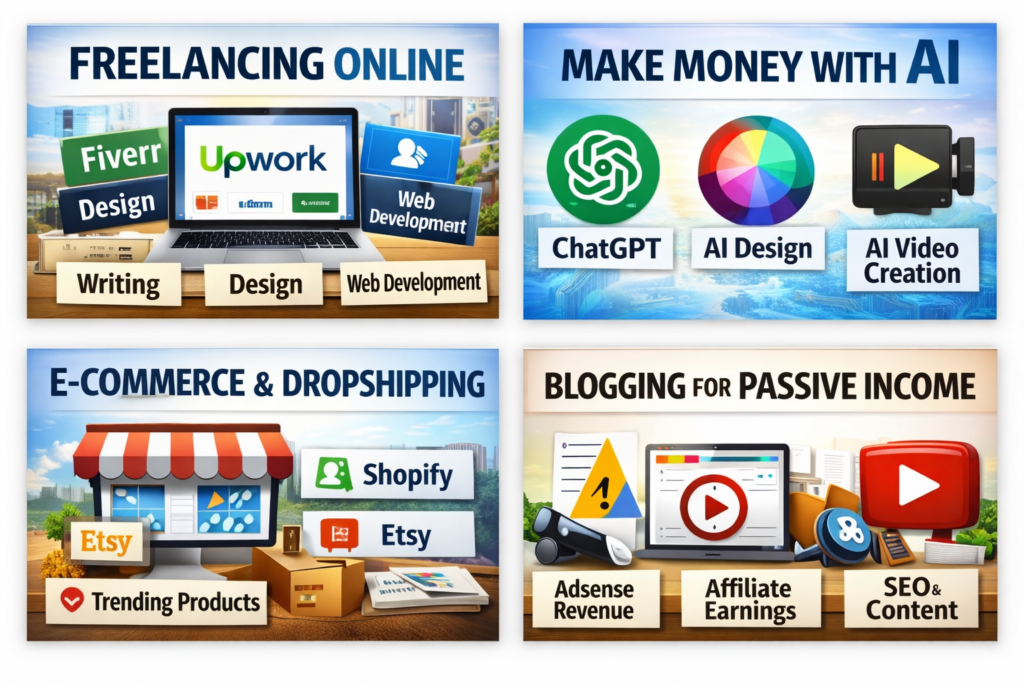
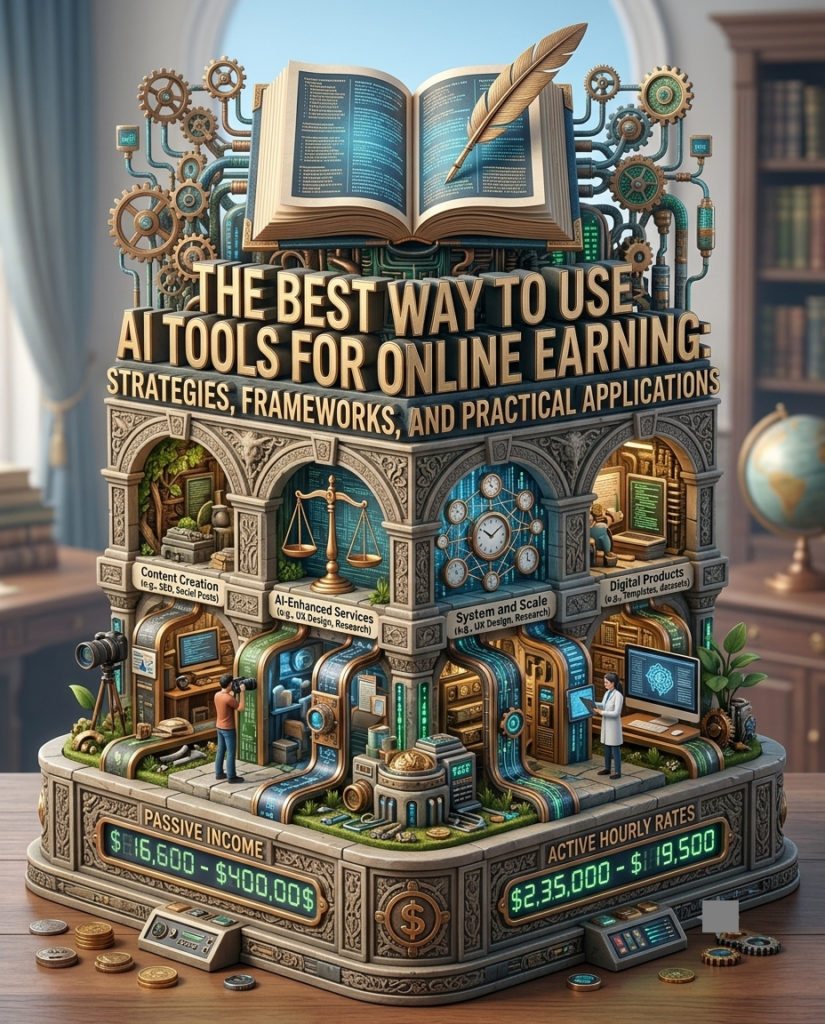
Artificial intelligence tools have democratised access to digital income streams that once required specialist expertise or large capital outlays. This article examines the most effective strategies for using AI tools to generate income online covering freelance services, content creation, product development, and automated workflows. We synthesise practical frameworks, outline a skills-to-income pathway, and identify the highest-yield AI categories for new and experienced earners alike.

1. Introduction
The rise of large language models, generative image engines, AI coding assistants, and automation platforms has compressed the skill barriers to online earning in ways that were unimaginable five years ago. A writer, a designer, a developer, or an entrepreneur can now accomplish in hours what previously required a full team working for days. Yet many people who adopt AI tools quickly discover that owning the software is not the same as knowing how to deploy it profitably.
Effective use of AI for income generation rests on three pillars: selecting the right tool category for one’s skills and market, integrating those tools into repeatable workflows rather than using them ad hoc, and understanding which human-value elements to preserve so that AI-enhanced output commands premium pricing rather than commodity rates.
This article draws on published platform data, independent practitioner surveys, and workflow analysis to offer a structured framework for turning AI capability into sustainable online income.
2. The Top AI Tool Categories for Earning
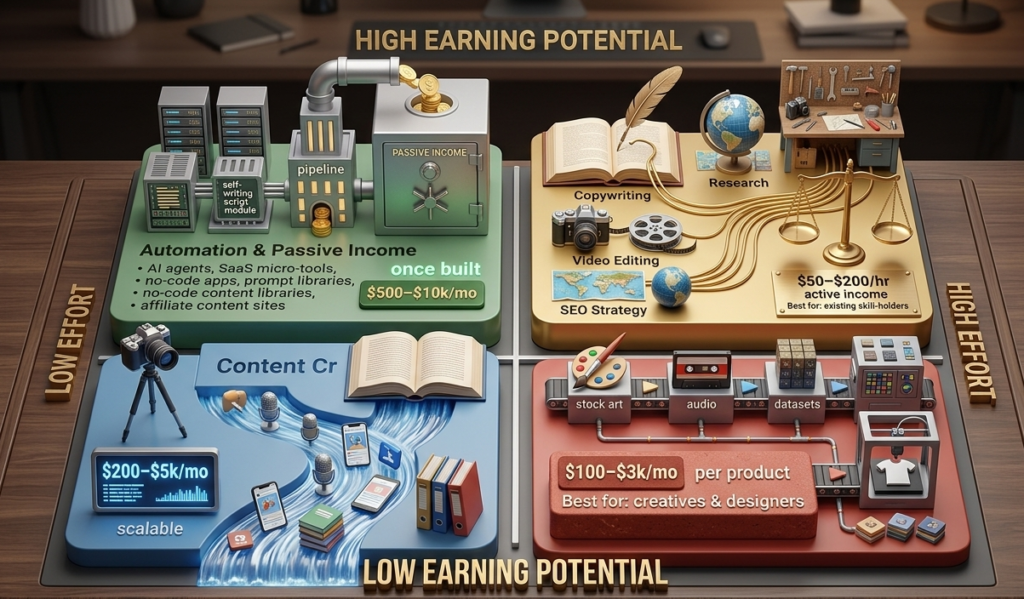
2.1 Language and Writing AI
Large language models — including ChatGPT, Claude, and Gemini are the most immediately accessible AI tools for earners. They enable copywriters to deliver four to five times their previous output, allow non-native speakers to produce publication-quality English, and help consultants generate detailed reports, proposals, and analyses in a fraction of the time previously required. The key to monetising these tools is not volume alone but the combination of AI speed with human editorial judgement, domain knowledge, and audience understanding.
High-value writing niches that reward AI-assisted production include: technical documentation for software products, long-form SEO content for competitive industries, email sequences for B2B companies, and white-label content for marketing agencies.
2.2 Image and Visual Generation
Platforms such as Midjourney, Adobe Firefly, and Stable Diffusion have created direct revenue channels for visual creators. Stock image licensing, print-on-demand merchandise, logo and brand identity services, and book cover design are among the most active markets. The competitive advantage lies less in raw generation capability which is now widely accessible and more in prompt engineering precision, brand consistency, and post-processing refinement that ensures commercial usability.
2.3 AI-Assisted Coding
GitHub Copilot, Cursor, and similar coding assistants have allowed developers to take on more projects simultaneously and non-developers to build minimum-viable products without traditional programming backgrounds. Revenue pathways include: building micro-SaaS tools, automating business workflows on Zapier or Make, creating custom GPTs with subscription monetisation, and offering done-for-you automation services to small businesses.
2.4 Video and Audio AI
AI video generation tools such as Runway, Pika, and HeyGen, combined with AI voice platforms like ElevenLabs, have unlocked faceless YouTube channels, AI-generated course videos, and professional voiceover production at minimal marginal cost. These categories reward consistency and niche targeting over technical complexity.

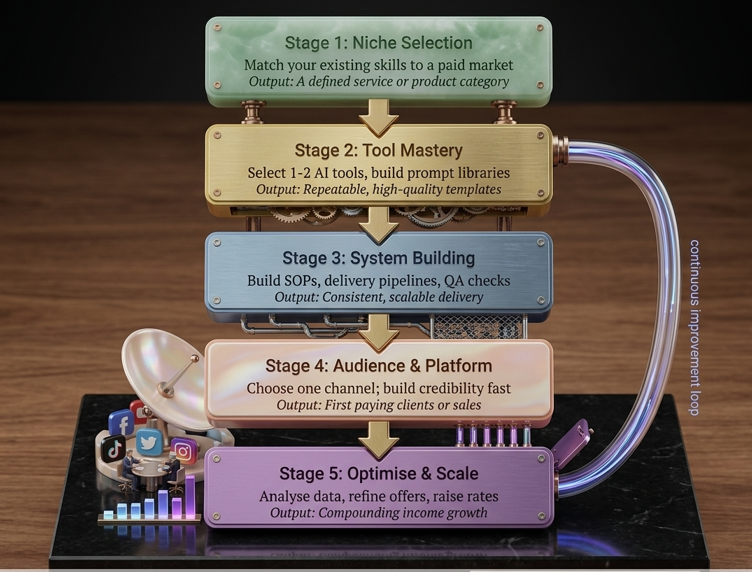
3. The AI Earning Workflow Framework
Research into high-earning AI practitioners consistently reveals a five-stage workflow rather than ad-hoc tool use. Understanding and implementing this framework separates sustainable income generators from those who experience initial results followed by plateau.
4. Platform Selection and Positioning
Choosing where to sell is as consequential as choosing which AI tools to use. The major income platforms fall into three categories: service marketplaces (Upwork, Fiverr, Toptal), content monetisation platforms (YouTube, Substack, Medium Partner Program, Gumroad), and direct client channels (LinkedIn outreach, niche communities, cold email). Each carries different risk profiles and time-to-income curves.
Service marketplaces offer the fastest path to first income but impose margin compression as supply of AI-enhanced services increases. Content platforms involve longer build cycles but can produce durable, algorithm-distributed revenue. Direct channels require stronger relationship-building skills but allow for the highest pricing autonomy.
The optimal strategy for most practitioners starting out is to use a marketplace to generate initial income and testimonials while simultaneously building a content presence that reduces dependence on platform algorithms over time.
5. High-Yield AI Tool Combinations
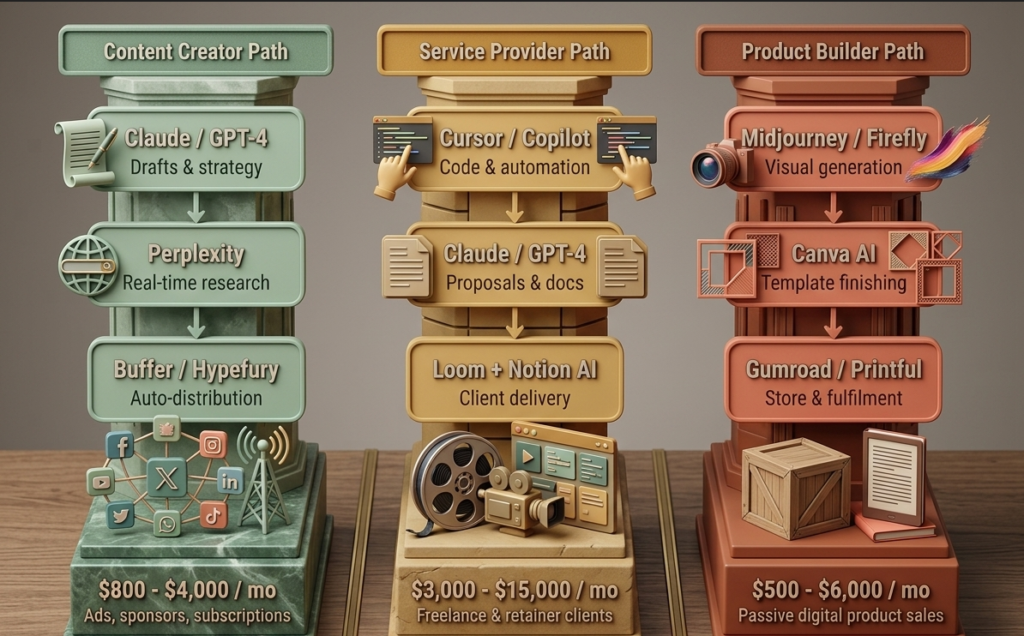
Practitioners who earn above median rates rarely rely on a single AI tool. The highest-yield configurations pair a generative tool with a research or editing tool and a distribution automation. For example: Claude (strategy + long-form writing) combined with Perplexity (real-time research) and Buffer or Hypefury (social scheduling) creates a content production pipeline that can publish daily across channels for a fraction of traditional agency cost.
For product creation, Midjourney or Adobe Firefly paired with Canva’s AI features and Printful’s on-demand fulfilment creates a zero-inventory digital product business. For developers, Cursor or GitHub Copilot paired with Bubble or Webflow can produce client websites and automation tools with near-zero marginal labour cost beyond the initial build.
6. Common Pitfalls and How to Avoid Them
The most frequently observed failure modes among AI earners fall into four categories. First, tool proliferation: acquiring access to many platforms without achieving mastery of any one, leading to shallow output that commands low prices. The antidote is a rule of two master two complementary tools deeply before adding a third.
Second, commodity positioning: offering generic AI-assisted services without a differentiating niche or voice. As AI tools commoditise production, buyers increasingly pay a premium for domain expertise, brand trust, and demonstrated track records rather than raw output volume. Positioning as “an AI copywriter” is less durable than positioning as “a SaaS onboarding specialist who happens to use AI.”
Third, neglecting quality gates: publishing or delivering AI output without substantive human review. Beyond the risk of factual errors, unedited AI content increasingly fails quality filters on major platforms and erodes client trust. A reliable quality-check routine fact verification, brand voice alignment, and structural editing is non-negotiable for sustainable income.
Fourth, platform dependency without diversification: relying entirely on a single marketplace or algorithm for discovery. Platform policy changes, algorithm shifts, and increased competition are constant risks. Diversification across at least two income channels significantly reduces this exposure.
7. Ethical Considerations and Disclosure
The question of disclosure when and how to inform clients or audiences that AI tools were used in production — is increasingly important both legally and reputationally. Several jurisdictions are introducing disclosure requirements for AI-generated content, particularly in journalism and advertising. Even absent legal obligation, proactive transparency tends to strengthen rather than weaken client relationships, as it frames AI use as a productivity innovation rather than a concealment.
Intellectual property questions around AI-generated imagery, training data, and derivative works remain actively contested in courts across multiple jurisdictions. Practitioners are advised to follow developments in their applicable markets and to favour tools with clear commercial licensing terms.
8. Conclusion
AI tools have fundamentally altered the economics of online earning, removing the skill floors that previously gated access to high-value digital work. However, the practitioners who achieve durable income do not treat AI as a replacement for expertise they treat it as a multiplier of expertise that already exists. The winning formula combines one clearly defined market niche, mastery of one to two purpose-selected AI tools, a documented and repeatable delivery system, and a credibility-building presence on at least one channel.
The opportunity is genuinely significant and accessible. But as more participants enter every AI-assisted category, the competitive moat shifts from the ability to use AI to the quality of judgement, positioning, and client relationships layered on top of it. Those who invest in both the tools and the human skills that amplify them will find the income ceiling substantially higher than in any previous era of online work.