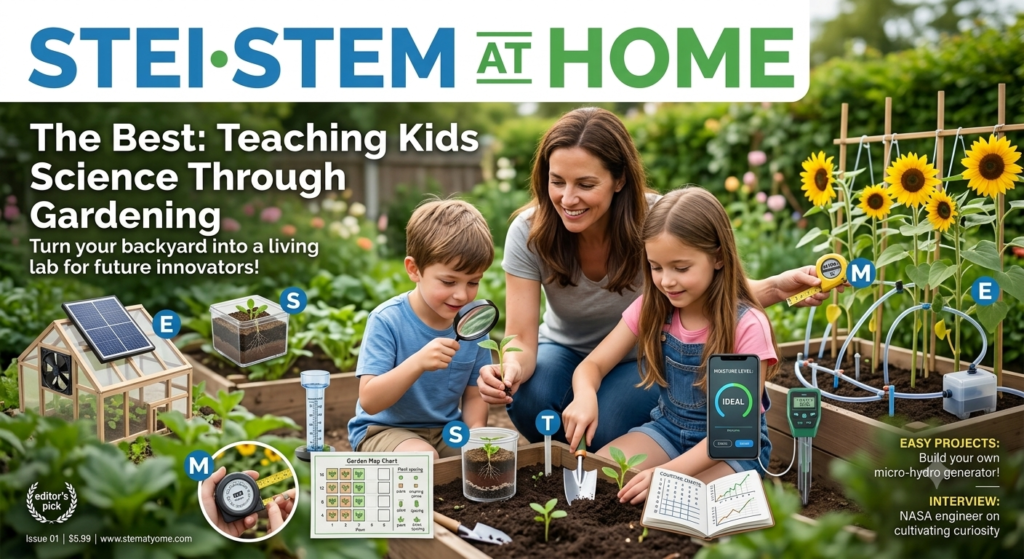
How a Backyard Plot or a Windowsill Pot Can Become Your Child’s Most Powerful Science Classroom
Somewhere between the seed packet and the dinner plate lies one of the richest, most accessible science curriculums available to any family and it doesn’t require a laboratory, a subscription, or a screen. It requires soil, sunlight, water, a little patience, and a child’s natural curiosity about why things grow.
Gardening is, in essence, applied biology, chemistry, physics, ecology, mathematics, and engineering all happening simultaneously in a single raised bed or container on a windowsill. For decades, researchers have studied what happens when children learn science through gardens rather than textbooks, and the findings are consistently striking: better academic outcomes, healthier eating habits, improved emotional regulation, and a level of genuine engagement that’s difficult to replicate in a classroom.
This article explores the research behind garden-based STEM learning, breaks down exactly which scientific concepts a garden naturally teaches, and offers a practical framework for turning any outdoor space or even just a few pots by a window into a genuine science education at home.
Why Gardens Work So Well as Science Classrooms
The core insight behind garden-based learning is deceptively simple: children understand abstract concepts far more deeply when they can see, touch, smell, and personally cause them. A textbook diagram of a plant’s life cycle is information. Watching a bean seed you planted yourself crack open, push a root downward and a shoot upward, and eventually produce a flower you can pollinate by hand that’s understanding.
This isn’t just intuition it’s backed by a substantial body of academic research. A review published in the Review of Educational Research analyzing garden-based learning studies between 1990 and 2010 found consistent positive impacts on academic outcomes, particularly in science achievement. A systematic review published in BMC Public Health similarly found measurable health and wellbeing benefits associated with school gardening programs, beyond the academic gains.
Researchers in horticultural and STEM education have also pushed the field further in recent years, arguing that garden-based learning shouldn’t be treated as a science add-on but reframed within a full STEM lens incorporating the technology and engineering dimensions of garden design (irrigation systems, raised bed construction, season-extension structures) alongside the biology and chemistry that gardens have traditionally been used to teach.
The Science Hiding in Plain Sight: What a Garden Actually Teaches
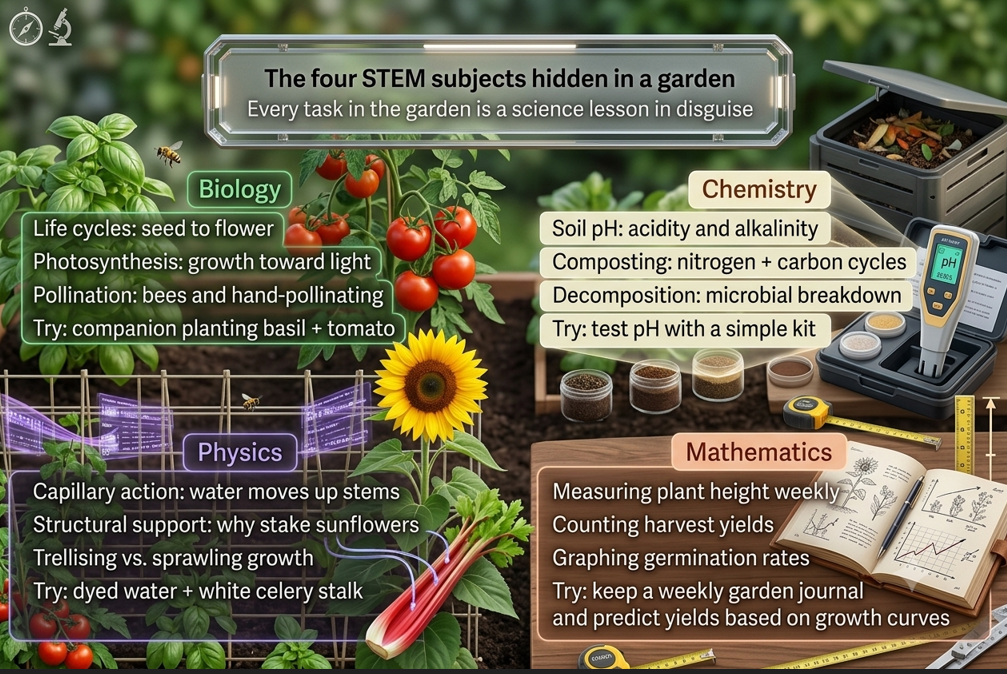
Biology: life cycles, systems, and adaptation
The most obvious science a garden teaches is plant biology but the depth available is significant. Children can observe germination (the process by which a seed becomes a seedling), photosynthesis (visible through the simple but profound fact that plants grow toward light), and pollination (made vivid the moment a child watches a bee visit a flower, or hand-pollinates a squash blossom themselves). Root systems demonstrate how plants compete for water and nutrients. Companion planting growing basil next to tomatoes, or marigolds next to vegetables to repel pests introduces ecological relationships and symbiosis in a way no diagram can match.
Chemistry: soil, decomposition, and nutrient cycles
Soil itself is a chemistry lesson. Testing soil pH with a simple kit teaches the concept of acidity and alkalinity in a tangible, visual way and lets children directly observe how pH affects plant health by comparing acid-loving plants like blueberries to alkaline-tolerant ones like lavender. Composting is perhaps the single richest chemistry unit available in a backyard: it teaches decomposition, the nitrogen and carbon cycles, microbial activity, and the chemistry of organic matter breaking down into usable nutrients all through a process kids can literally turn with a shovel and watch transform over weeks.
Physics: water, light, and structure
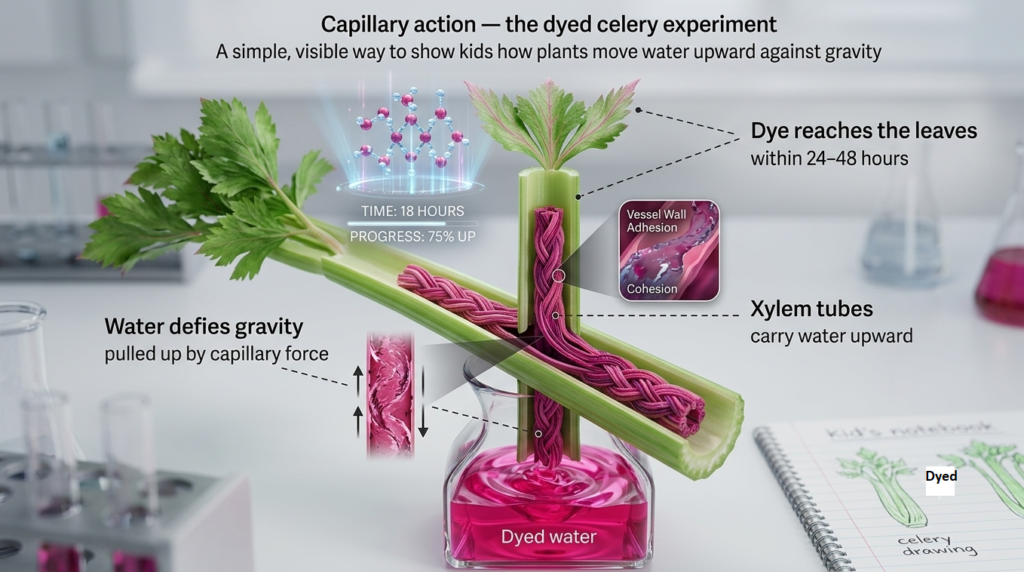
Physics shows up constantly in a garden, even if it’s rarely labeled as such. Capillary action the way water moves up through plant stems against gravity is observable when children place a white flower stem in colored water and watch the color travel upward over a day. Structural engineering questions emerge naturally: why does a tall sunflower need staking but a low-growing strawberry plant doesn’t? Why do trellised plants like peas and cucumbers grow differently when supported versus left to sprawl? These are genuine physics and engineering questions, made concrete by a child’s own garden.
Mathematics: measurement, data, and prediction
A garden journal turns a child into a real scientist collecting real data. Measuring plant height weekly, counting the number of tomatoes harvested, tracking rainfall with a simple rain gauge, calculating the spacing needed between seeds based on package instructions, or graphing germination rates across different conditions these are authentic applications of measurement, data collection, graphing, and even basic statistics. Unlike a worksheet, the numbers in a garden journal matter to the child because they represent something they’re personally invested in watching grow.
The Research-Backed Benefits Beyond Academics
The case for garden-based STEM learning extends well past test scores. A landmark study published in the journal Health Education & Behavior, and corroborated by subsequent research including a 12-week intervention study with 202 elementary students, found that gardening programs combined with nutrition education significantly increased children’s vegetable preference and consumption, while measurably decreasing food neophobia the reluctance to try new foods. Children who grow their own vegetables are simply more willing to eat them, in part because growing something builds ownership and curiosity rather than resistance.
There is also a substantial body of evidence connecting time in nature, including gardening, to improved mental health outcomes in children. Research consistently shows that outdoor activity reduces anxiety, stress, and symptoms of depression and the slow, rhythmic, repetitive nature of gardening tasks like weeding, watering, and tending appears to have a particularly calming, regulating effect, especially valuable for children who struggle with emotional regulation or attention.
Gardens also build responsibility and patience in a way few other childhood activities can. A garden cannot be rushed. A tomato seedling takes roughly 60–80 days to produce fruit regardless of how impatient a child feels about it. Learning to care for something consistently over weeks and months watering even when it’s inconvenient, weeding even when it’s tedious builds a kind of delayed-gratification resilience that complements, rather than competes with, academic learning.
A Practical Framework: Building Your Home Garden Science Lab
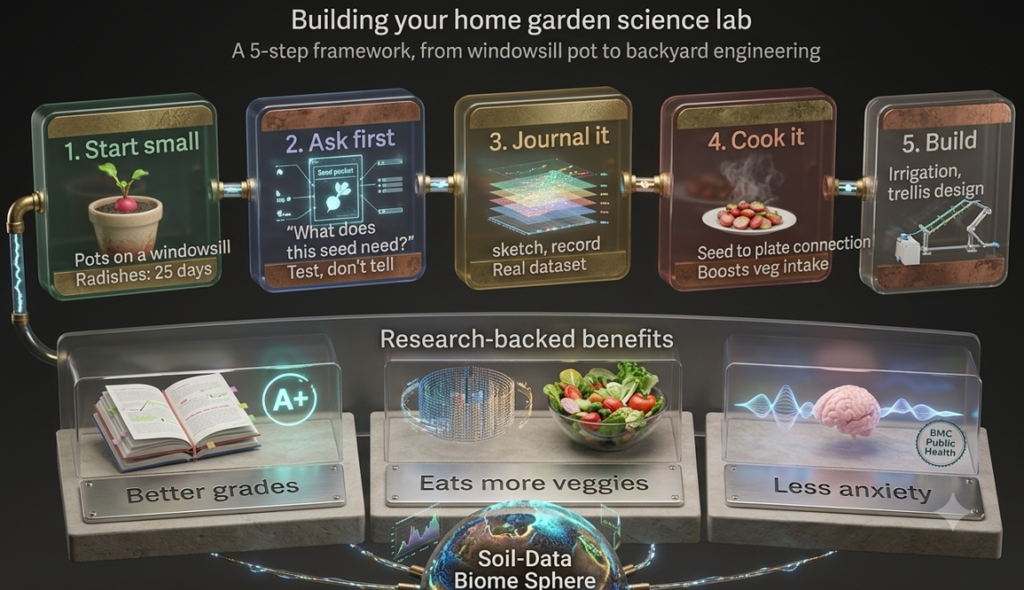
Step 1: Start small and start with what you have
You don’t need a backyard. A few pots on a sunny windowsill, a simple container garden on an apartment balcony, or even a single raised bed are more than enough to begin. Fast, forgiving plants are the best starting point for young scientists who want to see results quickly: bush beans, radishes, sunflowers, and cherry tomatoes are reliable, fast-germinating, and visually dramatic as they grow. Radishes in particular can be ready to harvest in as little as 25 days ideal for a child’s attention span and excitement.
Step 2: Turn every task into a question
The educational value of gardening comes from framing, not just doing. Instead of simply planting seeds, ask: ‘What do you think this seed needs to grow? Let’s test it.’ Plant identical seeds in three pots one with no water, one with no light, one with both and let your child predict and observe the outcome over a week. This single experiment teaches the scientific method (hypothesis, experiment, observation, conclusion) more memorably than almost any classroom activity.
Step 3: Keep a garden journal
A simple notebook transforms casual observation into real scientific practice. Have your child record the date of planting, sketch the seedling’s appearance each week, measure and record height, and note any changes new leaves, flowers, pests, weather damage. Over a full growing season, this notebook becomes a genuine longitudinal dataset that your child collected and owns and reviewing it together at the end of the season is a powerful lesson in how science builds understanding over time.
Step 4: Connect the garden to the kitchen
The loop from seed to plate is one of the most powerful teaching tools available. Harvesting something a child grew themselves and helping prepare it for a meal closes the educational circle connecting biology and chemistry to nutrition, food systems, and even basic culinary chemistry (why does heat change a vegetable’s color and texture?). Research specifically shows that this seed-to-table connection is one of the strongest drivers of children’s willingness to eat and enjoy vegetables.
Step 5: Layer in technology and engineering as kids get older
As children grow more capable, the garden can scale in complexity to introduce genuine engineering and technology challenges: designing and building a simple drip irrigation system from tubing, constructing a trellis for climbing plants, building a small cold frame to extend the growing season, or using a basic soil moisture sensor connected to a simple electronics kit. These projects introduce real engineering design thinking define the problem, design a solution, build it, test it, iterate using the garden as the proving ground.
Five Garden Experiments to Try This Season
- The capillary action flower: Place a white carnation or celery stalk in water dyed with food coloring. Watch over 24–48 hours as the color travels up through the plant’s vascular system, making an invisible process visible.
- The germination race: Plant the same seed variety in different conditions varying light, water, or temperature — and have kids predict and chart which germinates fastest. A simple, rigorous introduction to controlled variables.
- The compost time-lapse: Start a small compost bin and have kids photograph or sketch it weekly, tracking how kitchen scraps and yard waste transform into rich soil over 8–12 weeks.
- The pH garden test: Use an inexpensive soil pH testing kit to test different areas of the garden, then research and select plants suited to those specific conditions — a real-world application of chemistry to design.
- The pollinator count: Spend 10 minutes a day for a week recording every pollinator (bee, butterfly, hoverfly) that visits the garden. Graph the data and discuss what it reveals about biodiversity and ecosystem health.
Final Thoughts
A garden is, quietly, one of the most complete STEM curriculums a family can access and one of the few that costs almost nothing, requires no screens, and rewards patience with something you can literally eat. The research is clear that children who learn through gardens don’t just absorb biology, chemistry, physics, and math more deeply; they build healthier eating habits, stronger emotional regulation, and a more durable sense of curiosity about the natural world.
You don’t need expertise to start. You need a few seeds, a sunny spot, a notebook, and a willingness to ask ‘what do you think will happen?’ before the answer is obvious. The garden will teach the rest one seed, one season, one curious question at a time.
Plant something this week. The science will follow.