How intelligent 1:1 experiences are reshaping the economics of customer engagement and what measurable returns organizations can expect.
For decades, personalization meant sorting customers into segments and tailoring a message to a few thousand cohorts. That era is ending. AI-driven hyper-personalization the ability to synthesize behavioral signals, purchase history, contextual data, and predictive modeling into a distinct experience for every individual, at every moment has crossed from pilot project to strategic imperative.
The financial case is compelling but nuanced. Done well, hyper-personalization compounds across the entire customer lifecycle: it lifts conversion, extends tenure, grows basket size, and reduces churn simultaneously. Done poorly, it erodes trust faster than any other digital strategy. This article examines the empirical evidence, maps the ROI pathways, and offers a practical framework for forecasting returns before committing capital.
I. Defining the Difference
Traditional personalization inserts a first name into an email or recommends yesterday’s viewed product. Hyper-personalization combines real-time behavioral data with machine learning to predict intent, adjust content, sequence communications, and calibrate offers — dynamically, continuously, and at scale.
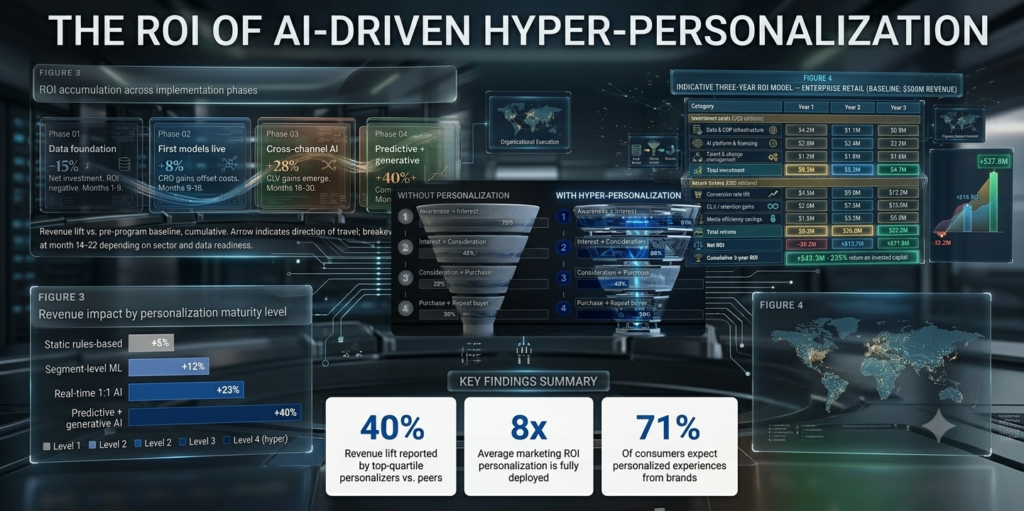
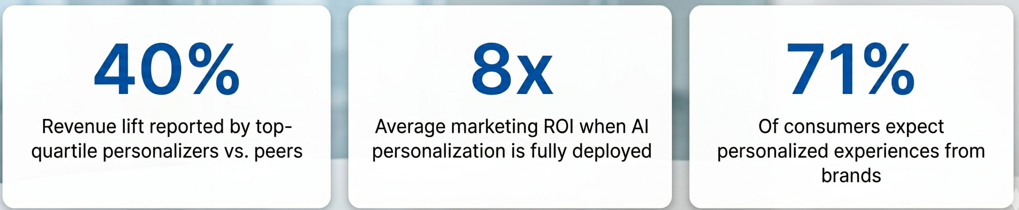
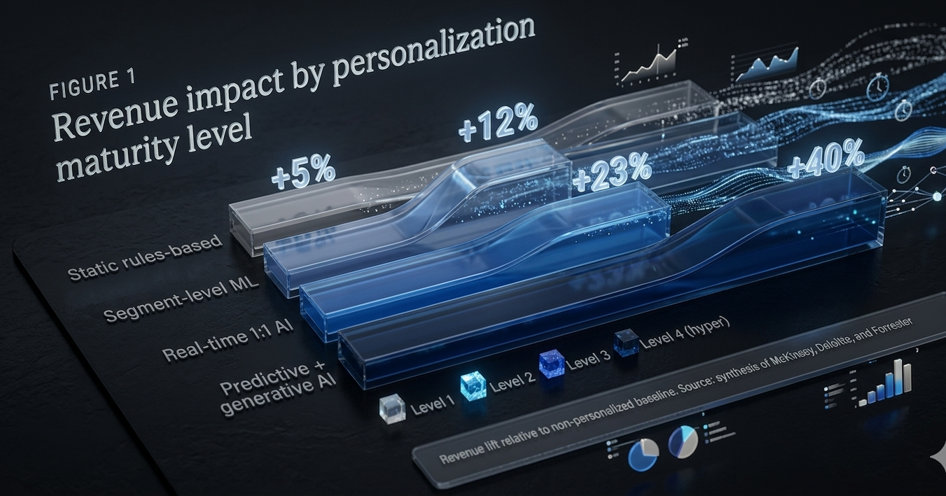
The distinction matters for ROI modeling. Traditional personalization typically yields a 5–10% conversion lift on isolated touchpoints. Hyper-personalization, when orchestrated across channels and lifecycle stages, has been measured delivering compound effects that are an order of magnitude larger because it operates on the relationship, not merely the transaction.
II. The Five ROI Pathways
Hyper-personalization generates returns through five distinct mechanisms. Organizations that fail to measure all five systematically undercount the investment case sometimes by a factor of three or more.
Conversion rate optimization (CRO) is the most visible lever. When content, timing, and offer are matched to individual intent signals, conversion rates in e-commerce have been documented rising 20–40% against control groups. In B2B software, personalized onboarding sequences correlate with 30% faster time-to-activation.
Customer lifetime value (CLV) extension is typically the largest ROI driver but the slowest to measure. Personalized post-purchase communication, intelligent cross-sell sequencing, and churn-risk interventions compound over years. McKinsey’s research suggests top-decile personalizers generate 2.4× the CLV of median peers within the same vertical.
Cost efficiency gains are underappreciated. AI personalization dramatically reduces wasted impressions, suppresses offers to customers unlikely to convert, and concentrates spend on highest-propensity moments. A major European retailer reported a 35% reduction in cost per acquisition after deploying real-time propensity scoring, with no change in total media budget.
Retention and churn reduction represent a third pathway. Predictive models that identify at-risk customers 30–90 days before churn allow intervention before intent becomes irreversible. Financial services firms using AI-driven early-warning systems report 15–25% reductions in voluntary attrition among targeted segments.
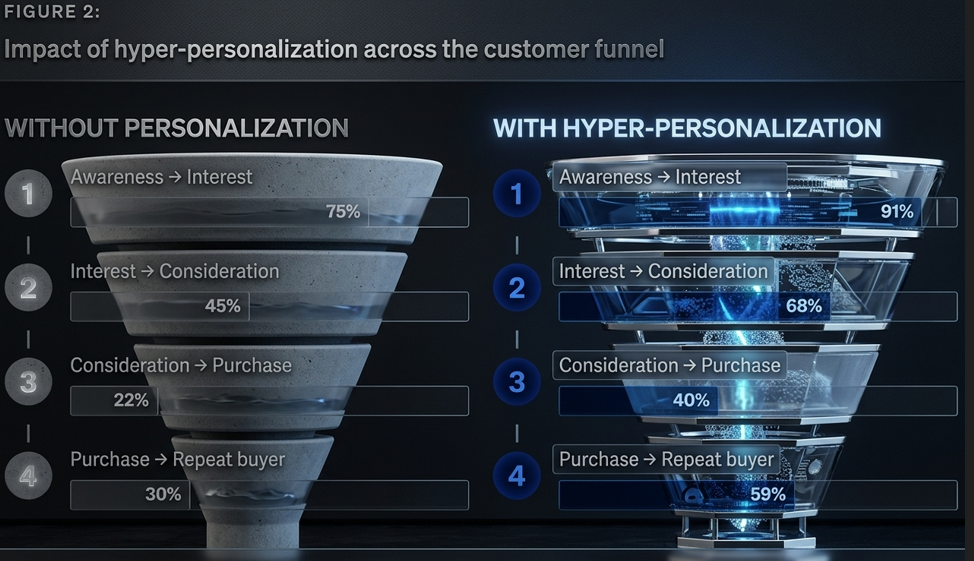
Net Promoter Score (NPS) and referral amplification close the loop. Customers who feel understood whose experience reflects their individual preferences and history score significantly higher on satisfaction surveys and are measurably more likely to refer. Epsilon’s 2024 research found that 80% of consumers are more likely to purchase from a brand that provides personalized experiences, and 44% have become repeat buyers after a personalized experience.
III. The Investment Architecture
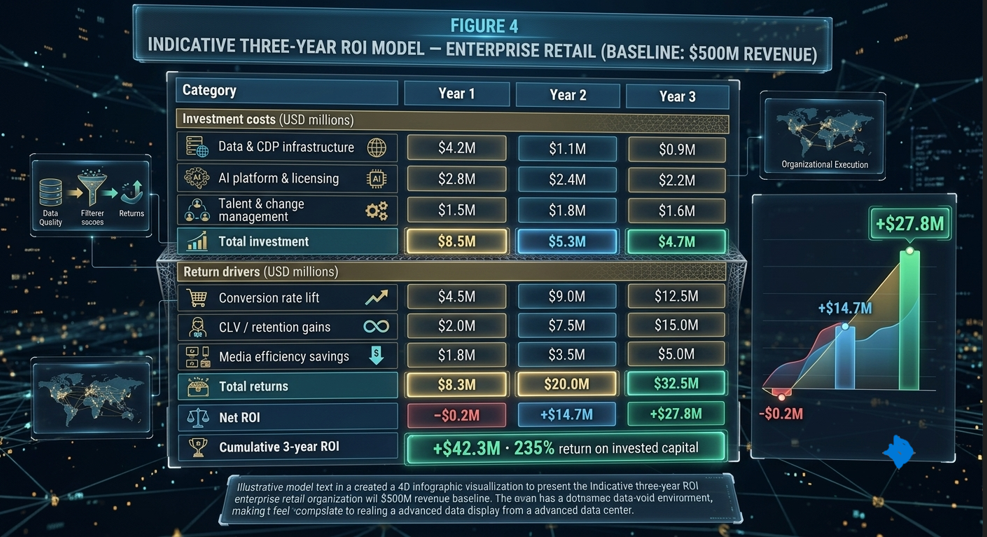
Calculating ROI requires clarity on what hyper-personalization actually costs to build and operate. Investments fall into three categories: data infrastructure, AI platform, and organizational capability.
Data infrastructure the unified customer data platform (CDP), identity resolution, event streaming, and consent management layers typically represents 40–50% of total investment and is the most frequently underestimated line item. Many organizations discover mid-implementation that their data quality and coverage gaps require 12–18 months of remediation before AI models can generate reliable predictions.
The AI platform layer recommendation engines, propensity models, next-best-action systems, generative content tools has become markedly less expensive since 2023. Cloud-native personalization platforms have driven down per-API-call costs by roughly 60% since 2021, and open-model alternatives have reduced licensing fees significantly. This component now represents 25–35% of total investment for most enterprise deployments.
Organizational capability talent, change management, experimentation culture, and governance accounts for the remaining 20–30%. It is the variable most consistently linked to whether an investment delivers its projected returns or stalls in pilot indefinitely.
IV. The Hidden Costs of Personalization Failure
The ROI calculus cannot be completed without accounting for downside risk. There are three failure modes that systematically destroy the investment case.
The first is the creepiness threshold. Personalization that feels intrusive that reveals the surveillance behind the experience rather than concealing it within genuine helpfulness generates backlash disproportionate to the benefit. Customers who feel their data has been used inappropriately are 2.3× more likely to churn and significantly more likely to share their experience publicly. Privacy-by-design architecture, preference centers, and transparent data practices are not ethical extras; they are ROI protection mechanisms.
The second is model drift and feedback loops. Recommendation engines trained on historical behavior can trap users in filter bubbles that accelerate disengagement. Netflix’s research on recommendation diversity illustrates the principle: increasing catalog exploration modestly reduced short-term click rates but substantially improved 90-day retention. Optimizing personalization for immediate conversion while neglecting long-horizon relationship health is among the most common and costly implementation errors.
The third is data fragmentation. Organizations that deploy personalization AI before resolving identity across touchpoints generate a fractured experience recommendations that contradict each other, service interactions that ignore purchase history, communications that feel generic because the model lacks context. The experience can perform worse than no personalization at all.
V. Sector Variations in Returns
Hyper-personalization ROI is not uniform across industries. The magnitude of returns correlates with three structural factors: the frequency of customer interaction (more touchpoints = more personalization opportunities), the degree to which product or content is inherently customizable, and the economic value of incremental engagement.
Financial services where individual product selection can determine lifetime relationship value of $50,000 or more reports among the highest measured ROIs, often exceeding 300% over three years in wealth management and retail banking deployments. Healthcare is emerging rapidly, with AI-driven patient engagement programs demonstrating dramatic improvements in medication adherence, preventive care uptake, and chronic disease management with downstream cost savings that dwarf marketing returns.
Media and streaming companies occupy a unique position: personalization is their core product, not an overlay on it. For Netflix, Spotify, and their peers, recommendation quality is the primary retention lever. Their personalization R&D investments measured in billions generate returns primarily through reduced churn rather than direct monetization lift.
B2B SaaS companies have been slower adopters but are experiencing disproportionate returns from AI-personalized onboarding and success programs. Product engagement scores, feature adoption rates, and expansion revenue all respond strongly to individualized guidance and with annual contract values in the $50,000–$500,000 range, even modest improvements in retention carry extraordinary ROI.
VI. Building the Business Case
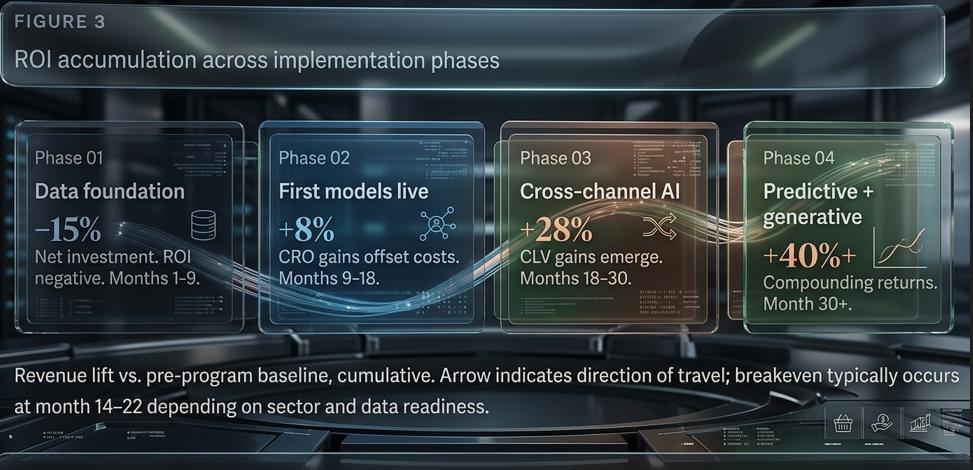
For executives constructing the investment case, three principles govern ROI reliability. First, model conservatively on data readiness. Most organizations are 6–12 months further from AI-ready data infrastructure than they believe. Padding the timeline protects the business case from the most common failure mode.
Second, sequence returns correctly. Conversion optimization returns arrive first and fastest within months of first model deployment. CLV returns arrive 12–24 months later. Retention returns may take 18–36 months to be measurable. A business case that frontloads CLV returns will disappoint and may lose organizational support before compound effects materialize.
Third, build in trust-protection costs from the start. Privacy engineering, preference management, explainable AI tooling, and ongoing consent compliance are not optional additions to a personalization program they are structural requirements whose omission creates tail risk that can exceed the entire investment. Organizations that treat privacy as a post-deployment compliance checkbox consistently report worse long-run ROI than those that architect for trust from day one.