Introduction
In the span of roughly fifteen years, social media platforms have transformed from niche communication tools into architecturally sophisticated behavioral systems. What began as simple networks for sharing status updates has evolved into platforms engineered with one primary objective: maximizing time-on-device. For adults with fully developed cognitive infrastructure, this engineering presents a significant challenge. For adolescents whose brains are still under active neurological construction the consequences are measurably more severe. Understanding how recommendation algorithms and interface design conspire to create psychological hook loops in teenagers requires an examination of adolescent neuroscience, behavioral psychology, and the deliberate design philosophy embedded in platforms like TikTok, Instagram, and Snapchat.
The Adolescent Brain as a Target System
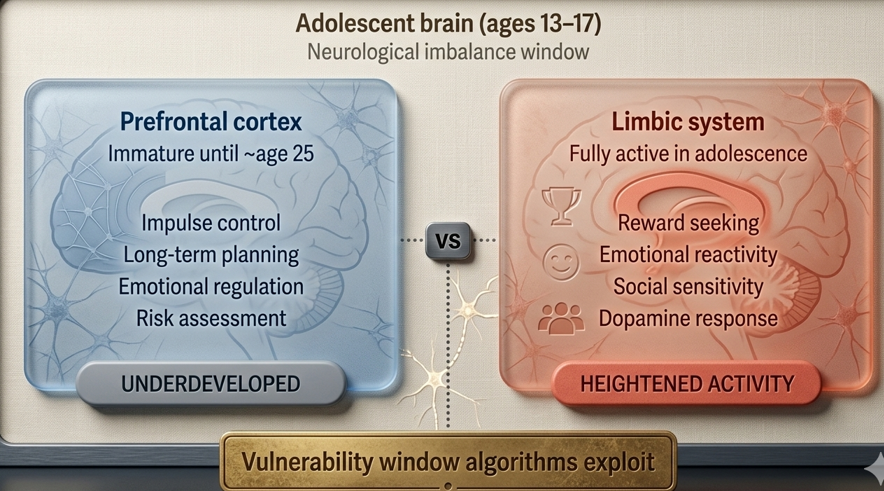
The human prefrontal cortex, responsible for impulse control, long-term planning, and the regulation of emotional responses, does not reach full maturity until approximately age twenty-five. During adolescence, the brain operates in a state of productive imbalance: the limbic system the seat of reward-seeking, emotional reactivity, and social sensitivity is highly active, while the regulatory prefrontal structures that might moderate its impulses remain underdeveloped. This neurological asymmetry creates a window of particular vulnerability.
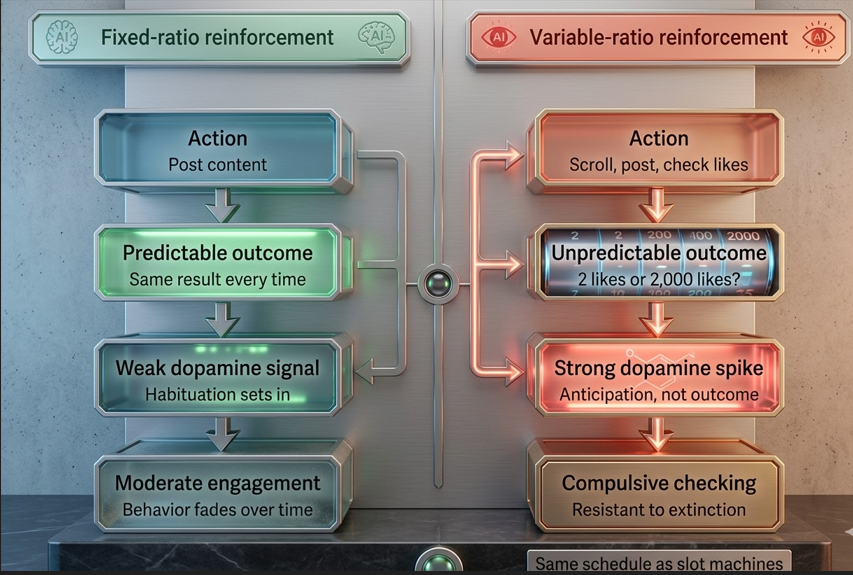
Dopamine, the neurotransmitter most associated with motivation and reward prediction, is released not primarily when a reward is received but when a reward is anticipated. Research in behavioral neuroscience, most famously associated with Wolfram Schultz’s work on reward prediction error, demonstrates that variable and unpredictable reward schedules produce far stronger dopamine responses than consistent ones. Adolescent brains show heightened dopamine sensitivity relative to adult brains, making them disproportionately responsive to exactly the kind of intermittent reinforcement schedules that social media algorithms are designed to produce. This is not an incidental feature. It is the mechanism.
The Hook Model and Algorithmic Reinforcement
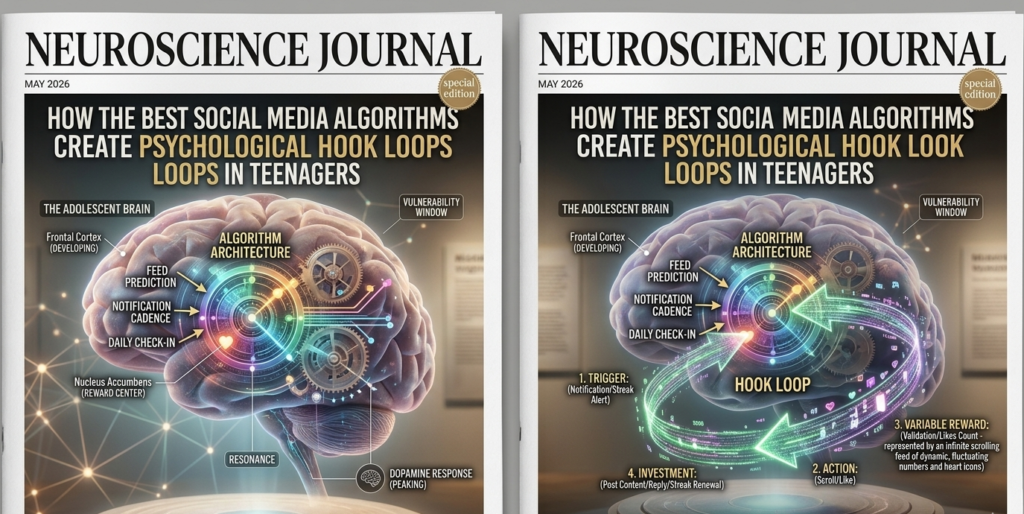
Nir Eyal’s “Hook Model,” originally conceived as a product design framework, describes a four-stage cycle: a trigger initiates behavior, which produces an action, which delivers a variable reward, which generates investment that deepens the user’s stake in the system. Social media platforms have operationalized this framework with algorithmic precision, and teenagers cycle through it dozens to hundreds of times per day.
The trigger phase begins with the notification layer. Push notifications are calibrated to interrupt at moments of disengagement — when a teenager puts their phone down, an alert arrives within minutes, engineered to provoke re-entry. But the deeper trigger is internal: the anticipatory anxiety of missing social information, colloquially known as FOMO (fear of missing out). Adolescent social identity is intensely peer-oriented, and platforms exploit this by framing absence from the feed as a form of social risk. The notification is merely the external signal; the internal craving is the product.
Once re-engaged, the action phase begins. Scrolling, posting, liking, commenting, and replying all feel effortless and costless, but each interaction generates behavioral data that feeds the recommendation engine. On TikTok, the algorithm reportedly analyzes not just what users click but how long they pause on each piece of content, when they replay a video, and at what point they abandon a post. This micro-behavioral surveillance produces a model of the user’s psychological profile more granular than anything the user consciously understands about themselves. The algorithm becomes, in effect, a better predictor of the teenager’s interests than the teenager.
Variable Reward: The Slot Machine Architecture
The variable reward phase is where the psychological engineering becomes most visible. Unlike fixed-schedule reinforcement — where a predictable outcome follows a predictable action variable-ratio reinforcement delivers rewards unpredictably, which produces behavior that is highly resistant to extinction. This is precisely the schedule used by slot machines, and it is precisely the schedule used by social media feeds.
When a teenager posts content, the outcome is genuinely uncertain. The post may receive thirty-seven likes within an hour, or two. The comments may be enthusiastic or silent. The content may be algorithmically boosted to thousands of strangers or reach only a small circle of followers. This uncertainty is not a design flaw; it is the central feature. The unpredictability of the outcome sustains the compulsive checking behavior that follows every post. Studies of adolescent social media use consistently find that checking frequency spikes in the hours immediately following content publication, driven by anticipatory dopamine release rather than conscious intent.
Beyond individual posts, the infinite scroll format itself functions as a variable reward mechanism. Unlike pagination — which creates natural stopping points infinite scroll removes friction between the user and the next piece of content. Each swipe or scroll carries the probabilistic promise of something engaging, amusing, or socially validating. The design creates what behavioral economists call a “near-miss” effect: each piece of unremarkable content feels like it was almost satisfying, which motivates the next scroll rather than signaling satiation.
Investment and the Deepening of Stakes
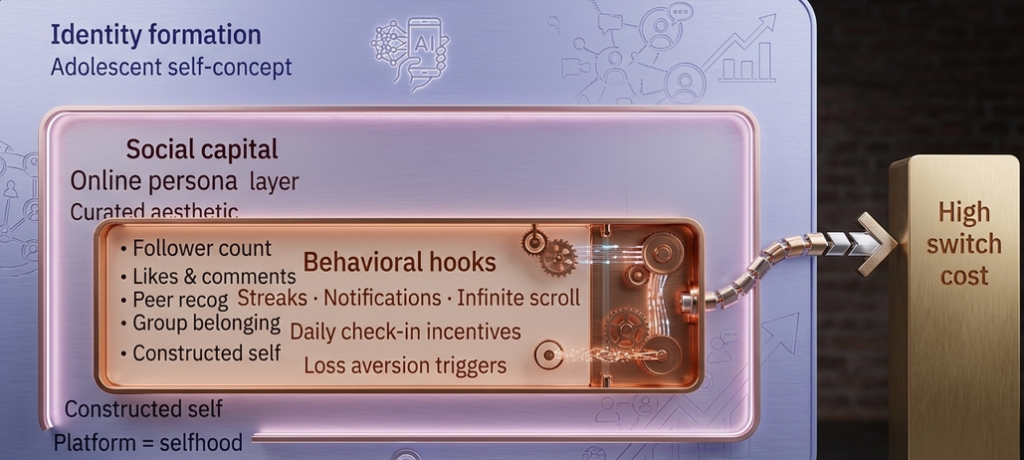
The investment stage is perhaps the most psychologically sophisticated element of the hook loop. As teenagers accumulate followers, build streaks, curate their aesthetic, and develop platform-specific identities, they embed themselves in a structure that becomes increasingly costly to leave. Snapchat’s streak feature is an especially clear example: maintaining a daily streak with a friend produces no intrinsic value, but the potential loss of a long streak generates genuine anxiety, which is experienced as a compelling reason to return. The platform has manufactured a loss aversion trigger from nothing.
Identity investment is deeper still. Adolescence is defined developmentally by identity formation, and social media platforms have inserted themselves into that process. A teenager’s follower count, engagement metrics, and online persona become entangled with their self-concept in ways that blur the boundary between platform behavior and selfhood. Leaving the platform does not merely mean missing content; it means abandoning a constructed identity and the social validation architecture that surrounds it. This creates a psychological switching cost far greater than any rational accounting of the platform’s value would justify.
Neurological Consequences Over Time
Repeated cycling through the hook loop produces neurological changes that researchers are only beginning to fully characterize. Chronic exposure to high-frequency, low-depth content appears to attenuate the capacity for sustained attention a phenomenon sometimes described as “shortened attention span” in popular discourse but more precisely understood as a recalibration of the brain’s reward-processing baseline. When the brain habituates to rapid, low-effort dopamine spikes from scrolling, activities requiring sustained effort and delayed gratification reading, practicing an instrument, studying produce comparatively weaker reward signals and are subjectively experienced as more aversive.
Longitudinal research also associates heavy adolescent social media use with elevated rates of anxiety, depression, and sleep disruption, particularly among girls. The mechanisms are multiple: social comparison exposure, cyberbullying, and sleep displacement from nighttime device use all contribute. But the hook loop architecture plays a specific role by sustaining activation of the body’s stress-response systems cortisol levels rise alongside dopamine when the anticipatory craving phase is engaged creating a physiological state that resembles low-grade chronic stress even during nominally recreational use.
Platform Accountability and Design Ethics
It would be incomplete to analyze the hook loop without acknowledging that it is a product of deliberate choices. Internal documents from Meta, made public through whistleblower Frances Haugen in 2021, revealed that the company’s researchers had documented harmful effects on teenage girls’ body image and mental health, and that these findings were minimized in the face of engagement metrics. The same growth-optimization logic that produced the variable reward scroll produced the recommendation algorithms that surface increasingly extreme content to sustain engagement, and the notification systems that interrupt sleep.
The hook loop is not a neutral technological outcome. It is an engineering solution to the business problem of attention capture. The adolescent brain is the substrate on which this engineering operates most effectively, and the gap between platform awareness of that fact and platform accountability for it represents one of the central ethical and regulatory questions of the current technological moment.
Conclusion
Social media platforms have constructed environments that are, from a behavioral psychology standpoint, close to optimally designed for capturing and retaining the attention of adolescent users. By exploiting the neurological vulnerabilities of the developing brain — heightened dopamine sensitivity, underdeveloped impulse regulation, intense social orientation — the hook loop produces engagement patterns that bear a closer resemblance to compulsive behavior than to voluntary recreation. Addressing these effects requires more than individual digital hygiene; it requires structural interventions in platform design, algorithmic transparency, and regulatory frameworks that treat adolescent neurological development as a meaningful constraint on technological permissiveness. The hook loop is not inevitable. It is a choice, made at scale, that can be unmade.