The Complete 2026 Guide to Talking to AI and Actually Getting What You Want
You’ve activated ChatGPT, Claude or Gemini. You enter some text. The answer is back — and it is of course correct, but it’s not exactly what you were thinking. Too generic. Too long. Missing the point. So you try again. And again. Sound familiar?
That frustration has a name – and a remedy. The name is a substandard prompt. The answer lies in how to communicate with AI in a manner that it can actually understand. A skill that is one of the most valuable for any person in 2026, and not just developers and data scientists — prompt engineering.
This guide will help you get started. Requires no technical skills. At the end of this you’ll know just how to write prompts that will ensure you get sharp, relevant, useful responses every time.
Let’s explore what Prompt Engineering is?
Prompt is a question, instruction or text that you provide to an AI model and expect it to respond to it. Prompt engineering involves creating and optimizing the inputs to ensure that the AI consistently generates accurate, relevant, and useful outputs.
Imagine that you have a brilliant assistant who has read all books, articles, scientific papers and websites ever written on the internet. The knowledge of this colleague is of an extraordinary nature. They don’t have any context of your situation, your goal, your audience, or of your style. If you don’t provide it, they’ll provide a generic answer. They will give you something useful and specific and it won’t be generic when you provide the right context (prompt).
At its core, prompt writing is a communication skill. It’s about providing your AI partner with enough background, guidance and limitations so that they can perform at their best.
However, in 2026, what is the importance of prompt engineering?
In the past few years, AI models have gotten much more powerful. Now, GPT-5, Claude 4.0, and Gemini 2.0 can solve complex problems, code, analyze data, create creative content, and engage in nuanced conversations. The thing is, though, that these models are able to do a lot more than get decent results in 2024, and the techniques for prompting them have only been scratched at.
Majority of people are prompting the same way they were doing in 2024 brief, vague, unprompted, unstructured queries and getting 90% of AI’s potential. IBM’s 2026 guide to prompt engineering says that the majority of people are still prompting the same way as 2024, with short, vague requests and no structure, and leaving 90% of AI’s potential on the table. The difference between a person who is knowledgeable about how to prompt and one who is not is being felt in hiring practices, content, productivity and business.
The great news is that prompt engineering isn’t just for engineers or AI researchers. It’s a formalized way of communicating that anyone can learn and you can become much better at in practice in a few hours.
A great prompt is like a book. A great prompt is like a book.
All good prompts consist of the same key elements. These are not always used on every occasion but the fact that they are known to you enables you to use them intentionally when they are required.
- What is the role of the AI to be?
The tone, vocabulary, depth and perspective of the AI change instantly when given a role. Giving the AI the role of a marketing director will get you very different answers than asking the same question without context.
No role found: “Write a product description.
Write a product description for a handmade leather wallet for a professional man 30-45 years old, you are a senior copywriter for the e-commerce sector, specializing in luxury goods.
- Context: What information will the AI require?
Context is the background information that enables an AI to comprehend your scenario. Otherwise, the AI is left to guess. It will make each answer more specific. Provide appropriate information: audience, what have tried so far, the desired outcome, platform/format of output.
- Task: What is the task desired?
Be explicit about what you’re asking. The general the task, the general the output. Rather than ‘help me with my email,’ consider saying ‘rewrite it so that it conveys the same meaning but is shorter and more professional – from 300 words to under 100′. Each constraint you add accentuates the outcome.
- Form: What is the expected format of the answer?
Explain to the AI how you’d like the output to be organized. Is it a series of bullet points or continuous writing? Table or numbered list? 200 words or 500? Formal or conversational? Please let the AI know if you need something you can copy and paste into a document or email — it will format it accordingly.
- Tone: How should it sound?
Tone visibility means you won’t get material that doesn’t sound like your brand and you. They are: professional, friendly, authoritative, conversational, humorous, empathetic, persuasive, and neutral. If you want to reference a specific person or publication, you can: ‘Write in the style of a Harvard Business Review article.
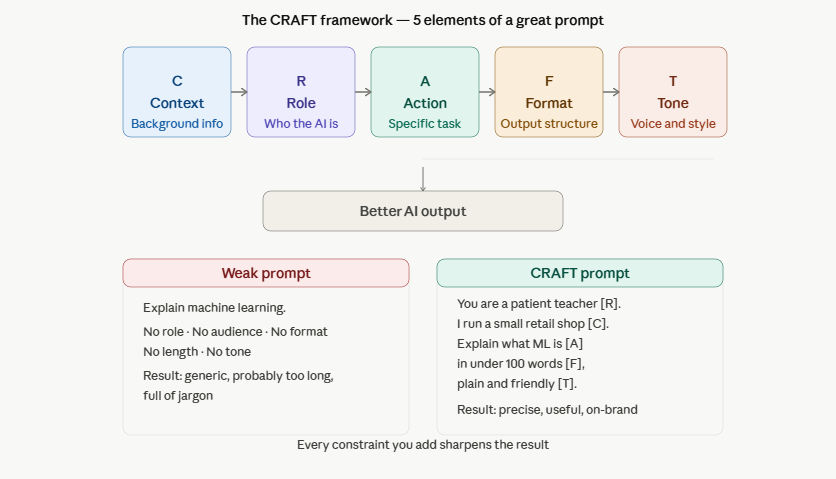
CRAFT Framework, A Beginners’ Blueprint
CRAFT is another easy-to-memorize acronym for novices, representing the five key components of a successful prompt.
• H — History: Past events and information relevant to your current situation.
• S — Sequence: The order of events and information that led up to the current situation.
An AI must assume a role in order for the user to interact with it. The AI role is the person that the AI should act as (expert, teacher, copywriter, and analyst)
You can use this to specify what you want to be done. This can be used to describe the action that you want to have carried out.
These are the subcategories of the Format parameter:
The voice and style the response should take.
Weak prompt: “What is machine learning?
CRAFT prompt: “You are a patient teacher who takes the time to explain technology to non-technical customers (Role). I’m a small business owner who has no coding skills and I want to know whether machine learning can assist with my inventory management (Context). Explain what machine learning is and provide one example that is applicable to a retail business (Action). Use simple language (under 150 words) (Format) and have a friendly, encouraging tone (Tone).
The following 5 Core Prompting Techniques are a must-have for every beginner.
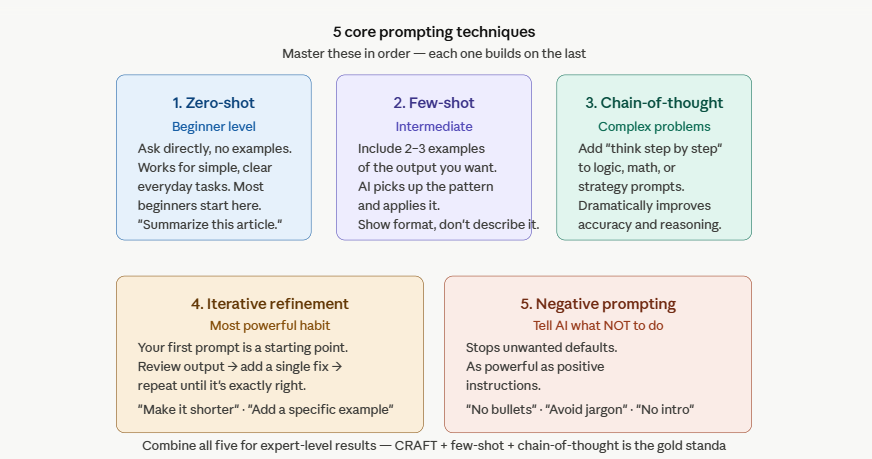
1. Zero-Shot Prompting: This is just asking the AI to do something, but with no examples. It’s easy to use and suitable for simple, everyday tasks. Most of the prompts used by beginners are zero-shot prompts. The important thing is to be specific enough for the AI that it does not need an example; your instructions are clear on their own.
2. Few-Shot Prompting: Few-shot prompting refers to providing two or three samples showing the desired output before requesting the desired output. Do not describe the format – demonstrate it. This is particularly effective when you’re creating structured lists, formatting data, classing content, or writing in a certain style. The AI picks up the pattern from your examples and applies it.
3. Chain-of-Thought Prompting: The addition of the ‘Think through this step by step’ to the analytical, mathematical or logic-based prompts has a significant impact on accuracy. This method involves having the AI work out a solution step by step before arriving at the conclusion to ensure accuracy and prevent mistakes on more complex tasks. It is especially useful in question types that involve making decisions using multiple steps, problem solving and strategy.
4. Iterative Refinement: The first prompt is not the finished article. The best prompt engineers see prompting as a dialogue they look at the result, see where it is deficient, then feed another prompt to “fine tune” the result. Any of the following moves are good ‘refinements’ to make: ‘Make it shorter’, ‘Add more specific examples’, ‘and Rewrite the opening to be more engaging’. Every time, the next version is closer to exactly what you need.
5. Negative Prompting: It is as well to instruct the AI what NOT to do. The ‘don’t use bullet points’ constraint prevents the AI from using the standard bullet point style, the ‘avoid jargon’ constraint stops the AI using jargon, the ‘don’t start with a generic introduction’ constraint stops the AI starting with a generic introduction, and the ‘don’t make any assumptions about my technical background’ constraint disables the AI making assumptions about my technical background.
Five Common Beginner Mistakes and how to avoid them:
The prompt is too general: ‘Write me something about marketing’ provides no content for the AI. Include topic, audience, purpose, form and duration. If you want a table, request a table:
Format: If you don’t specify format, a table won’t be produced. Say three paragraphs if you mean 3 paragraphs. The AI will automatically assume the most common answer, which could be different from what you need. Don’t start over after the initial response fails: Do not repeat the beginning, if the first answer has gone astray. Add a single refinement instruction and build on what you have.
Not setting a word limit: AI will tend to over-explain without a word limit. Explicitly specify the length of the response. Treat it like a search engine: AI models are NOT search engines. Are more likely to respond to specific instructions and tasks than to keywords. Communicate with them as you would with a competent and capable colleague, not as you would type into Google.
Good Prompts: Real-World Applications: What You Can Do with Good Prompts After grasping the basics, there are countless practical applications to be found in everyday life for prompt engineering: Draft emails, blog posts, social captions, cover letters, reports, and more and edit in seconds.
Research and summarization: Summarize lengthy documents, glean key information from articles, or get explanations of complicated topics in plain language.
Data analysis: Pass in a data set or copy/paste in a table and request that the AI identifies trends, propose charts to visualize, or alert for anomalies.
Learning: Request explanations at your level ‘explain this like I’m a beginner’ or ‘explain this like I have a Ph.D. in biology.
Brainstorming: Generate ideas, look at options, shake loose ideas and assumptions, and to think through decisions with an available thinking partner.
Your First Week: A Practical Action Plan – A Practical Action Plan for the First Week The best way to learn prompt engineering is to try it out with actual tasks you need to do.
Here’s a simple schedule for the first week:
Day 1–2: Practice CRAFT with three tasks from your real-life or work experience. Compare the results with those of the regular prompts.
Day 3-4: Continue working on iterative refinement. Pick one task and perform the minimum of 4 iterations of improvement on the same product.
Day 5-6: Experiment with few-shot prompting and chain-of-thought for structured/reasoning tasks.
Day 7: Store 5-10 of your most successful prompts in your own prompt library. You’ve just begun to create the most valuable resource for your AI.
Final Thoughts Prompt engineering” in the year of 2026 is to using Google as “how to” was to using a search engine in the year of 2005: if you know how, you’re getting way better results than if you don’t, with the same tools. Today’s models, such as GPT-5, Claude, and Gemini, are all very powerful. They’re only as useful as you can get them to be though. That’s all the game is. Unlike most skills, the learning curve is really steep. With a few hours of structured practice, one can see the difference.
Start with one prompt. Make it better. Save what works. The gap between a beginner and an expert prompt engineer is mostly just time spent practicing and there’s no better time to start than right now.