A Comprehensive Analysis of Intelligent Automation Across the End-to-End Claims Lifecycle in 2026
Abstract
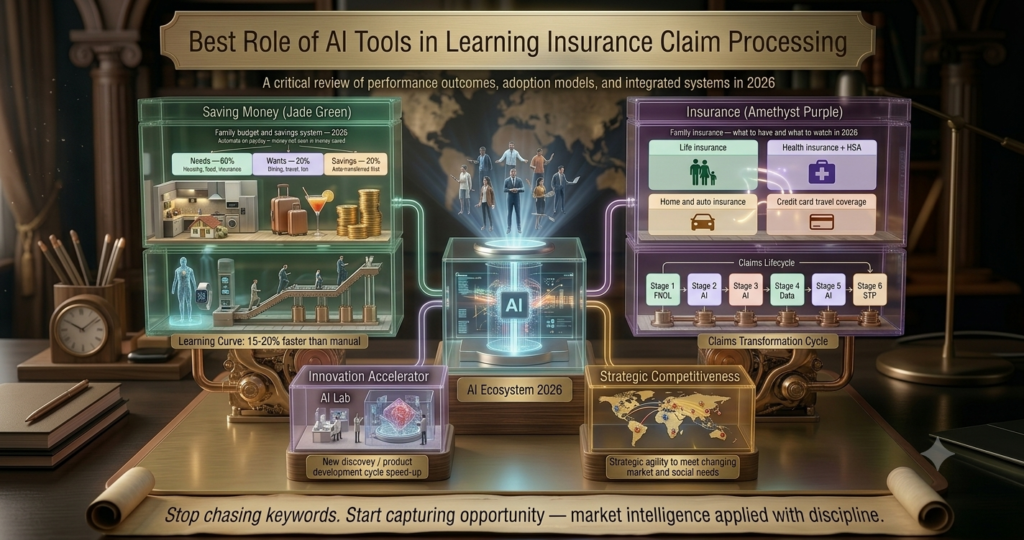
The insurance claims processing industry has reached a structural inflection point in 2026. Full-scale AI adoption among insurers climbed from 8% in 2024 to 34% in 2025 a 325% increase in a single year and leading carriers are now reporting documented outcomes that would have been considered extraordinary just 18 months ago: claim resolution times reduced from 30 days to 7.5 days (75%), straight-through processing rates climbing from 10–15% to 70–90%, fraud detection accuracy improving from 20–40% with traditional rule-based methods to 70–80% with AI, and cost per claim falling from $40–60 to $25–36. This paper examines how AI tools are being applied across the six key stages of the insurance claims lifecycle. First Notice of Loss (FNOL), document processing, fraud detection, reserve modelling, adjudication, and settlement analyses the leading platforms delivering these outcomes, evaluates the implementation challenges that explain why 95% of firms report weak ROI despite high investment, and identifies the organisational and governance conditions that distinguish high-performing from underperforming AI deployments. We conclude that AI in claims processing is no longer an optional competitive advantage but a structural operational baseline, with the global AI-in-insurance market projected to grow from $15 billion today to $246 billion by 2035.
1. Introduction: A Tipping Point, Not a Trend
For most of the past decade, AI in insurance claims processing existed primarily in the form of narrow, rule-based automation systems that could route standardised claims through pre-defined decision trees, flag obvious fraud patterns using keyword matching, and extract structured data from templated forms. These systems improved on pure manual processing but left the structural inefficiencies of the traditional claims model largely intact: high-volume human review queues, reserve estimation errors, lengthy settlement cycles, and fraud losses estimated at $80–160 billion in P&C insurance alone (Deloitte, 2026). The industry’s relationship with AI passed a qualitative threshold in 2025–2026 that these earlier systems did not represent.
What has changed is not incremental it is architectural. The combination of large language models (LLMs), computer vision, multimodal data integration, and agentic AI workflows has produced systems capable of understanding unstructured documents, analysing photographic damage evidence, reasoning through policy terms and coverage conditions, scoring fraud probability at intake, and completing entire claims workflows without human involvement. Lemonade, the AI-first insurer, now closes some claims in three seconds with zero human involvement. FNOL-to-triage times have fallen from 4–8 hours to under five minutes at carriers deploying agentic workflows (VCAS, 2026). Underwriting timelines have collapsed from 3–5 days to 12.4 minutes at AI-enabled carriers.
The market is responding: insurtech funding reached $728.47 million in Q2 2025 nearly tripling from the prior quarter and marking the highest level since Q2 2022 (AIBuzz, 2026). McKinsey’s insurance AI analysis found that early AI leaders are generating roughly six times the total shareholder returns of their AI-laggard peers a gap that is widening rather than narrowing. This paper analyses where, how, and why AI tools are delivering these outcomes across the claims processing lifecycle, and what separates the organisations achieving results from the majority that have invested heavily without capturing proportionate returns.
2. AI Across the Claims Lifecycle: Six Stages of Transformation

2.1 Stage 1: First Notice of Loss (FNOL) From Hours to Minutes
FNOL is the entry point of every insurance claim the moment a policyholder reports an incident and the claims process formally begins. In the traditional model, FNOL processing required a human agent to receive the report, manually enter information across multiple systems, verify policy coverage, and assign the claim to an adjuster queue. This process routinely took 4–8 hours and was the first major bottleneck in the claims lifecycle. AI-powered FNOL systems transform this stage through a combination of natural language processing (NLP), multimodal intake (accepting reports by text, photo, video, or app), automated policy verification, and intelligent triage routing.
In an agentic FNOL workflow, the AI system simultaneously validates coverage dates, cross-references the incident description against policy terms, requests missing documentation via automated communication, scores fraud probability based on claim characteristics and historical patterns, and either routes the claim for straight-through processing or assigns it to the appropriate human adjuster all within minutes of intake and with a full compliance log generated automatically. Carriers deploying agentic FNOL workflows report triage times falling from 4–8 hours to under 5 minutes (VCAS, 2026), a 95%+ reduction in the first and largest bottleneck of the traditional claims cycle.
2.2 Stage 2: Document AI Eliminating the Manual Extraction Burden
Insurance claims generate enormous volumes of unstructured documentation: police reports, medical records, repair estimates, contractor invoices, photographs, witness statements, and third-party assessments. Extracting, validating, and integrating this information manually is one of the most time-consuming and error-prone activities in claims management. Document AI combining optical character recognition (OCR), NLP, and large language models automates the extraction, classification, and validation of data from unstructured documents with high accuracy.
Modern document AI platforms can extract structured data from handwritten medical records, parse complex contractor repair estimates, cross-reference multiple documents against each other for consistency, and flag missing or contradictory information for human review. The elimination of manual data extraction removes a major source of claims processing error and dramatically accelerates document-heavy stages of the claims lifecycle. In health insurance, where documentation complexity is highest, 80–85% of claims are already processed automatically without human document review (GetProsper, 2026), with AI handling the routine volume and routing only genuinely complex cases to specialist adjusters.
2.3 Stage 3: Fraud Detection From Rule Matching to Pattern Intelligence
Insurance fraud is estimated to cost the global industry over $80 billion annually, with traditional rule-based detection systems catching only a fraction of fraudulent activity. Rule-based systems are inherently backward-looking: they can only detect fraud patterns that human analysts have previously identified and codified as rules. AI fraud detection systems operate on a fundamentally different principle — they analyse the full statistical distribution of claims characteristics, identify anomalous patterns that human analysts would never detect in high-volume data, and score fraud probability at intake rather than at the later review stage where detection traditionally occurred.
The performance gap is documented and significant. Traditional rule-based fraud detection achieves accuracy of 20–40%, generating high false positive rates that consume adjuster time and damage policyholder relationships. AI fraud detection achieves 70–80% accuracy (AIBuzz, 2026), with leading platforms such as Shift Technology and FRISS demonstrating the ability to detect organised fraud rings and staging patterns that are completely invisible to rule-based systems. Deloitte projects that P&C insurers could save $80–160 billion in fraudulent claims by 2032 through AI-driven detection a number that justifies substantial technology investment on fraud reduction alone. Scoring fraud probability at FNOL rather than at week two of the claims review cycle the traditional pattern fundamentally changes the economics of fraud management.
2.4 Stage 4: Damage Assessment Computer Vision at Scale
For property and casualty lines auto, home, commercial property damage assessment is one of the most labour-intensive and potentially subjective stages of the claims process. Traditional physical inspection models require scheduling, travel, and manual estimation, adding days to the claims cycle and introducing estimator-level variability into damage quantification. Computer vision AI, trained on millions of labelled damage images, can assess vehicle collision damage, structural property damage, and contents losses from photographs or video submitted by policyholders at the time of incident report.
Tractable, one of the leading computer vision platforms for insurance, uses deep learning models trained on vast image datasets to generate repair estimates from photographs within minutes of submission. CCC Intelligent Solutions applies similar capabilities specifically to auto claims, integrating telematics data, OEM part pricing, and collision physics modelling to produce estimates that are both faster and more accurate than manual assessment. The removal of the physical inspection requirement for straightforward claims is one of the single largest contributors to the 75% reduction in claims resolution time that AI-enabled carriers are documenting eliminating the scheduling, travel, and estimation lag that traditionally stretched simple claims over multiple weeks.
2.5 Stage 5: Reserve Modelling — From Estimation to Prediction
Setting accurate reserves the financial provisions insurers hold against outstanding claims is a critical actuarial function with direct balance sheet implications. Inaccurate reserve estimates increase reserve development variance, expose carriers to regulatory scrutiny, and reduce financial predictability. Traditional reserve estimation relied on historical averages, actuarial tables, and adjuster experience methods that struggle with the non-linear complexity of large or unusual claims. AI reserve modelling applies machine learning to the full population of comparable historical claims, incorporating dozens of variables to generate probabilistic reserve estimates that are continuously updated as new claim information arrives.
The improvement in reserve accuracy translates directly to balance sheet quality and regulatory capital efficiency. AI-powered reserve models that process real-time claim development data can reduce reserve development variance the percentage difference between initial reserve estimates and final settled amounts by a measurable margin, with the most advanced implementations generating reserve confidence intervals rather than point estimates, giving actuaries a much richer picture of financial exposure across the claims portfolio. This shift from estimation to probabilistic prediction represents one of the less visible but financially significant applications of AI in claims management.
2.6 Stage 6: Settlement and Straight-Through Processing
Straight-through processing (STP) the automated end-to-end resolution of a claim without human adjuster involvement is the most powerful operational metric in AI-enabled claims management. At leading carriers, STP rates have climbed from the industry baseline of 10–15% to 70–90% of eligible claims, with IDC projecting the industry-wide STP rate for auto, homeowners, and commercial auto will reach at least 65% by the end of 2026. Claims that qualify for STP typically those with clear coverage, straightforward documentation, low fraud probability, and damage assessments within pre-approved thresholds move from FNOL to settlement payment without any human queue time. Lemonade’s most streamlined claims are settled in three seconds. Even average STP cycle times have compressed from 30 days to 7.5 days at AI-enabled carriers (Datagrid / BCG, December 2025).
3. Leading AI Tools in Insurance Claims Processing
The AI claims processing market has produced a set of specialist platforms that have achieved production-scale deployment across the industry’s major lines of business:
- Shift Technology: Paris-based, specialising in fraud detection and claims automation for global insurers. One of the most widely deployed AI fraud platforms in the industry, with particular strength in detecting organised fraud rings and anomalous claim patterns across large claim populations.
- Tractable: Applies computer vision and deep learning to auto and property damage assessment from photographs. Enables carriers to generate repair estimates at FNOL, eliminating physical inspection for straightforward claims and dramatically compressing cycle times.
- CCC Intelligent Solutions: The dominant US platform for auto insurance claims, collision repair, and telematics integration. Its AI integrates vehicle data, OEM parts pricing, and collision physics to generate estimates that are both faster and more consistent than adjuster-produced estimates.
- Aptarro: Leading health insurance claims processing platform whose RevCycle Engine integrates AI for high-volume routine claim adjudication, denial prevention, and compliance. Specifically designed for the documentation complexity of health insurance claims.
- Snapsheet: Cloud-native claims management platform powered by AI, designed for carriers, TPAs, and insurtechs. Supports the full claims lifecycle with particular strength in virtual appraisals and policyholder-facing digital claim submission.
- FRISS: Global leader in AI-powered fraud detection and risk management, with deployments across 170+ insurers in 40+ countries. FRISS integrates at the policy application, FNOL, and claim investigation stages, providing a continuous fraud risk signal throughout the customer relationship.
4. The Implementation Gap: Why 95% of Firms Report Weak ROI
Despite the compelling performance data from leading deployments, joint MIT and WEF research from 2025 found that 95% of firms report weak ROI from their AI investments a finding that appears to contradict the documented results described above. The resolution of this apparent paradox lies in implementation quality, not technology capability. The organisations achieving transformative results share a consistent set of structural conditions; the majority that do not achieve results share an equally consistent set of failure modes.
The primary structural failure is data fragmentation. Most carriers currently operate 4–7 separate systems across their core functions policy administration, claims management, billing, underwriting, fraud detection, and third-party vendor applications (CMARIX, 2026). AI systems trained on fragmented, poorly integrated data cannot produce reliable predictions, and AI agents that cannot access real-time policy and claim data cannot execute the agentic workflows that deliver the largest efficiency gains. Data integration is the unglamorous prerequisite that separates successful from unsuccessful AI deployments and it is the step that most organisations attempt to skip.
The second failure mode is the absence of clear success metrics defined before deployment. The organisations consistently achieving strong ROI from AI claims tools define specific, measurable, baseline-referenced performance targets STP rate by claim type, FNOL-to-triage time, fraud detection precision and recall, cost per claim by line of business before deploying technology, and track those metrics weekly during deployment. Organisations that define success as ‘improved efficiency’ or ‘better customer experience’ without quantification are structurally unable to attribute results to specific interventions or diagnose the causes of underperformance. Aviva’s documented saving of over £60 million from 80+ AI models deployed across its claims domain is a product of exactly this metric-driven, systematic approach to implementation.
5. The Human-AI Collaboration Model: Automation Augments, It Does Not Replace
A critical and sometimes overlooked dimension of AI claims processing is the role of human expertise within AI-augmented workflows. The most effective deployments do not attempt to automate everything they apply automation precisely where it delivers the highest quality at the lowest cost, and route genuinely complex or high-stakes cases to experienced human adjusters with AI-generated case summaries, relevant precedent, and recommended actions. This hybrid model reflects both the genuine limitations of current AI systems and sound operational design.
In health insurance, where documentation complexity is highest and regulatory compliance stakes are greatest, 80–85% of routine claims are now processed automatically, while the remaining 15–20% typically involving complex diagnoses, contested coverage determinations, or high-value settlements are routed to specialist reviewers. The AI system’s role in complex cases is not to make the decision but to prepare the human decision-maker: extracting and organising relevant information, identifying comparable historical claims, flagging regulatory considerations, and scoring the probability of different claim outcomes based on available evidence.
This human-AI collaboration model has implications for how claims professionals need to be trained and how their roles are defined going forward. The skills that matter most in an AI-augmented claims environment are not data entry, document extraction, or routine decision-making — all of which AI handles at scale. They are judgment in complex and ambiguous situations, communication with policyholders in sensitive circumstances, oversight and quality assurance of AI-generated outputs, and the ability to identify and escalate edge cases where automated systems may be producing unreliable results. Investing in this reconfigured skill set is as important as investing in the technology itself.
6. The Market and Regulatory Horizon
The global AI-in-insurance market is projected to grow from approximately $15 billion today to $246 billion by 2035 a compound annual growth rate that places insurance among the highest-AI-adoption sectors in the global economy (VCAS, 2026). Insurtech funding has resumed strong momentum following the correction of 2022–2023, with $728 million deployed in a single quarter of 2025, suggesting capital markets have validated the commercial viability of AI-enabled insurance models. Industry surveys confirm that 65% of insurers are scaling AI agents for claims processing in 2026, and by 2030, AI is expected to be a standard component of core insurance operations across all lines and geographies (GetProsper, 2026).
The regulatory dimension is evolving in parallel with technology deployment. Regulators in the United States, European Union, and United Kingdom have begun developing specific guidance for AI use in insurance, with particular attention to three areas: explainability of AI-driven claims decisions (policyholders’ right to understand why a claim was approved, declined, or partially settled), non-discrimination in AI underwriting and claims models (ensuring that AI systems do not encode or amplify demographic bias in coverage or settlement decisions), and data privacy compliance in multimodal AI systems that process photographic, video, and biometric data. Carriers building governance frameworks that proactively address these regulatory dimensions will be better positioned than those that treat compliance as a reactive constraint.
7. Conclusion
AI tools in insurance claims processing have moved from experimental promise to operational reality in 2026. The documented outcomes at scale 75% faster resolution, 30–40% cost reduction, STP rates of 70–90% at leading carriers, fraud detection accuracy rising from 20–40% to 70–80%, and underwriting timelines collapsing from days to minutes establish AI claims automation not as a competitive advantage but as the new operational baseline. Carriers that have not made meaningful progress toward intelligent automation are not failing to gain an advantage: they are actively losing ground to peers that have already restructured their economics.
The path to these results, however, is not simply technology procurement. It requires data integration as a prerequisite, metric-defined success criteria as a discipline, and a human-AI collaboration model that retains human expertise where it is irreplaceable while deploying automation where it consistently outperforms. The organisations that will lead the insurance industry of 2030 are not necessarily those with the largest AI budgets — they are those building the governance, data, and talent foundations that allow AI tools to produce their documented best results reliably, at scale, and in compliance with an evolving regulatory environment.